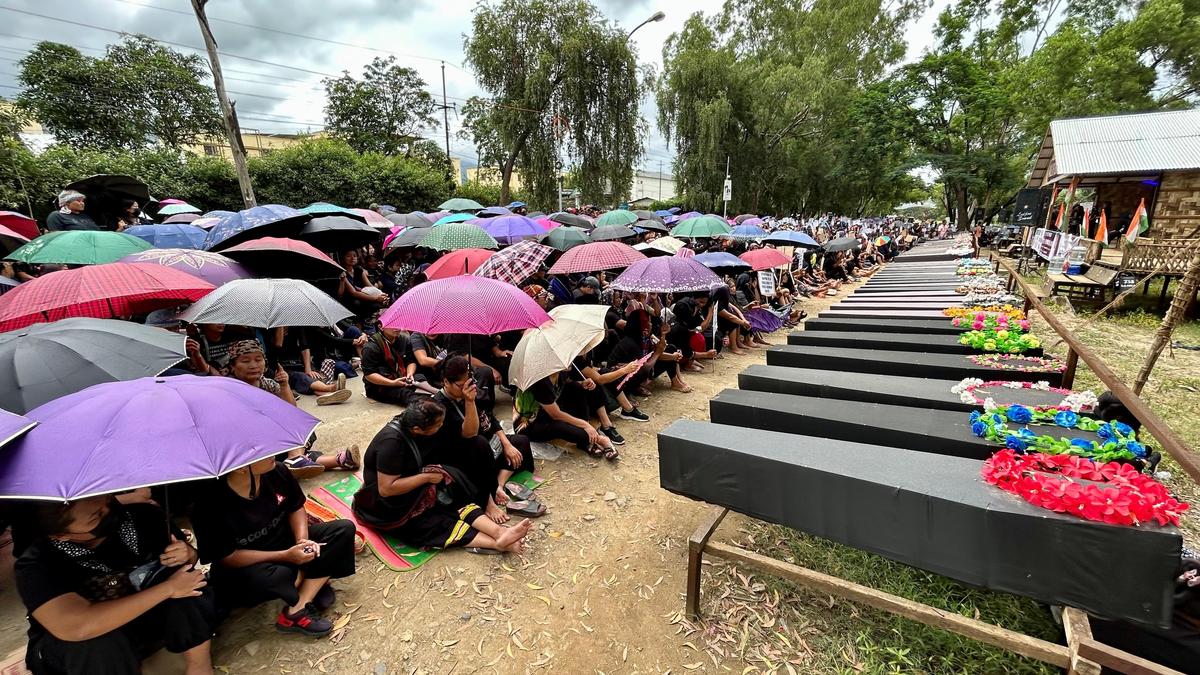
When home becomes hostile: women of the Northeast write their stories Premium
The Hindu
Explore the powerful narratives of Northeast women confronting violence and resilience in Hoihnu Hauzel's poignant new book.
A new government is in place in Manipur after two years of violence. In an attempt to represent the three major communities in the government, a Chief Minister and two Deputy Chief Ministers were announced. While Chief Minister Yumnam Khemchand Singh is a Meitei, Nemcha Kipgen, a Kuki, and Losii Dikho, a Naga, were named Deputy Chief Ministers. But Kipgen not only had to take the oath virtually, she has also not been able to set foot in the Meitei-dominated Imphal Valley due to security reasons. She has to work from Kuki-dominated Kangpokpi, trying to help her community heal and bridge the divide.
In her new book, Stories the Fire Could Not Burn (Speaking Tiger Books), journalist and writer Hoihnu Hauzel traces the reasons for the ethnic strife that erupted between the Meiteis and Kuki-Zomi people on May 3, 2023. “It is the Kuki-Zomi/Mizo people – my people – who have borne the brunt of the inhumanity unleashed in Manipur,” she writes in the Preface, “...hill communities [who] have lived under systemic neglect, routine violence, and constant threat” ever since the inception of the State in 1972.
But what unfolded in 2023 and beyond, says Hauzel, “shattered what little illusion of safety that remained.” Healing takes time, Kipgen said in an interview to The Hindu, urging the government to let the buffer zones between the Meiteis and the Kuki-Zo communities remain for now, particularly in areas where the violence was high, because safety comes first.
Hauzel poignantly writes about the night her family had to flee Imphal — “how silence hung heavier than the air, how we carried not just our belongings, but our memories, our dead, our dread. That night, we didn’t just leave behind homes. We left behind parts of ourselves we may never be able to reclaim.”
Many people were not as lucky. At least 250 people lost their lives in the violence, and over 60,000 people have been displaced. “There is no hierarchy of horror,” says Hauzel, “but each story demands to be told. Each name deserves remembrance.”
Hauzel asks a pertinent question that every marginalised person will identify with: What does one do when home becomes hostile? Manipur has seen waves of violence through the years due to insurgencies and ethnic conflagrations. Growing up in Manipur during the 1980s, violence wasn’t an exception, writes Hauzel – “it was part of the routine”, and she could tell the difference between the sound of a cracker and the pop of a pistol, “the way someone else might know birds by their calls.” In neighbouring Nagaland, no stranger to violence herself, schools would often accommodate students from Manipur fleeing the heightened tension.


The government plans to amend the FCRA, introducing new regulations for NGO asset management and accountability for key functionaries.

The draft policy for “Responsible Digital Use Among Students”, released on Monday by the Department of Health and Family Welfare, has recommended that parents set structured routines with clear screen-time rules and prioritise privacy, safety, and open conversation with children on digital well-being.

Police Observer Sushant Kumar Saxena conducts surprise inspection at Shencottai police station, reviewing warrants and security arrangements ahead of elections.

Andhra Pradesh government to launch key projects in April, focusing on industrial growth and infrastructure development, says Nara Lokesh.

Lok Sabha refers the Corporate Laws (Amendment) Bill to a JPC amid opposition concerns over CSR provisions dilution.

SHG members in Kanniyakumari use snakes and ladders to raise election awareness and boost voter turnout.

Government accelerates consultations for early implementation of the Women’s Reservation Act to ensure women’s representation in 2029 elections.

CM A. Revanth Reddy distributes ₹1 crore insurance cheques to families of deceased Electricity department employees, enhancing financial security for workers.

The Bengaluru Traffic Police (BTP) registered 634 cases of drunk driving during a week-long special enforcement drive conducted across the city between March 16 and March 22.

GHMC intensifies action against property tax defaulters, seizing properties and offering a One Time Settlement scheme for payments.

CCB arrests three drug peddlers in Mangaluru, seizing ₹2.5 lakh worth of MDMA and other valuables.

TVK's 28 candidates in Puducherry include former BJP MLAs, a sitting Independent, and a retired police IG.

BRS submits notice on private member bill to Speaker