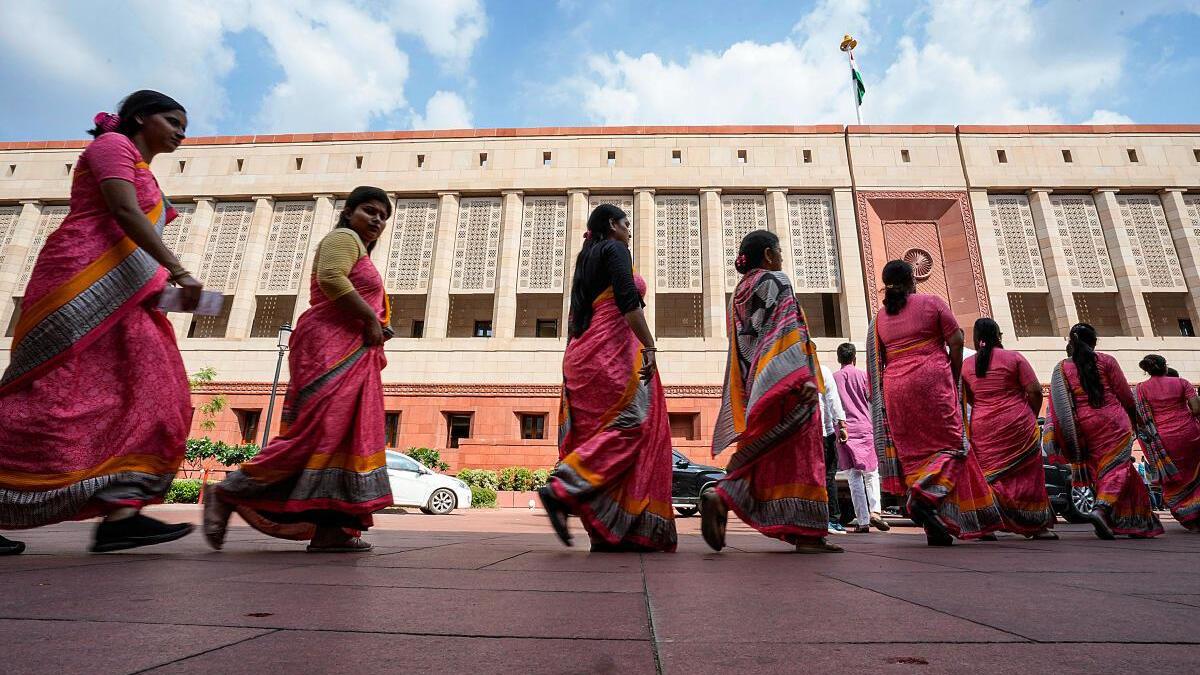
Govt revs up consultations on early implementation of Women’s Reservation Act
The Hindu
Government accelerates consultations for early implementation of the Women’s Reservation Act to ensure women’s representation in 2029 elections.
The Narendra Modi government on Monday (March 23, 2026) indicated that it will bring amendments to the Women’s Reservation Act, 2023 to ensure its implementation for the 2029 Lok Sabha election, along with an increase in the number of Parliamentary seats for women.
The amendment Bill, to reserve one-third of seats in the Lok Sabha and State Assemblies for women, will seek to provide the reservation on the basis of the 2011 Census. Government managers, including Union Home Minister Amit Shah, met with leaders of several Opposition parties on Monday (March 23, 2026), including the Nationalist Congress Party (SP)’s Supriya Sule, YSR Congress Party’s P.V. Midhun Reddy, the All India Majlis-e-Ittehadul Muslimeen’s Asaduddin Reddy and the Shiv Sena (UBT)’s Arvind Sawant, among others. The Trinamool Congress and Left parties skipped the meeting. The government managers had consulted the Congress and Samajwadi Party earlier.
Also read | Parliament’s historic law, an extended wait for women
Following the latest development, Congress president Mallikarjun Kharge, the Leader of the Opposition in the Rajya Sabha, had a closed-door meeting with party colleagues Sonia Gandhi and Priyanka Gandhi Vadra on Monday (March 23, 2026) morning. He is likely to have a meeting of floor leaders of the Indian National Developmental Inclusive Alliance (INDIA) on Tuesday (March 24, 2026) morning.
Sources in the government said only then will the amendments to the Constitution (106th Amendment) Act, 2023 or the Women’s Reservation Act, 2023 be introduced for passage, either in the ongoing Budget Session itself, or in a Special Session to be called.
“The amendments will require two-thirds majority of both Houses which is why extensive consultations are being held with the Opposition. Under the amendments that the government wants to bring in, the basis for the selection of seats will be the Census data of 2011. The number of seats in Parliament will increase to 816, out of which 273 will be reserved for women,” said a government source.


The government plans to amend the FCRA, introducing new regulations for NGO asset management and accountability for key functionaries.

The draft policy for “Responsible Digital Use Among Students”, released on Monday by the Department of Health and Family Welfare, has recommended that parents set structured routines with clear screen-time rules and prioritise privacy, safety, and open conversation with children on digital well-being.

Police Observer Sushant Kumar Saxena conducts surprise inspection at Shencottai police station, reviewing warrants and security arrangements ahead of elections.

Andhra Pradesh government to launch key projects in April, focusing on industrial growth and infrastructure development, says Nara Lokesh.

Lok Sabha refers the Corporate Laws (Amendment) Bill to a JPC amid opposition concerns over CSR provisions dilution.

SHG members in Kanniyakumari use snakes and ladders to raise election awareness and boost voter turnout.

Government accelerates consultations for early implementation of the Women’s Reservation Act to ensure women’s representation in 2029 elections.

CM A. Revanth Reddy distributes ₹1 crore insurance cheques to families of deceased Electricity department employees, enhancing financial security for workers.

The Bengaluru Traffic Police (BTP) registered 634 cases of drunk driving during a week-long special enforcement drive conducted across the city between March 16 and March 22.

GHMC intensifies action against property tax defaulters, seizing properties and offering a One Time Settlement scheme for payments.

CCB arrests three drug peddlers in Mangaluru, seizing ₹2.5 lakh worth of MDMA and other valuables.

TVK's 28 candidates in Puducherry include former BJP MLAs, a sitting Independent, and a retired police IG.

BRS submits notice on private member bill to Speaker