Salem West Constituency: deteriorating ground water quality worries residents of Chettichavadi
The Hindu
Residents of Chettichavadi express concerns over deteriorating groundwater quality due to long-standing garbage dumping issues in Salem West.
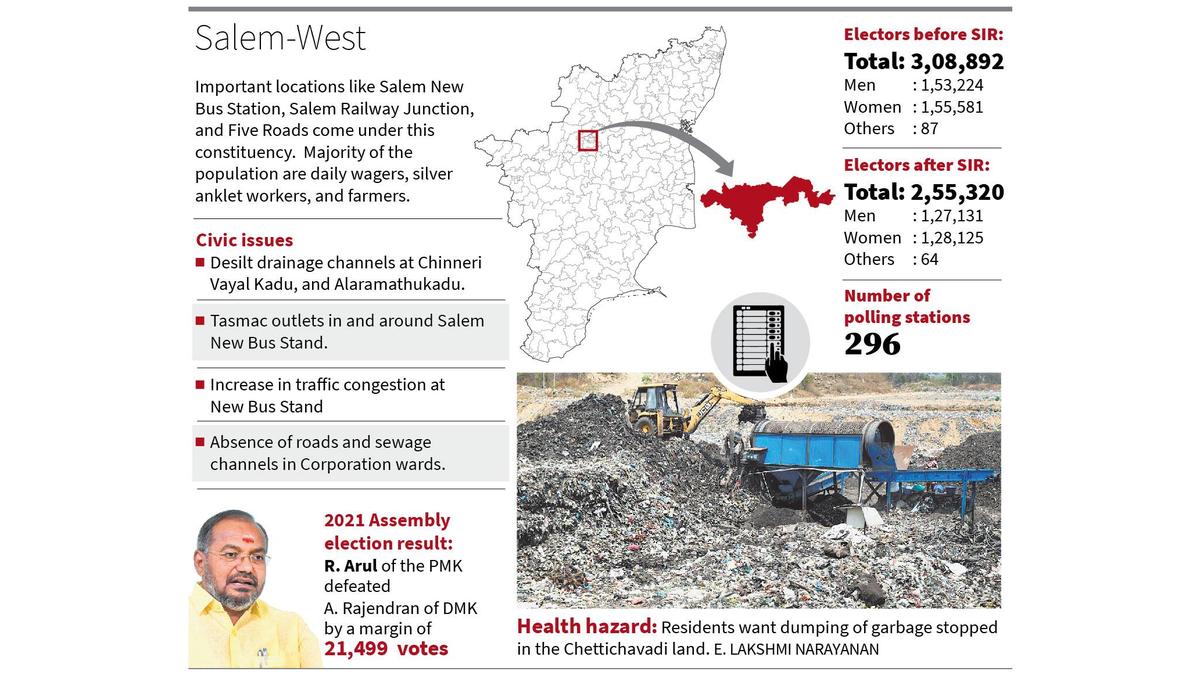
The Salem West became a constituency after the restructuring of the Salem I and Salem II Assembly constituencies during 2008. It includes 14 wards of the Salem Corporation (wards 1 to 5 and 17 to 25) and parts of Salem Taluk such as Chettichavadi, Kondappanaickenpatti, Sarkar Kollapatti, Steel Plant, and Thalavaipatti, and parts of Omalur Taluk.
Salem West is considered an AIADMK stronghold, as the party and its alliance have secured victory thrice (2011, 2016, and 2021 (PMK alliance)), since the creation of this constituency.
A majority of the people in the constituency are daily wagers, farmers, and those involved in silver anklet manufacturing at Selathampatti, Sivathapuram, Panankadu, and Sooramangalam.
One of the major issues highlighted by the residents is the functioning of four Tasmac outlets near the New Bus Stand. Tipplers pose a big challenge to residents and the passengers, said P. Kumar, a resident of Pallapatti. Though multiple protests have been staged by political parties and residents, no action has been taken so far, he said and wanted the shops shifted.
Residents of Chinneri Vayalkadu and Alamarathukadu demanded measures to prevent sewage mixed rainwater from entering the houses in the two localities. K. Praveen, a resident of Chinneri Vayalkadu also raised the issue of inadequate toilet facilities at the New Bus Stand. Hygiene takes a beating in the bus stand as people urinate in the open, he said.
Absence of road facility and inadequate drainage channels plague the 120 families residing in Palani Andavar Street for the past 23 years. “Due to narrow roads on Mitta Pudur Road, schoolchildren on bicycles used to fall into the sewage channel and it was recently addressed by the Corporation,” said V. Giri, a resident of the locality.


The government plans to amend the FCRA, introducing new regulations for NGO asset management and accountability for key functionaries.

The draft policy for “Responsible Digital Use Among Students”, released on Monday by the Department of Health and Family Welfare, has recommended that parents set structured routines with clear screen-time rules and prioritise privacy, safety, and open conversation with children on digital well-being.

Police Observer Sushant Kumar Saxena conducts surprise inspection at Shencottai police station, reviewing warrants and security arrangements ahead of elections.

Andhra Pradesh government to launch key projects in April, focusing on industrial growth and infrastructure development, says Nara Lokesh.

Lok Sabha refers the Corporate Laws (Amendment) Bill to a JPC amid opposition concerns over CSR provisions dilution.

SHG members in Kanniyakumari use snakes and ladders to raise election awareness and boost voter turnout.

Government accelerates consultations for early implementation of the Women’s Reservation Act to ensure women’s representation in 2029 elections.

CM A. Revanth Reddy distributes ₹1 crore insurance cheques to families of deceased Electricity department employees, enhancing financial security for workers.

The Bengaluru Traffic Police (BTP) registered 634 cases of drunk driving during a week-long special enforcement drive conducted across the city between March 16 and March 22.

GHMC intensifies action against property tax defaulters, seizing properties and offering a One Time Settlement scheme for payments.

CCB arrests three drug peddlers in Mangaluru, seizing ₹2.5 lakh worth of MDMA and other valuables.

TVK's 28 candidates in Puducherry include former BJP MLAs, a sitting Independent, and a retired police IG.

BRS submits notice on private member bill to Speaker