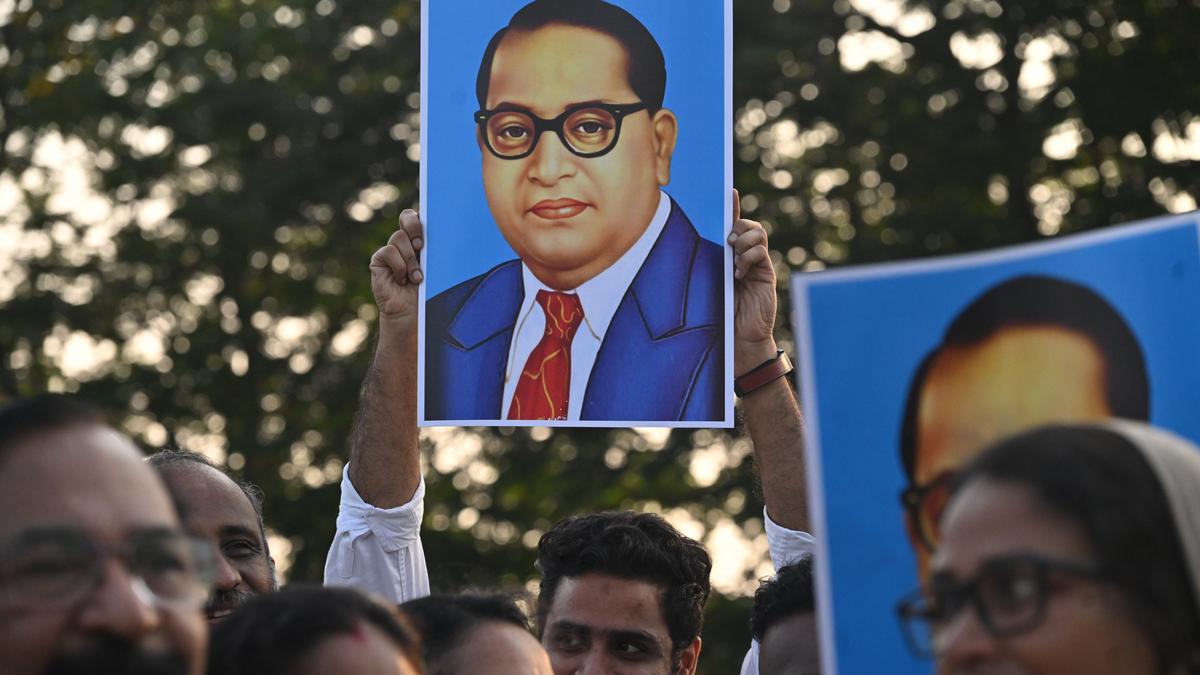
The Three Ambedkars: force, energy, and pragmatism in action Premium
The Hindu
Explore the intellectual interplay between Dr. B. R. Ambedkar and Prof. John Dewey's pragmatism in understanding societal issues.
Last December, on the serene campus of Columbia University, one friend asked me to describe Dr. B. R. Ambedkar in two words. I immediately responded — force and energy. These two secular terms summate the principled and organic idea of Ambedkar. Looking at it as a verb removes the zeal to barricade him into a sectarian idea. My thinking-doing Ambedkar is derived from these two enlightened ideas. This is what Dr. Ambedkar, as a noun, expected from his followers. So, it becomes essential to dissect these — force and energy.
For two years now, I have been reading Professor John Dewey’s texts as a scholar interested in understanding the shades of pragmatism, its critique(s) and its impact on the constitution of the verb — Ambedkar. In light of this, I believe Prof. Scott R. Stroud’s recent work ‘The Evolution of Pragmatism in India: Ambedkar, Dewey, and the Rhetoric of Reconstruction’ is essential for understanding the dialectics of the philosophy of pragmatism and Ambedkar. It is a necessary addition to the scholarship on Ambedkar, an attempt to infuse fresh thinking into understanding his philosophy and politics.
It is a fact that Prof. Dewey was one of the teachers of young Bhimrao at Columbia University. Also, there are various copies of Professor Dewey’s works and their updated editions in Dr. Ambedkar’s collection. Dr Ambedkar also marked these copies, showing his protracted engagement with Prof. Dewey’s ideas and those of other thinkers of his time. So, it becomes crucial to understand the intellectual interplay between Dr. Ambedkar and Prof. Dewey’s ideas of pragmatism.
My reading in delineating the hermeneutics of force and energy shall foreground the concept of the Three Ambedkars to understand these complex engagements in a simple framework. These Three Ambedkars embody the principles of pragmatic philosophy that Dr. Ambedkar often used as part of his strategic approach.
Dr. Ambedkar owned a copy of Prof. John Dewey’s classic, A Theory of Ethics, doing multiple readings. His underlining of the text with different coloured pencils shows his constant engagement with it. The text says that moral laws are the principles on which actions are based. Any moral judgement is made by duly weighing the consequences of the actions a person or an individual could take. This underscores an individual’s self-agency in exercising their choices.
In his classic treatise, Annihilation of Caste, Dr. Ambedkar, inspired by Deweyan pragmatism, highlights the modus operandi of the caste system. He stresses that it is the individual agency that caste inhibits, ultimately denying a person their freedom. This divinely sanctioned, dogmatic, and systemic caste takes away individuality in thought and action. Reflexive morality, which gives the discretion of choice, the edifice on which the idea of freedom is based, is denied to a person. The person is crushed under the burden of hegemonic customary laws that are motivated by parochial dogmas, energised by the motivation — maintaining a stagnant, graded, unequal caste system. A holy system wherein birth decides the worth by the caste into which they are born.
In communication studies, the term rhetoric means persuasive communication using the instruments of text, speech, images, and other mediums. Dr. Ambedkar uses this technique inspired by Deweyan pragmatism to reconstruct a gender-biased and casteist society. Knowing the limitations, he employs them selectively in his writings, speeches, and actions. The two examples illustrate this: the battle of Bhima Koregaon, and his brilliant lecture ‘Ranade, Gandhi and Jinnah’, delivered in 1943 at the Gokhale Memorial Hall.


The government plans to amend the FCRA, introducing new regulations for NGO asset management and accountability for key functionaries.

The draft policy for “Responsible Digital Use Among Students”, released on Monday by the Department of Health and Family Welfare, has recommended that parents set structured routines with clear screen-time rules and prioritise privacy, safety, and open conversation with children on digital well-being.

Police Observer Sushant Kumar Saxena conducts surprise inspection at Shencottai police station, reviewing warrants and security arrangements ahead of elections.

Andhra Pradesh government to launch key projects in April, focusing on industrial growth and infrastructure development, says Nara Lokesh.

Lok Sabha refers the Corporate Laws (Amendment) Bill to a JPC amid opposition concerns over CSR provisions dilution.

SHG members in Kanniyakumari use snakes and ladders to raise election awareness and boost voter turnout.

Government accelerates consultations for early implementation of the Women’s Reservation Act to ensure women’s representation in 2029 elections.

CM A. Revanth Reddy distributes ₹1 crore insurance cheques to families of deceased Electricity department employees, enhancing financial security for workers.

The Bengaluru Traffic Police (BTP) registered 634 cases of drunk driving during a week-long special enforcement drive conducted across the city between March 16 and March 22.

GHMC intensifies action against property tax defaulters, seizing properties and offering a One Time Settlement scheme for payments.

CCB arrests three drug peddlers in Mangaluru, seizing ₹2.5 lakh worth of MDMA and other valuables.

TVK's 28 candidates in Puducherry include former BJP MLAs, a sitting Independent, and a retired police IG.

BRS submits notice on private member bill to Speaker