‘Thaai Kizhavi’ movie review: Radikaa Sarathkumar’s masala comedy of gold standards signals a commanding new filmmaking voice
The Hindu
‘Thaai Kizhavi’ movie review: Radikaa Sarathkumar’s film, produced by Sivakarthikeyan, is a riotous rural comedy, which blends soul, style and subversion, and announces Sivakumar Murugesan as Tamil mainstream cinema’s most assured new disruptor
A cinephile friend once said how cinema, both the art form and industry, is a thriving, sentient being that knows who it must embrace or let go, and when it needs what at any specific time. And if we were to believe in that fantastical idea, the box office rut in 2026 feels like a reckoning call for Tamil cinema’s next torchbearer to rise to the occasion. There’s a new filmmaker in the block, who, by all means, seems to be the recalibrating voice Tamil mainstream cinema needed.
Sivakumar Murugesan’s debut Thaai Kizhavi is a film that feels like the perfection of an archetype many filmmakers have been toying with over the last few years — it’s a rollicking, leave-you-in-splits comedy that surprises you every step of its way, has a pressing emotional core, fields for the right progressive register, and leaves you feeling thoroughly satisfied.
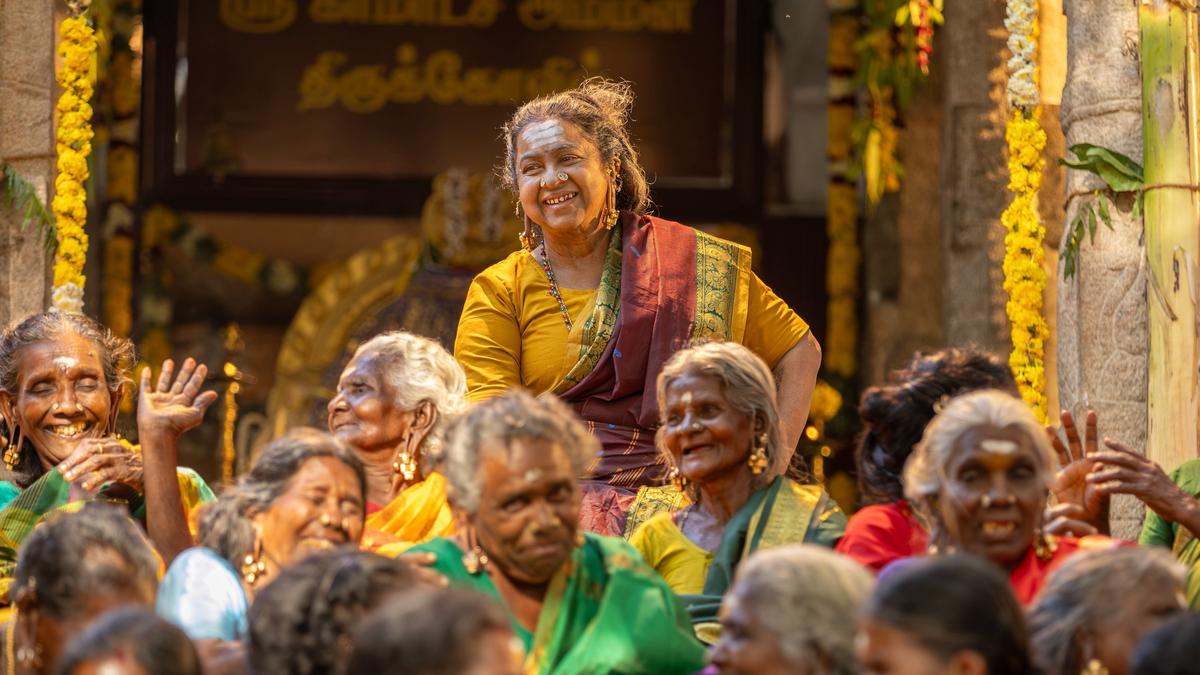
In the colourful world of Thaai Kizhavi, everything and anything seems spring-loaded to tickle you or sting you. There’s a tattoo of Kamal Haasan’s face on a man’s chest that gets its share of respect; there’s a wayward drunkard whose only job is to keep alight a lamp outside the Lord Karuppan temple; there’s a loudspeaker that somehow knows which Kamal song to play when, just like the photo of a deceased elderly man whose expressions keep changing. At the centre of it all is Pavunuthaayi (Radikaa Sarathkumar is exceptional), the stronghold around which all of Karumathur pivots, her daughter Suruli (Raichal Rabecca) and her good-for-nothing husband, her three dimwit sons, and a 40-something most-eligible bachelor of the town. Hell, heaven, and Karumathur all move around these wonderfully written characters.
A still from ‘Thaai Kizhavi’
Interestingly, the person we first meet is the one who would perfectly bookend this ensemble-driven story — the walls of the houses in Karumathur feature the male and female heads of the family, all except that of Pennycuick (Munishkanth), who does everything he can to get married. Then we meet Pavunuthaayi, who is a beautiful contradiction of all-embracing love and iron-fisted authority. She prays to many gods of her world for the wellness and prosperity of all beings, a prayer that crescendos into a Murugan song (Sivakumar Murugesan, interestingly, is also helming Sivakarthikeyan’s next, Seyon, meaning ‘Murugan’, also set in Karumathur). Her daughter Suruli, in contrast, gets a muted entrance in the big shadow her mother casts. Every day, when Pavunuthaayi finishes her prayers and steps out of her house, sirens go off in the heads of the townsmen, for they know what is to come — she would go on a merciless walk around the town, collecting interests on the money she has lent over the years. “Kaal mulachi nadandhu varum ayyanaar aruva iva,” “Local don-u, Sungudi kattivandha Superman-u,” go the lyrics of a song, as in this duality of Pavunuthaayi lies the film’s honest core. She once vowed that even if she dies, she would walk to the graveyard all by herself and lie down. Whether it was the doing of the Yaman, whom she mocks, or the Karuppan, who Vesakutta (Aathadi Kumaran) asks to take Pavunuthaayi away, the elderly woman gets bedridden all of a sudden.
The news reaches Pavunuthaayi’s sons, wastrels of each kind, who get elaborate introductions that leave you in splits. Vijayan (Aruldoss), an auto driver, is the kind who would squander Rs 50 in pursuit of a one-rupee coin. Uppiliyan (Singampuli), a Kamal Haasan fanatic, rents out music systems to functions; he plays only Kamal songs to the dismay of fans of Rajinikanth, Sathyaraj, Ramki, and Raj Kiran. Meanwhile, flower seller Selvam’s (Bala Saravanan) garlands all look shriveled — Sivakumar’s brilliance lies in how even Selvam’s relationship with flowers goes on a full journey in the film. The three prodigal sons all return to Karumathur, not because they are worried about their mother, but because she had vowed that none of them would get any share of her properties, at least until her death. A fourth and loud entrance is made by Pavunuthaayi’s son-in-law (Muthukumar), vowing to collect the remainder of the dowry owed to him.


The government plans to amend the FCRA, introducing new regulations for NGO asset management and accountability for key functionaries.

The draft policy for “Responsible Digital Use Among Students”, released on Monday by the Department of Health and Family Welfare, has recommended that parents set structured routines with clear screen-time rules and prioritise privacy, safety, and open conversation with children on digital well-being.

Police Observer Sushant Kumar Saxena conducts surprise inspection at Shencottai police station, reviewing warrants and security arrangements ahead of elections.

Andhra Pradesh government to launch key projects in April, focusing on industrial growth and infrastructure development, says Nara Lokesh.

Lok Sabha refers the Corporate Laws (Amendment) Bill to a JPC amid opposition concerns over CSR provisions dilution.

SHG members in Kanniyakumari use snakes and ladders to raise election awareness and boost voter turnout.

Government accelerates consultations for early implementation of the Women’s Reservation Act to ensure women’s representation in 2029 elections.

CM A. Revanth Reddy distributes ₹1 crore insurance cheques to families of deceased Electricity department employees, enhancing financial security for workers.

The Bengaluru Traffic Police (BTP) registered 634 cases of drunk driving during a week-long special enforcement drive conducted across the city between March 16 and March 22.

GHMC intensifies action against property tax defaulters, seizing properties and offering a One Time Settlement scheme for payments.

CCB arrests three drug peddlers in Mangaluru, seizing ₹2.5 lakh worth of MDMA and other valuables.

TVK's 28 candidates in Puducherry include former BJP MLAs, a sitting Independent, and a retired police IG.

BRS submits notice on private member bill to Speaker