Tamil Nadu: a trendsetter for all-round development Premium
The Hindu
Tamil Nadu is the most urbanised State in the country, with close to 50% of the population living in urban areas, according to the 2011 Census.
The story of Tamil Nadu’s post-Independence economic development stands out from those of many other States in the country. From the beginning, the political leadership, regardless of affiliation, has consciously followed policies that are aimed at ensuring an even distribution of development. In this respect, it has been aided by an active and self-effacing bureaucracy and a responsive industrial community.
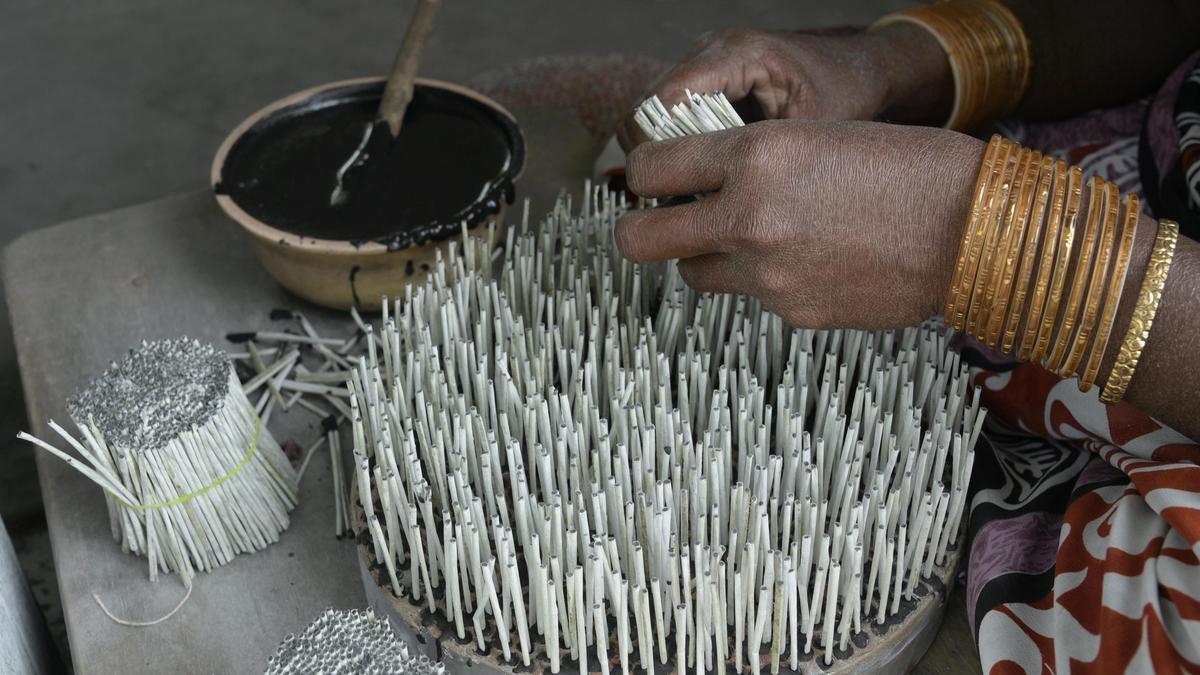
Unlike in other States such as Maharashtra and Karnataka, where economic activity is concentrated in a couple of cities, Tamil Nadu has been witnessing dispersed development. Besides Chennai, the State has other urban centres — Coimbatore, Madurai, Tiruppur, Tiruchi, Vellore, and Salem — contributing significantly to its economy and helping bridge the urban-rural divide. The spread of activity can be seen from the location of a host of spinning mills in the western district of Tiruppur (which accounted for 55% of the country’s knitwear exports to the tune of ₹30,690 crore in 2023-24, providing jobs to six lakh persons) to oil refineries and fertiliser production in the northern district of Tiruvallur. Calendar- and cracker-making units in the southern district of Virudhunagar, cement production in the central district of Perambalur, and beedi-making and mat-weaving in Tirunelveli are also a testament to this fact.
Tamil Nadu is the most urbanised State in the country, with close to 50% of the population living in urban areas, according to the 2011 Census. The State not only had the first-mover advantage during the ‘Licence Raj’ in creating a solid base in manufacturing, but also did not lag behind others in taking to information technology (IT) and IT-enabled services (ITES) in the post-1990 ‘economic reforms’ era.
In the Sustainable Development Goals (SDG) India Index 2023-24 published by the NITI Aayog in 2024, Tamil Nadu emerged as a frontrunner, reflecting the State’s dedicated efforts and comprehensive policies on sustainable development. The composite score for Tamil Nadu rose to 78 in the edition in question — a remarkable rise from 66 in 2018. The upward trajectory placed the State among the top performers across the nation, underscoring its commitment to social equity, economic growth, and environmental sustainability. The State ranks second in low infant mortality and low birth rate, and third in the Health Index.It is known for its innovative welfare schemes such as the noon-meal scheme — twice revived in 1956 and 1982, with improvements made over the previous versions — and the old-age pension scheme, introduced in April 1962. Today, these schemes are implemented across the country.
Even in the field of institution-building, the State is a trendsetter, as it had, within two years of freedom, set up what is now called the Tamil Nadu Industrial Investment Corporation (TIIC) to handle long-term financing. This was accomplished when the existence of such a State-level body was largely unheard of in the country. The TIIC’s presence came in handy very shortly, as K. Kamaraj, who was Chief Minister of the State from 1954 to 1963, had realised that capital in his State was poor and shy. To overcome this limitation, he enabled the Corporation to participate in the share capital of private enterprises, an action described as “bold and imaginative” by R. Venkataraman, who was the Industries Minister during 1957 to 1967, in an article in The Hindu on July 15, 1964. Building on what it did with school education in the early 1980s, the State, in the mid-1980s, opened up higher education to the private sector, facilitating the formation of a number of engineering and medical colleges. Naturally, the State has developed a solid network in certain aspects of professional education: as of now, there are 22 self-financing private medical colleges, four private universities, and 13 colleges affiliated with deemed-to-be universities. In engineering and architecture, there are 429 self-financing colleges, apart from 11 government colleges.
Accounting for 4% of India’s land area and 6% of the country’s population, Tamil Nadu contributed 9.21% to the national GDP in 2024-25, ranking second only to Maharashtra. Its Gross State Domestic Product (GSDP) at constant prices (2011-12 series) reached about ₹17.23 lakh crore, reflecting the real economic growth of 11.19% over the previous year. In fact, the State was the only one to register a double-digit growth rate in the year in question, besides having the growth rate in double digits after a gap of 14 years. Broadly, the respective shares of the primary (agriculture and allied activities), secondary (industry), and tertiary (services) sectors in the GSDP of the State are 13%, 34%, and 53%.


The government plans to amend the FCRA, introducing new regulations for NGO asset management and accountability for key functionaries.

The draft policy for “Responsible Digital Use Among Students”, released on Monday by the Department of Health and Family Welfare, has recommended that parents set structured routines with clear screen-time rules and prioritise privacy, safety, and open conversation with children on digital well-being.

Police Observer Sushant Kumar Saxena conducts surprise inspection at Shencottai police station, reviewing warrants and security arrangements ahead of elections.

Andhra Pradesh government to launch key projects in April, focusing on industrial growth and infrastructure development, says Nara Lokesh.

Lok Sabha refers the Corporate Laws (Amendment) Bill to a JPC amid opposition concerns over CSR provisions dilution.

SHG members in Kanniyakumari use snakes and ladders to raise election awareness and boost voter turnout.

Government accelerates consultations for early implementation of the Women’s Reservation Act to ensure women’s representation in 2029 elections.

CM A. Revanth Reddy distributes ₹1 crore insurance cheques to families of deceased Electricity department employees, enhancing financial security for workers.

The Bengaluru Traffic Police (BTP) registered 634 cases of drunk driving during a week-long special enforcement drive conducted across the city between March 16 and March 22.

GHMC intensifies action against property tax defaulters, seizing properties and offering a One Time Settlement scheme for payments.

CCB arrests three drug peddlers in Mangaluru, seizing ₹2.5 lakh worth of MDMA and other valuables.

TVK's 28 candidates in Puducherry include former BJP MLAs, a sitting Independent, and a retired police IG.

BRS submits notice on private member bill to Speaker