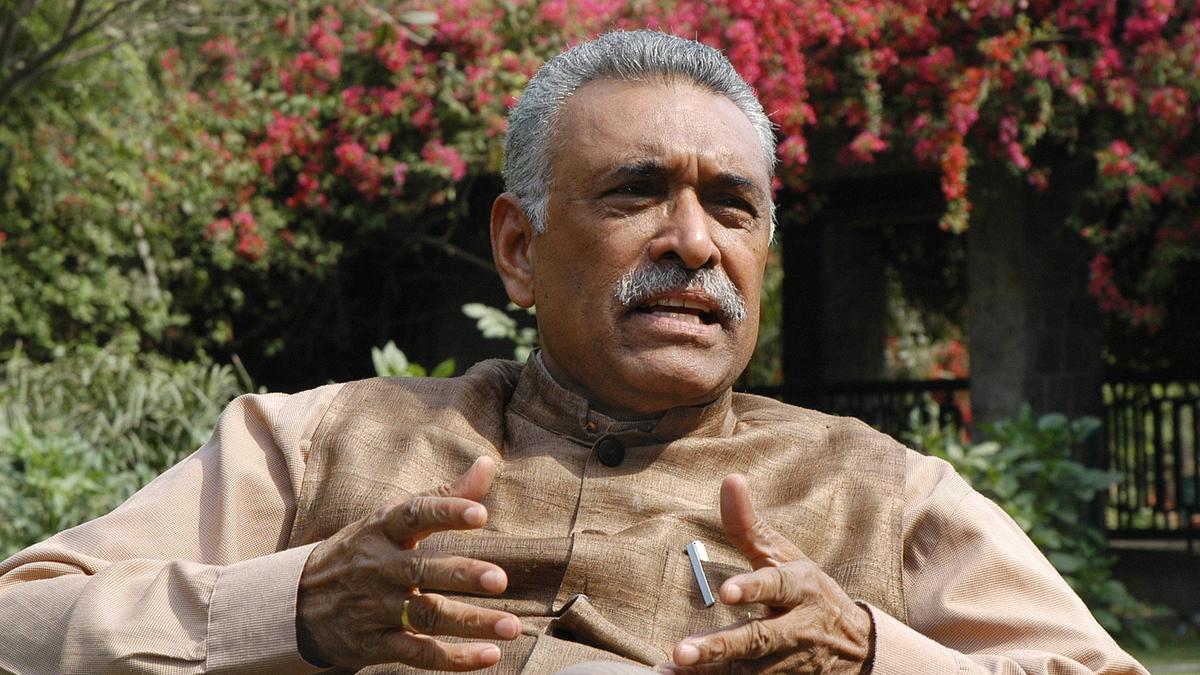
T.K. Oommen, a leading architect of modern Indian sociology, passes away
The Hindu
Renowned sociologist T.K. Oommen, a pioneer in modern Indian sociology, has passed away at 88, leaving a lasting legacy.
Eminent sociologist and Professor Emeritus at the Jawaharlal Nehru University’s (JNU) Centre for the Study of Social Systems, T.K. Oommen, who is regarded as a leading architect of modern Indian sociology, passed away on Thursday (February 26, 2026). He was 88 and his end came in Gurugram.
A highly respected scholar, teacher and author, Prof. Oommen is known for his writings and approaches to social justice, identity and pluralism. He had gained wide attention for his study of the Bhoodan Movement and as chairperson of the Advisory Committee of the Gujarat Harmony Project, formed after the 2002 communal violence in the State.
Prof. Oommen was a former president of the International Sociological Association (ISA) and the Indian Sociological Society and a member of the Sachar Committee, which studied the social, economic and educational status of India’s Muslim community.
His main areas of interest included social movements and social transformations, political sociology, professions and social theory. For Prof. Oommen, sociology was never a mere assemblage of abstract theories but a scientific instrument to grasp the pulse of a society in constant transition, Antony Palackal, former professor and head, Department of Sociology, University of Kerala, said. Prof. Oommen placed Indian sociology firmly on the global intellectual map, he said.
“His scholarship spanned five major domains. First, he examined social movements and their transformative potential, beginning with his study of the Bhoodan Movement. Second, in the Sociology of occupation, his study of the nursing profession (1978) was pioneering, bringing attention to socially undervalued yet indispensable occupations. Third, in his work on State and ethnicity, most notably in ‘Understanding Security: A New Perspective’, he offered a novel framework for analysing social security in the context of communal violence and ethnic conflict in India. He interrogated the complex relationship between State and civil society and explored how modern nation-states confront dissent and pluralism. Throughout, he argued that sociology is not an isolated discipline but one intrinsically connected to history, politics, and culture,” Dr. Palackal said.
Prof. Oommen was born on October 16, 1937, to K.M. Koshy and Saramma Koshy in Venmony, Alappuzha, which was then part of Travancore. He secured his BA in Economics from the University of Kerala in 1957 and a master's in Sociology from Poona University (since renamed Savitribai Phule Pune University) in 1960. For his PhD (in Sociology from Poona University), his thesis was on ‘Charisma, stability and change: an analysis of the Bhoodan-Gramdan movement in India.’ From 1964 to 1971, he taught at the Delhi School of Social Work, Delhi University. From 1971 to 1976, he was associate professor at the Centre for the Study of Social Systems (CSSS) in JNU and from 1976 to 2002, he was professor of sociology at the centre. He has been Professor Emeritus at JNU from 2007 onwards.


The government plans to amend the FCRA, introducing new regulations for NGO asset management and accountability for key functionaries.

The draft policy for “Responsible Digital Use Among Students”, released on Monday by the Department of Health and Family Welfare, has recommended that parents set structured routines with clear screen-time rules and prioritise privacy, safety, and open conversation with children on digital well-being.

Police Observer Sushant Kumar Saxena conducts surprise inspection at Shencottai police station, reviewing warrants and security arrangements ahead of elections.

Andhra Pradesh government to launch key projects in April, focusing on industrial growth and infrastructure development, says Nara Lokesh.

Lok Sabha refers the Corporate Laws (Amendment) Bill to a JPC amid opposition concerns over CSR provisions dilution.

SHG members in Kanniyakumari use snakes and ladders to raise election awareness and boost voter turnout.

Government accelerates consultations for early implementation of the Women’s Reservation Act to ensure women’s representation in 2029 elections.

CM A. Revanth Reddy distributes ₹1 crore insurance cheques to families of deceased Electricity department employees, enhancing financial security for workers.

The Bengaluru Traffic Police (BTP) registered 634 cases of drunk driving during a week-long special enforcement drive conducted across the city between March 16 and March 22.

GHMC intensifies action against property tax defaulters, seizing properties and offering a One Time Settlement scheme for payments.

CCB arrests three drug peddlers in Mangaluru, seizing ₹2.5 lakh worth of MDMA and other valuables.

TVK's 28 candidates in Puducherry include former BJP MLAs, a sitting Independent, and a retired police IG.

BRS submits notice on private member bill to Speaker