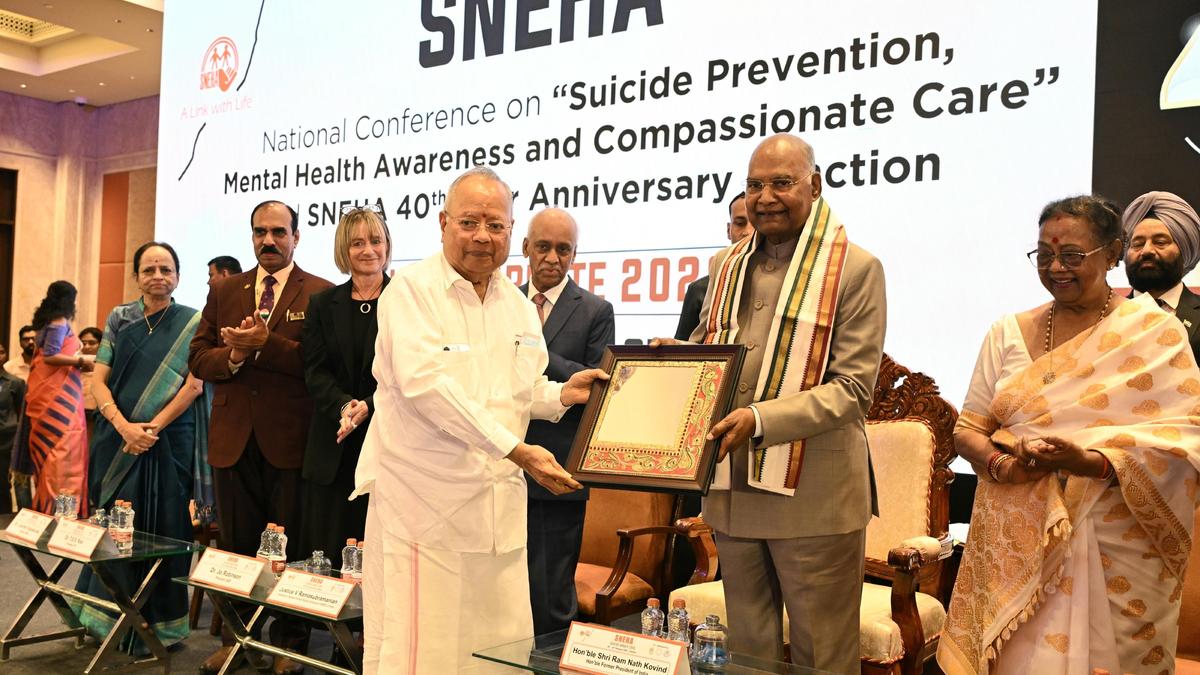
Suicide prevention should be national priority, says Kovind
The Hindu
Kovind emphasizes suicide prevention as a national priority, urging collective societal responsibility at Sneha's 40th anniversary conference.
Suicide prevention is not just the responsibility of psychiatrists, but of society as a whole, said former president Ram Nath Kovind at the 40th year anniversary of Sneha, a non-governmental organsation dedicated to suicide prevention.
Mr. Kovind was speaking at the inaugural event of the national conference on Suicide Prevention, Mental Health Awareness and Compassionate Care being organised by Sneha from February 26 to 28.
The event was attended by Justice V. Ramasubramanian, former judge of the Supreme Court; Bharat Lal, secretary general and CEO, National Human Rights Commission; Jo Robinson, president of International Association for Suicide Prevention; T.S.S. Rao, president of Indian Psychiatric Society; Nalli Kuppuswami Chetti, president of Sneha; Lakshmi Vijayakumar, founder of Sneha; and M.C. Anand, director of Sneha.
“Sneha has been a beacon of hope, transforming distress into pathways of healing and hope. The organisation has relied on the selfless dedication of volunteers to reach 1.5 million lives through email, phone calls, chat, and in-person interactions,” Mr. Kovind said.
Mr. Kovind said National Crime Records Bureau data for 2023 recorded over 1,71,000 suicides across the country. He noted that student suicides had surged by 65% between 2013 and 2023, reaching a high of 13,892 cases last year. He added that students, women from disadvantaged backgrounds, farmers, and elderly persons grappling with loneliness remain particularly vulnerable.
“Suicide prevention is a national priority and imperative, linked to the Right to Life under Article 21 of the Constitution. Addressing the crisis requires bridging systemic gaps that fuel vulnerability,” he said, adding that at the heart of effective prevention lie compassionate care, early intervention, and robust support systems.


The government plans to amend the FCRA, introducing new regulations for NGO asset management and accountability for key functionaries.

The draft policy for “Responsible Digital Use Among Students”, released on Monday by the Department of Health and Family Welfare, has recommended that parents set structured routines with clear screen-time rules and prioritise privacy, safety, and open conversation with children on digital well-being.

Police Observer Sushant Kumar Saxena conducts surprise inspection at Shencottai police station, reviewing warrants and security arrangements ahead of elections.

Andhra Pradesh government to launch key projects in April, focusing on industrial growth and infrastructure development, says Nara Lokesh.

Lok Sabha refers the Corporate Laws (Amendment) Bill to a JPC amid opposition concerns over CSR provisions dilution.

SHG members in Kanniyakumari use snakes and ladders to raise election awareness and boost voter turnout.

Government accelerates consultations for early implementation of the Women’s Reservation Act to ensure women’s representation in 2029 elections.

CM A. Revanth Reddy distributes ₹1 crore insurance cheques to families of deceased Electricity department employees, enhancing financial security for workers.

The Bengaluru Traffic Police (BTP) registered 634 cases of drunk driving during a week-long special enforcement drive conducted across the city between March 16 and March 22.

GHMC intensifies action against property tax defaulters, seizing properties and offering a One Time Settlement scheme for payments.

CCB arrests three drug peddlers in Mangaluru, seizing ₹2.5 lakh worth of MDMA and other valuables.

TVK's 28 candidates in Puducherry include former BJP MLAs, a sitting Independent, and a retired police IG.

BRS submits notice on private member bill to Speaker