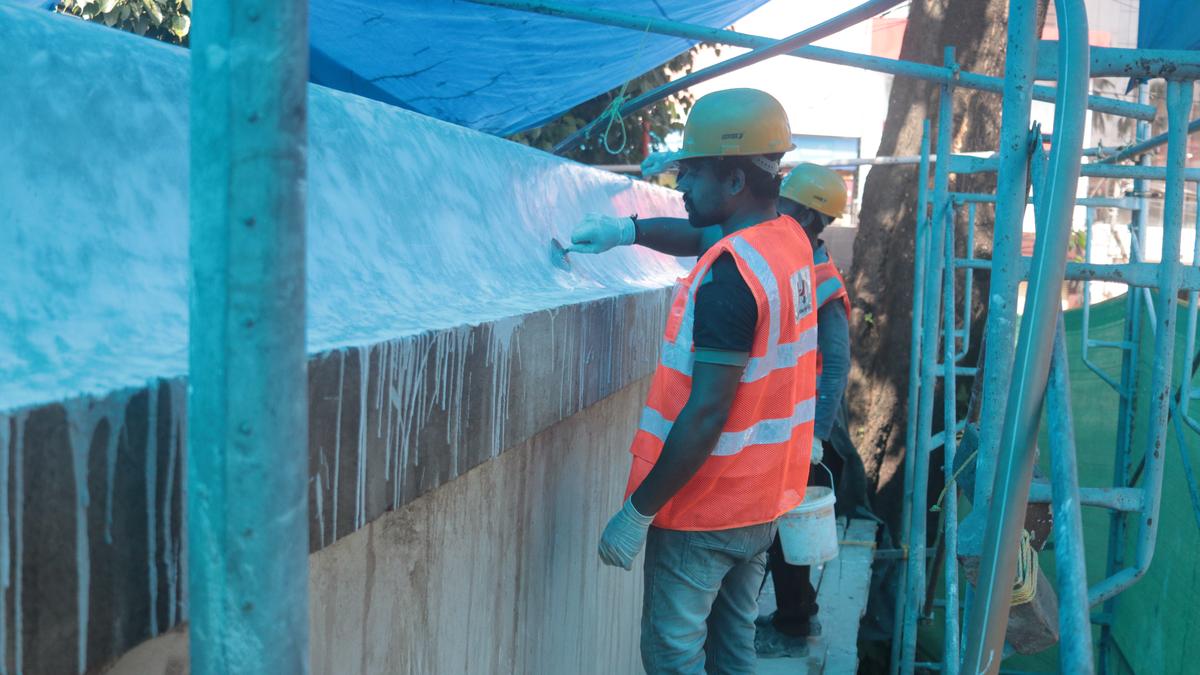
Restoration work underway on Fort wall in Thiruvananthapuram in spite of several challenges
The Hindu
The Thiruvananthapuram Fort, which stood guard against possible enemy invasions of the Sree Padmanabhaswamy temple and the city for centuries, is losing the battle against the elements.
The Thiruvananthapuram Fort, which stood guard against possible enemy invasions of the Sree Padmanabhaswamy temple and the city for centuries, has been losing the battle against the elements for some time.
The construction of the present fort began around 1747 during the reign of Marthanda Varma and completed in 1787 during the rule of Karthika Thirunal Dharmaraja. The 3.65-km fortification comprises a granite part and a laterite part. The laterite fort on the southern side at Attakulangara has been at the receiving end of various development works and the lime mortar plastering has chipped off at many places.
Use of excavators and heavy machinery for developing the road abutting the fort wall literally shook the fort’s foundations, dislocating the laterite bricks and exposing the age-old structure to the vagaries of the weather. It was then the Kerala Archaeology department stepped in to renovate this part of the protected monument under it.
But restoring a fortification from another era, situated in the middle of a bustling city, poses unique challenges. One is the encroachments on various parts. Another is that the building and plastering techniques used are different from the present cement plastering methods and finding labourers skilled in the work is not easy.
“To take up the fort wall renovation, we needed to surmount many obstacles, says E. Dinesan, Director, Department of Archaeology, Kerala. He adds, “While the fort is a protected monument, there is no prohibited area around the fort wall. Although we have declared a three-metre restricted zone around the fort, in many parts, we do not have access to the fort as its wall serves as one of the walls of the buildings built near it. There is not even space for labourers to stand and work on.”
Nevertheless, renovation work is now under way on 383 metres of the fort wall, from Attakulangara Junction to Azhikotta, estimated at about at ₹ 64.90 lakh. “The work is expected to be completed by October, weather permitting. The lime plastering method needs lot of curing time,” says Dinesan.
The ancient plastering method using lime mortar is no more practised commonly and requires skilled hands. At the go-down of Hi-Elect Enterprises, which has been awarded the work, workers mix lime and river sand in a specific proportion and leave it to ferment for 21 days. After this period, if the mixture is ready, it has a gooey consistency; otherwise, the process is repeated.


The government plans to amend the FCRA, introducing new regulations for NGO asset management and accountability for key functionaries.

The draft policy for “Responsible Digital Use Among Students”, released on Monday by the Department of Health and Family Welfare, has recommended that parents set structured routines with clear screen-time rules and prioritise privacy, safety, and open conversation with children on digital well-being.

Police Observer Sushant Kumar Saxena conducts surprise inspection at Shencottai police station, reviewing warrants and security arrangements ahead of elections.

Andhra Pradesh government to launch key projects in April, focusing on industrial growth and infrastructure development, says Nara Lokesh.

Lok Sabha refers the Corporate Laws (Amendment) Bill to a JPC amid opposition concerns over CSR provisions dilution.

SHG members in Kanniyakumari use snakes and ladders to raise election awareness and boost voter turnout.

Government accelerates consultations for early implementation of the Women’s Reservation Act to ensure women’s representation in 2029 elections.

CM A. Revanth Reddy distributes ₹1 crore insurance cheques to families of deceased Electricity department employees, enhancing financial security for workers.

The Bengaluru Traffic Police (BTP) registered 634 cases of drunk driving during a week-long special enforcement drive conducted across the city between March 16 and March 22.

GHMC intensifies action against property tax defaulters, seizing properties and offering a One Time Settlement scheme for payments.

CCB arrests three drug peddlers in Mangaluru, seizing ₹2.5 lakh worth of MDMA and other valuables.

TVK's 28 candidates in Puducherry include former BJP MLAs, a sitting Independent, and a retired police IG.

BRS submits notice on private member bill to Speaker