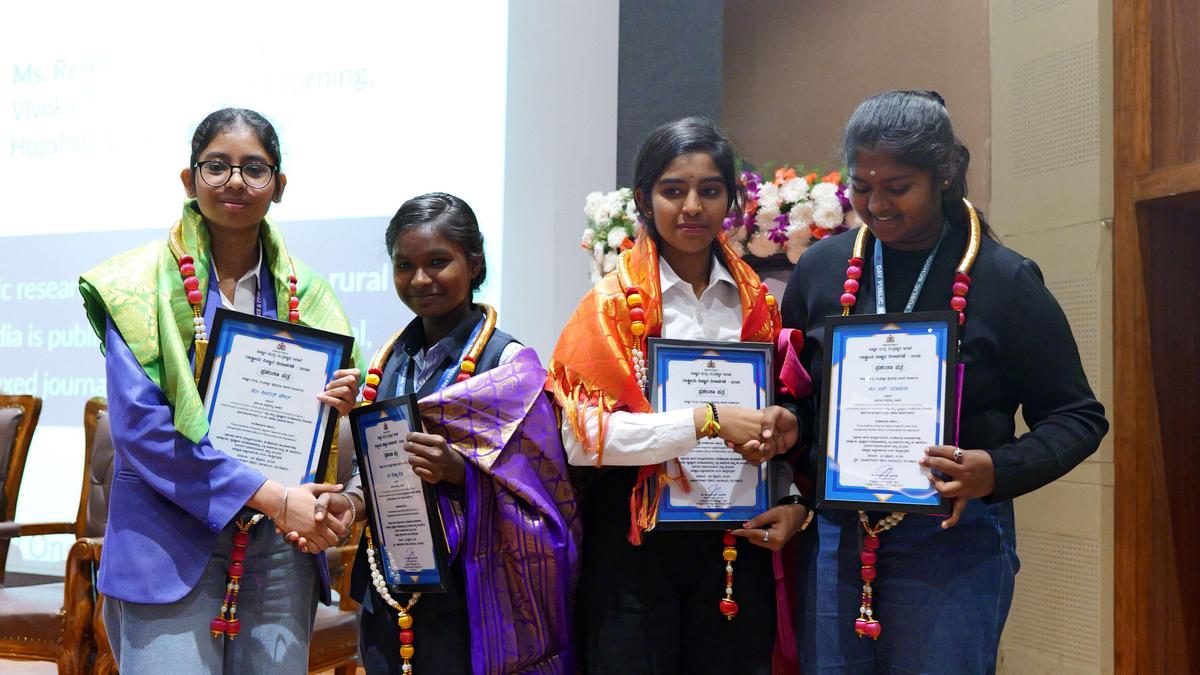
Karnataka school teens from rural and tribal backgrounds make scientific mark with international journal publication
The Hindu
Four Karnataka schoolgirls achieve international recognition by publishing research on eco-friendly copper nanoparticles in a prestigious journal.
Four young girls from Karnataka, one of them from a tribal community, have achieved a rare feat by co-authoring a research paper published in a Scopus-indexed international science journal.
Class 11 students, namely, Kirat Kaur from Bidar, S. Yamini from Hosadoddi village and Reshma J.V. from Hosahalli, H.D. Kote, and class 10 student Lakshmi G. from Kaggalipura village, contributed to research that explored an environmentally safe method to create copper-based nanoparticles using plant extracts.
Their research article titled “Green synthesis of saponin-capped copper (II) oxide (CuO) nanoparticles and their efficacy in photocatalytic dye degradation” was published in Sustainable Chemistry One World, a peer-reviewed, Scopus-indexed international journal by Elsevier.
“For students from tribal communities, the problem is not lack of skills or ability, but access. Most often, they don’t know who to turn to. If they receive the right opportunities, they can show their abilities,” said Ms. Reshma, a first-generation learner who hails from the Jenu Kuruba community and a student at Viveka Tribal Centre for Learning, Nagarahole Forest Region.
The students participated in the research between March and August 2024 as part of Anveshana, a fully funded science research programme by Prayoga Institute of Education Research. The project was undertaken under the guidance of Subhadip Senapati, lead researcher – Chemistry, Vagdevi Rao K.C., research associate – Botany, and Parikshit Kumar, research associate – Green Energy Technology.
The green copper-based nanoparticles developed in the research showed improved antibacterial and antioxidant activities, making them useful for biomedicinal applications. These particles can be used to purify contaminated water and eliminate harmful microbes, offering a low-cost and sustainable solution for rural and underserved communities where clean water access remains a challenge.


The government plans to amend the FCRA, introducing new regulations for NGO asset management and accountability for key functionaries.

The draft policy for “Responsible Digital Use Among Students”, released on Monday by the Department of Health and Family Welfare, has recommended that parents set structured routines with clear screen-time rules and prioritise privacy, safety, and open conversation with children on digital well-being.

Police Observer Sushant Kumar Saxena conducts surprise inspection at Shencottai police station, reviewing warrants and security arrangements ahead of elections.

Andhra Pradesh government to launch key projects in April, focusing on industrial growth and infrastructure development, says Nara Lokesh.

Lok Sabha refers the Corporate Laws (Amendment) Bill to a JPC amid opposition concerns over CSR provisions dilution.

SHG members in Kanniyakumari use snakes and ladders to raise election awareness and boost voter turnout.

Government accelerates consultations for early implementation of the Women’s Reservation Act to ensure women’s representation in 2029 elections.

CM A. Revanth Reddy distributes ₹1 crore insurance cheques to families of deceased Electricity department employees, enhancing financial security for workers.

The Bengaluru Traffic Police (BTP) registered 634 cases of drunk driving during a week-long special enforcement drive conducted across the city between March 16 and March 22.

GHMC intensifies action against property tax defaulters, seizing properties and offering a One Time Settlement scheme for payments.

CCB arrests three drug peddlers in Mangaluru, seizing ₹2.5 lakh worth of MDMA and other valuables.

TVK's 28 candidates in Puducherry include former BJP MLAs, a sitting Independent, and a retired police IG.

BRS submits notice on private member bill to Speaker