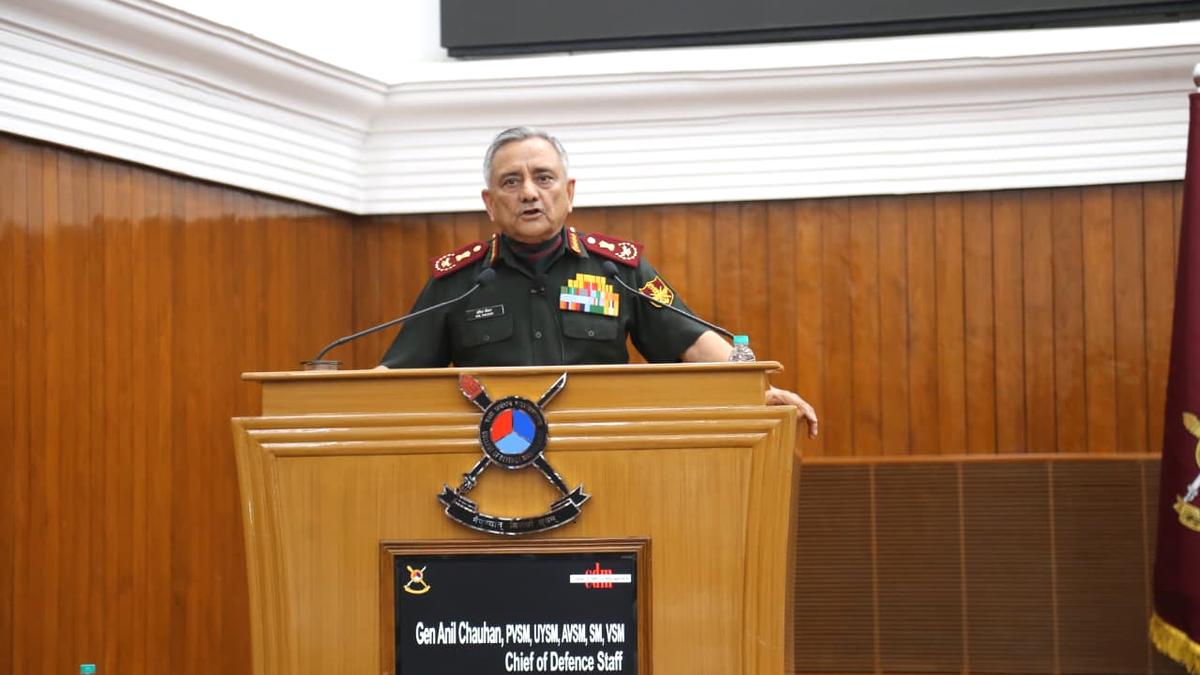
Indian armed forces need to transition from net-centric operations to intelligent warfare: CDS General Anil Chauhan
The Hindu
CDS General Anil Chauhan urges Indian Armed Forces to transition from Multi-Domain Operations to intelligent warfare for modern combat readiness.
“As warfare expands from the physical to the synthetic and cognitive realms, the Indian Armed Forces need to transition from net-centric operations toward Intelligent Warfare and move beyond Multi-Domain Operations (MDO) to All-Realm All-Domain Operations (ARADO)” said Chief of Defence Staff, General Anil Chauhan.
Delivering the inaugural address at the CDM annual seminar on the theme ‘Multi-Domain Integrated Technologically-Empowered Resilient Armed Forces’, or MITRA, at the College of Defence Management, Secunderabad, General Chauhan said the evolving character of warfare demands a shift in doctrine, capability development and organisational thinking to retain decision advantage across the spectrum of conflict.
He spoke about the Third Revolution in Military Affairs, marked by Convergence Warfare. He described this as the fusion of contact and non-contact operations, kinetic and non-kinetic means, and old and new domains across all levels of conflict. He also underlined the need to establish credible non-nuclear strategic deterrence, stressing that preparedness must ensure the ability to prevail at every rung of escalation.
The two-day seminar, held on February 24 and 25, was hosted by CDM with the Indian School of Business (ISB) as its knowledge partner. The seminar served as a strategic platform to align lessons from contemporary conflicts with India’s specific operational environment, with a focus on self-reliance and structural reform. The objective was to advance the MITRA vision by shaping armed forces that are multi-domain in outlook, integrated in action, technology-empowered in execution and resilient in purpose, as per a release.


The government plans to amend the FCRA, introducing new regulations for NGO asset management and accountability for key functionaries.

The draft policy for “Responsible Digital Use Among Students”, released on Monday by the Department of Health and Family Welfare, has recommended that parents set structured routines with clear screen-time rules and prioritise privacy, safety, and open conversation with children on digital well-being.

Police Observer Sushant Kumar Saxena conducts surprise inspection at Shencottai police station, reviewing warrants and security arrangements ahead of elections.

Andhra Pradesh government to launch key projects in April, focusing on industrial growth and infrastructure development, says Nara Lokesh.

Lok Sabha refers the Corporate Laws (Amendment) Bill to a JPC amid opposition concerns over CSR provisions dilution.

SHG members in Kanniyakumari use snakes and ladders to raise election awareness and boost voter turnout.

Government accelerates consultations for early implementation of the Women’s Reservation Act to ensure women’s representation in 2029 elections.

CM A. Revanth Reddy distributes ₹1 crore insurance cheques to families of deceased Electricity department employees, enhancing financial security for workers.

The Bengaluru Traffic Police (BTP) registered 634 cases of drunk driving during a week-long special enforcement drive conducted across the city between March 16 and March 22.

GHMC intensifies action against property tax defaulters, seizing properties and offering a One Time Settlement scheme for payments.

CCB arrests three drug peddlers in Mangaluru, seizing ₹2.5 lakh worth of MDMA and other valuables.

TVK's 28 candidates in Puducherry include former BJP MLAs, a sitting Independent, and a retired police IG.

BRS submits notice on private member bill to Speaker