In a first, Indian Institute of Astrophysics astronomers spot ultraviolet emissions from novae in Andromeda galaxy
The Hindu
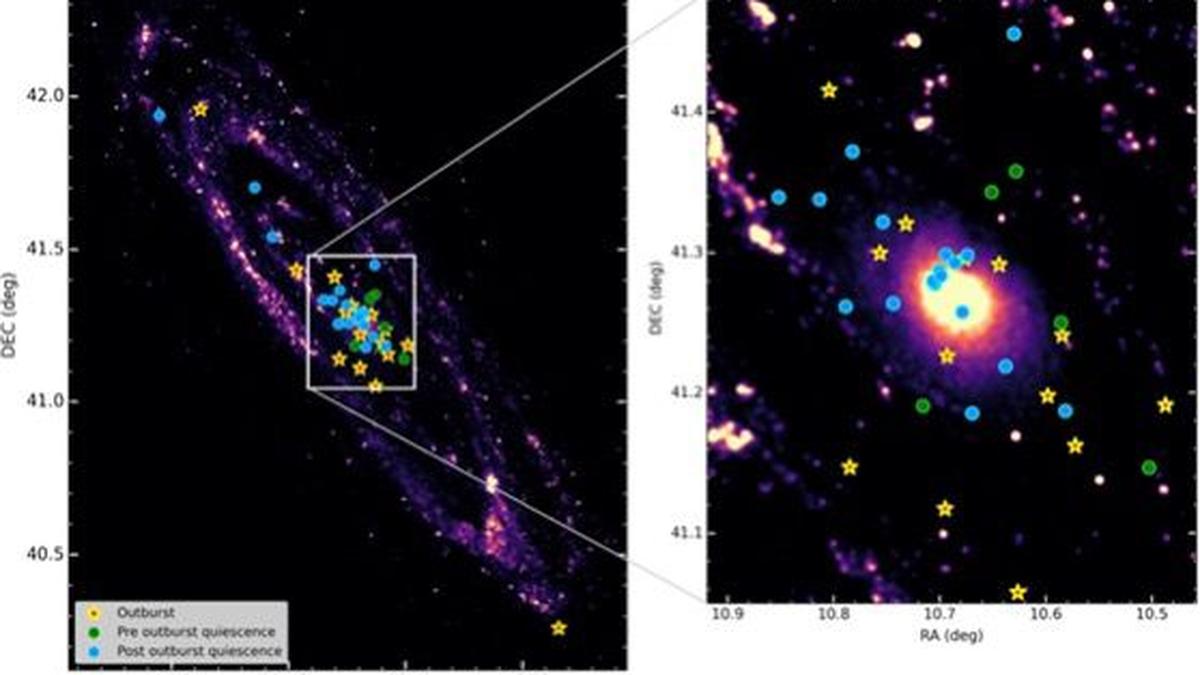
Astronomers from the Indian Institute of Astrophysics (IIA) have spotted far ultra violet (FUV) emissions from novae for the first time in the neighbouring Andromeda galaxy.
Astronomers from the Indian Institute of Astrophysics (IIA) have spotted far ultra violet (FUV) emissions from novae for the first time in the neighbouring Andromeda galaxy.
The ultraviolet emissions from novae are a special class of transient astronomical event that causes the sudden appearance of a bright, apparently new star that slowly fades over weeks or months, during their outburst.
The IIA team used ultraviolet imaging telescope (UVIT/AstroSat) data of the Andromeda galaxy from public archives, to look for FUV emission from novae during their dormancy.
AstroSat is India’s first dedicated space astronomy observatory and the UVIT is one of the primary payloads which was developed by IIA.
According to the Department of Science and Technology, the team stumbled upon the novae around their eruption phase.
It added that the team, consisting of Judhajeet Basu (IIA and Pondicherry University), Krishnendu S. (IIA and Amrita University), Sudhanshu Barway (IIA), Shatakshi Chamoli (IIA and Pondicherry University), and G. C. Anupama (IIA), also discovered ultraviolet emission from 42 novae, a special class of stellar explosions, and even caught four of them in the act of outburst itself.
The department said that this could help scientists study these interacting binary star systems in our nearest neighbor galaxy at different phases of their life, some piling up matter from their companion, while others spewing it into space.


The government plans to amend the FCRA, introducing new regulations for NGO asset management and accountability for key functionaries.

The draft policy for “Responsible Digital Use Among Students”, released on Monday by the Department of Health and Family Welfare, has recommended that parents set structured routines with clear screen-time rules and prioritise privacy, safety, and open conversation with children on digital well-being.

Police Observer Sushant Kumar Saxena conducts surprise inspection at Shencottai police station, reviewing warrants and security arrangements ahead of elections.

Andhra Pradesh government to launch key projects in April, focusing on industrial growth and infrastructure development, says Nara Lokesh.

Lok Sabha refers the Corporate Laws (Amendment) Bill to a JPC amid opposition concerns over CSR provisions dilution.

SHG members in Kanniyakumari use snakes and ladders to raise election awareness and boost voter turnout.

Government accelerates consultations for early implementation of the Women’s Reservation Act to ensure women’s representation in 2029 elections.

CM A. Revanth Reddy distributes ₹1 crore insurance cheques to families of deceased Electricity department employees, enhancing financial security for workers.

The Bengaluru Traffic Police (BTP) registered 634 cases of drunk driving during a week-long special enforcement drive conducted across the city between March 16 and March 22.

GHMC intensifies action against property tax defaulters, seizing properties and offering a One Time Settlement scheme for payments.

CCB arrests three drug peddlers in Mangaluru, seizing ₹2.5 lakh worth of MDMA and other valuables.

TVK's 28 candidates in Puducherry include former BJP MLAs, a sitting Independent, and a retired police IG.

BRS submits notice on private member bill to Speaker