How will Sheikh Hasina’s exit impact India? Premium
The Hindu
Uncertainty looms over India-Bangladesh relations post-Hasina era, impacting economic, defence, and regional connectivity agreements.
The story so far:
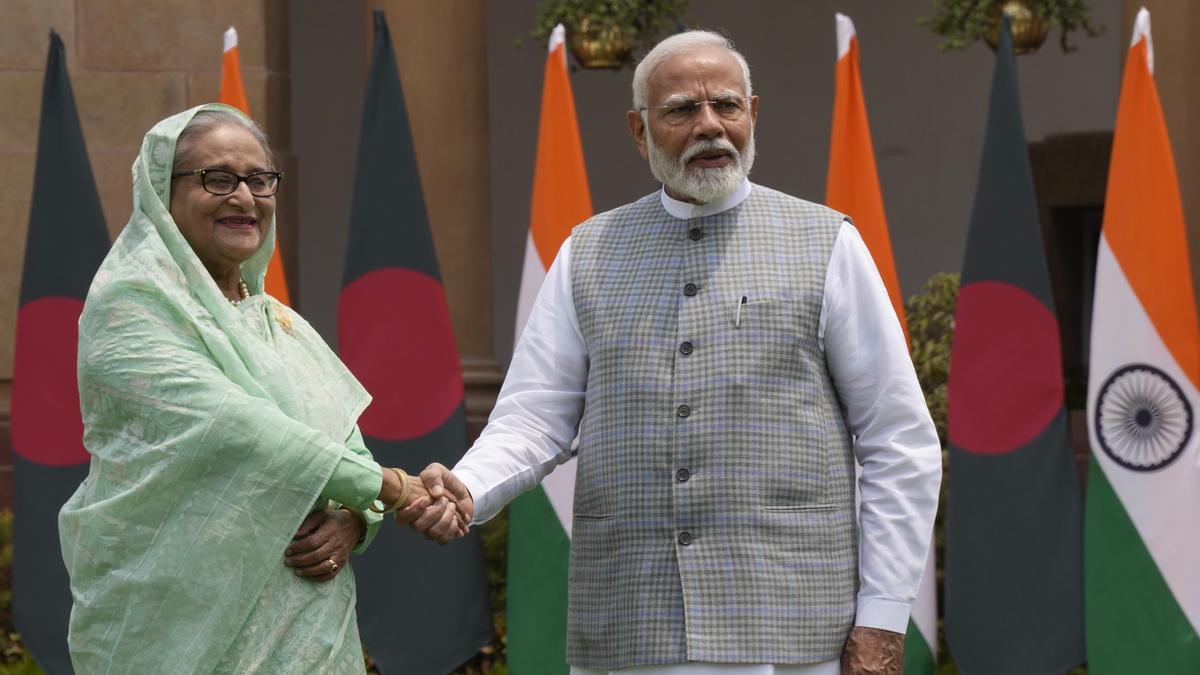
A week after protests in Bangladesh boiled over, forcing former Prime Minister Sheikh Hasina to flee to India, there’s little clarity about her future. While the Narendra Modi government has given her shelter, it has also moved to engage the regime that replaced the Awami League government, even as it counts the cost of Bangladesh’s political changes on India’s relations with the country.
Ms. Hasina’s removal from power in Bangladesh is no doubt a dramatic setback for India, as both countries have transformed ties on every front in the past decade and a half. The worry is that all the progress made on the economic front, border security, defence, and strategic ties, trade and connectivity, and linking people-to-people could be undone.
From her return to office (2009), Ms. Hasina made her intentions to forge strong ties with Delhi clear. She began a nationwide crackdown to shut down terror camps, a campaign against religious radicalisation, and extradited over 20 “most wanted” men accused of terrorism and crime to India. In sharp contrast to her predecessor Bangladesh Nationalist Party (BNP) Prime Minister Khaleda Zia’s government, Ms. Hasina also worked on ending border tensions caused by illegal immigration into India, particularly the 2001 incident where brutal BDR-BSF clashes left 15 dead. Several border patrolling agreements and the signing of the historic 2015 land boundary agreement followed.
In India, the Manmohan Singh government followed by the Modi government gave Bangladesh trade concessions and low-interest Lines of Credit to help Ms. Hasina take a country, once called the “basket case” of the global economy, to a developing country, that outstripped its neighbours on human development indices. India and Bangladesh worked on enhancing trade through connectivity, border ‘haats’, andrail, road and river links. This year Ms. Hasina and Mr. Modi even essayed new defence cooperation. Though Ms. Hasina’s government grew more and more authoritarian in the past decade, banning and arresting Opposition leaders, legislating tighter controls on the media, and filing hundreds of cases against any civil society group that criticised her, New Delhi remained steadfast in supporting her. In turn, Ms. Hasina stood with India on every issue, from boycotting SAARC (South Asian Association for Regional Cooperation) over terrorism from Pakistan, to the Citizenship Amendment Act that set off protests in Bangladesh.
Bangladesh has become a lynchpin to India’s regional connectivity plans to Southeast Asia and the Indo-Pacific, and an important buyer of Indian energy off the subcontinental grid. The worry is that many of the agreements signed, including the most recent power agreement with the Adani group, will now be reviewed.
New Delhi has shown that it continues to engage the interim government and any future elected government in Dhaka. The Indian High Commissioner in Dhaka, Pranay Verma, attended the swearing-in ceremony of the new interim government led by Muhammad Yunus.


The government plans to amend the FCRA, introducing new regulations for NGO asset management and accountability for key functionaries.

The draft policy for “Responsible Digital Use Among Students”, released on Monday by the Department of Health and Family Welfare, has recommended that parents set structured routines with clear screen-time rules and prioritise privacy, safety, and open conversation with children on digital well-being.

Police Observer Sushant Kumar Saxena conducts surprise inspection at Shencottai police station, reviewing warrants and security arrangements ahead of elections.

Andhra Pradesh government to launch key projects in April, focusing on industrial growth and infrastructure development, says Nara Lokesh.

Lok Sabha refers the Corporate Laws (Amendment) Bill to a JPC amid opposition concerns over CSR provisions dilution.

SHG members in Kanniyakumari use snakes and ladders to raise election awareness and boost voter turnout.

Government accelerates consultations for early implementation of the Women’s Reservation Act to ensure women’s representation in 2029 elections.

CM A. Revanth Reddy distributes ₹1 crore insurance cheques to families of deceased Electricity department employees, enhancing financial security for workers.

The Bengaluru Traffic Police (BTP) registered 634 cases of drunk driving during a week-long special enforcement drive conducted across the city between March 16 and March 22.

GHMC intensifies action against property tax defaulters, seizing properties and offering a One Time Settlement scheme for payments.

CCB arrests three drug peddlers in Mangaluru, seizing ₹2.5 lakh worth of MDMA and other valuables.

TVK's 28 candidates in Puducherry include former BJP MLAs, a sitting Independent, and a retired police IG.

BRS submits notice on private member bill to Speaker