How are Indian firms training LLMs? | Explained
The Hindu
Explore how Indian firms are training Large Language Models, overcoming challenges with data, capital, and innovative architectures.
The story so far:
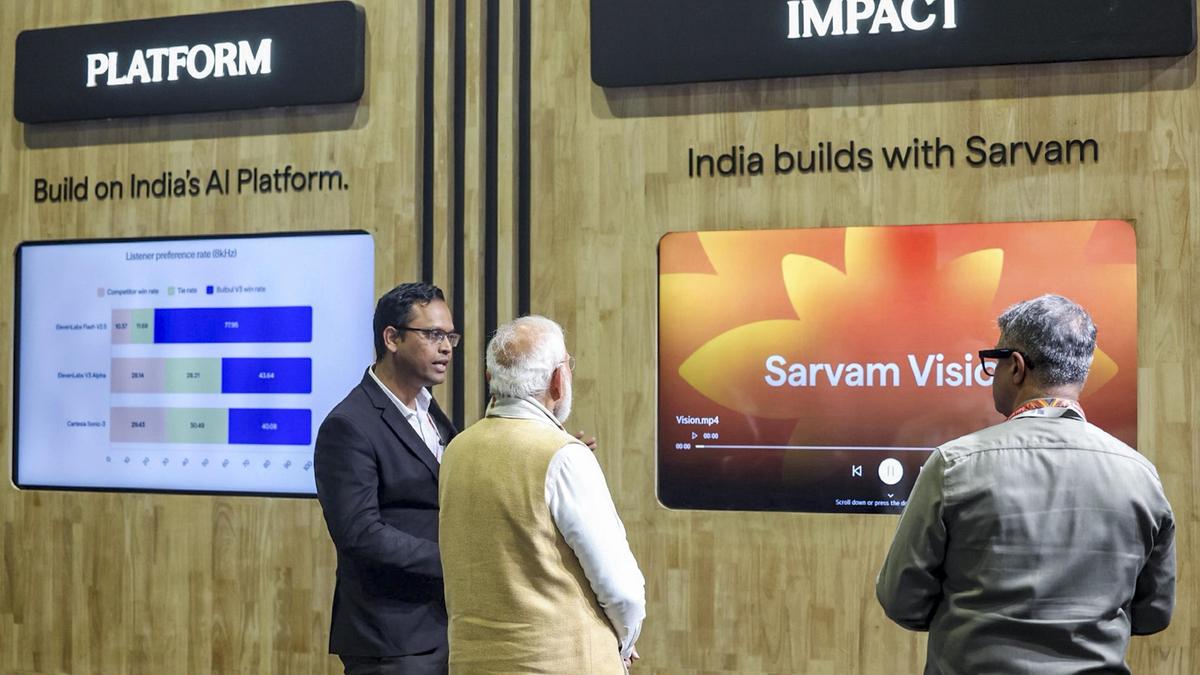
At the AI Impact Summit, the Bengaluru-based startup Sarvam AI released two Large Language Models (LLMs), which are the foundation for AI systems that power services like Google’s Gemini and OpenAI’s ChatGPT. The two models were trained on 35 billion and 105 billion parameters respectively, and were less power- and compute-intensive than comparable models, while demonstrating improvements over other models in Indian languages, Pratyush Kumar, a Sarvam co-founder said.
LLMs are trained and operated on clusters of Graphics Processing Units (GPUs). The combined cost of the GPUs and the electricity needed to run them long enough to train a model, run into millions of dollars. The grist for this mill is data, largely scraped from the Internet, where English, European languages and East Asian languages like Korean and Japanese are more richly represented than Indian languages.
This creates a twofold challenge for training an LLM on Indian soil with Indian capital: for one thing, with scarce data sources, many LLMs either perform worse when operating on Indian languages, or burn more “tokens” on inference to translate sentences into English (and translating responses back) to perform better. Since machine translation has improved dramatically for Indian languages, this remains the gold standard for many LLMs. Secondly, since capital is also scarce, efforts to train an LLM by Indian firms targeting Indian users can be challenging, especially if there is no immediate business use case for doing so.
Using translations as a fulcrum can be a challenge for developers who want to leverage local LLMs — like Sarvam’s 35 billion parameter model, which was shown off in a demo during the summit’s research symposium working on a feature phone — where suboptimal performance in Indian languages can impact adoption and quality of performance.
The IndiaAI Mission has subsidised efforts to conduct training in India, by commissioning over 36,000 GPUs in data centres operated by Indian firms like Yotta, and allowing researchers and startups to run training and inference workloads at a relatively nominal fee. The government gave Sarvam access to 4,096 GPUs from its common compute cluster, and the subsidy so far is estimated at almost ₹100 crore. The “bill of materials” for this cluster is ₹246 crore, though these GPUs can probably be continued to be used by others.


The government plans to amend the FCRA, introducing new regulations for NGO asset management and accountability for key functionaries.

The draft policy for “Responsible Digital Use Among Students”, released on Monday by the Department of Health and Family Welfare, has recommended that parents set structured routines with clear screen-time rules and prioritise privacy, safety, and open conversation with children on digital well-being.

Police Observer Sushant Kumar Saxena conducts surprise inspection at Shencottai police station, reviewing warrants and security arrangements ahead of elections.

Andhra Pradesh government to launch key projects in April, focusing on industrial growth and infrastructure development, says Nara Lokesh.

Lok Sabha refers the Corporate Laws (Amendment) Bill to a JPC amid opposition concerns over CSR provisions dilution.

SHG members in Kanniyakumari use snakes and ladders to raise election awareness and boost voter turnout.

Government accelerates consultations for early implementation of the Women’s Reservation Act to ensure women’s representation in 2029 elections.

CM A. Revanth Reddy distributes ₹1 crore insurance cheques to families of deceased Electricity department employees, enhancing financial security for workers.

The Bengaluru Traffic Police (BTP) registered 634 cases of drunk driving during a week-long special enforcement drive conducted across the city between March 16 and March 22.

GHMC intensifies action against property tax defaulters, seizing properties and offering a One Time Settlement scheme for payments.

CCB arrests three drug peddlers in Mangaluru, seizing ₹2.5 lakh worth of MDMA and other valuables.

TVK's 28 candidates in Puducherry include former BJP MLAs, a sitting Independent, and a retired police IG.

BRS submits notice on private member bill to Speaker