Explained | What are the ambiguities in India’s nuclear liability law?
The Hindu
How India’s nuclear liability law is making suppliers vary of setting up shop in India
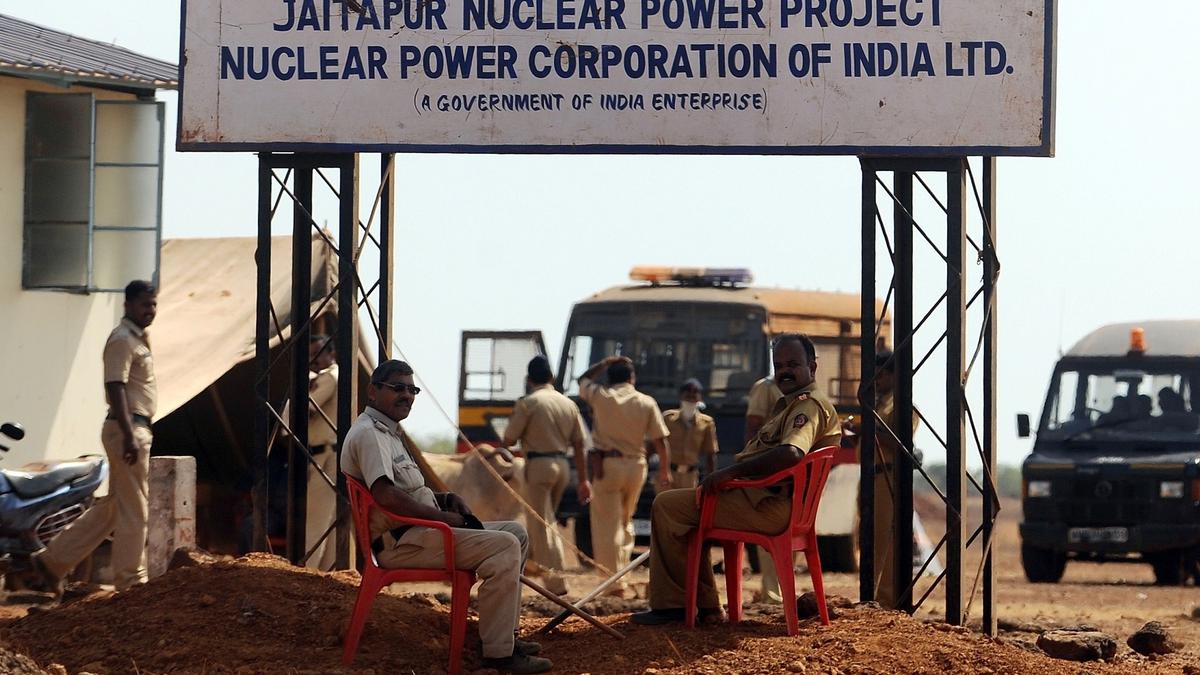
The story so far: The issues regarding India’s nuclear liability law continue to hold up the more than a decade-old plan to build six nuclear power reactors in Maharashtra’s Jaitapur, the world’s biggest nuclear power generation site under consideration at present. An official at the French energy company Electricite de France (EDF), which submitted its techno-commercial offer for the construction of the 9,900 MW project two years ago, told The Hindu that the issues arising out of the liability law “would have to be solved before any contract” could be signed with India.
Laws on civil nuclear liability ensure that compensation is available to the victims for nuclear damage caused by a nuclear incident or disaster and set out who will be liable for those damages. The international nuclear liability regime consists of multiple treaties and was strengthened after the 1986 Chernobyl nuclear accident. The umbrella Convention on Supplementary Compensation (CSC) was adopted in 1997 with the aim of establishing a minimum national compensation amount. The amount can further be increased through public funds, (to be made available by the contracting parties), should the national amount be insufficient to compensate the damage caused by a nuclear incident.
Even though India was a signatory to the CSC, Parliament ratified the convention only in 2016. To keep in line with the international convention, India enacted the Civil Liability for Nuclear Damage Act (CLNDA) in 2010, to put in place a speedy compensation mechanism for victims of a nuclear accident. The CLNDA provides for strict and no-fault liability on the operator of the nuclear plant, where it will be held liable for damage regardless of any fault on its part. It also specifies the amount the operator will have to shell out in case of damage caused by an accident at ₹1,500 crore and requires the operator to cover liability through insurance or other financial security. In case the damage claims exceed ₹1,500 crore, the CLNDA expects the government to step in and has limited the government liability amount to the rupee equivalent of 300 million Special Drawing Rights (SDRs) or about ₹2,100 to ₹2,300 crore. The Act also specifies the limitations on the amount and time when action for compensation can be brought against the operator.
India currently has 22 nuclear reactors with over a dozen more projects planned. All the existing reactors are operated by the state-owned Nuclear Power Corporation of India Limited (NPCIL).
The international legal framework on civil nuclear liability, including the annex of the CSC is based on the central principle of exclusive liability of the operator of a nuclear installation and no other person. In the initial stages of the nuclear industry’s development, foreign governments and the industry agreed that excessive liability claims against suppliers of nuclear equipment would make their business unviable and hinder the growth of nuclear energy, and it became an accepted practice for national laws of countries to channel nuclear liability to the operators of the plant with only some exceptions. Two other points of rationale were also stated while accepting the exclusive operator liability principle — one was to avoid legal complications in establishing separate liability in each case and the second was to make just one entity in the chain, that is the operator to take out insurance, instead of having suppliers, construction contractors and so on take out their own insurance.
Section 10 of the annex of the CSC lays down “only” two conditions under which the national law of a country may provide the operator with the “right of recourse”, where they can extract liability from the supplier — one, if it is expressly agreed upon in the contract or two, if the nuclear incident “results from an act or omission done with intent to cause damage”.
However, India, going beyond these two conditions, for the first time introduced the concept of supplier liability over and above that of the operator’s in its civil nuclear liability law, the CLNDA. The architects of the law recognised that defective parts were partly responsible for historical incidents such as the Bhopal gas tragedy in 1984 and added the clause on supplier liability. So, apart from the contractual right of recourse or when “intent to cause damage” is established, the CLNDA has a Section 17(b) which states that the operator of the nuclear plant, after paying their share of compensation for damage in accordance with the Act, shall have the right of recourse where the “nuclear incident has resulted as a consequence of an act of supplier or his employee, which includes supply of equipment or material with patent or latent defects or sub-standard services”.


The government plans to amend the FCRA, introducing new regulations for NGO asset management and accountability for key functionaries.

The draft policy for “Responsible Digital Use Among Students”, released on Monday by the Department of Health and Family Welfare, has recommended that parents set structured routines with clear screen-time rules and prioritise privacy, safety, and open conversation with children on digital well-being.

Police Observer Sushant Kumar Saxena conducts surprise inspection at Shencottai police station, reviewing warrants and security arrangements ahead of elections.

Andhra Pradesh government to launch key projects in April, focusing on industrial growth and infrastructure development, says Nara Lokesh.

Lok Sabha refers the Corporate Laws (Amendment) Bill to a JPC amid opposition concerns over CSR provisions dilution.

SHG members in Kanniyakumari use snakes and ladders to raise election awareness and boost voter turnout.

Government accelerates consultations for early implementation of the Women’s Reservation Act to ensure women’s representation in 2029 elections.

CM A. Revanth Reddy distributes ₹1 crore insurance cheques to families of deceased Electricity department employees, enhancing financial security for workers.

The Bengaluru Traffic Police (BTP) registered 634 cases of drunk driving during a week-long special enforcement drive conducted across the city between March 16 and March 22.

GHMC intensifies action against property tax defaulters, seizing properties and offering a One Time Settlement scheme for payments.

CCB arrests three drug peddlers in Mangaluru, seizing ₹2.5 lakh worth of MDMA and other valuables.

TVK's 28 candidates in Puducherry include former BJP MLAs, a sitting Independent, and a retired police IG.

BRS submits notice on private member bill to Speaker