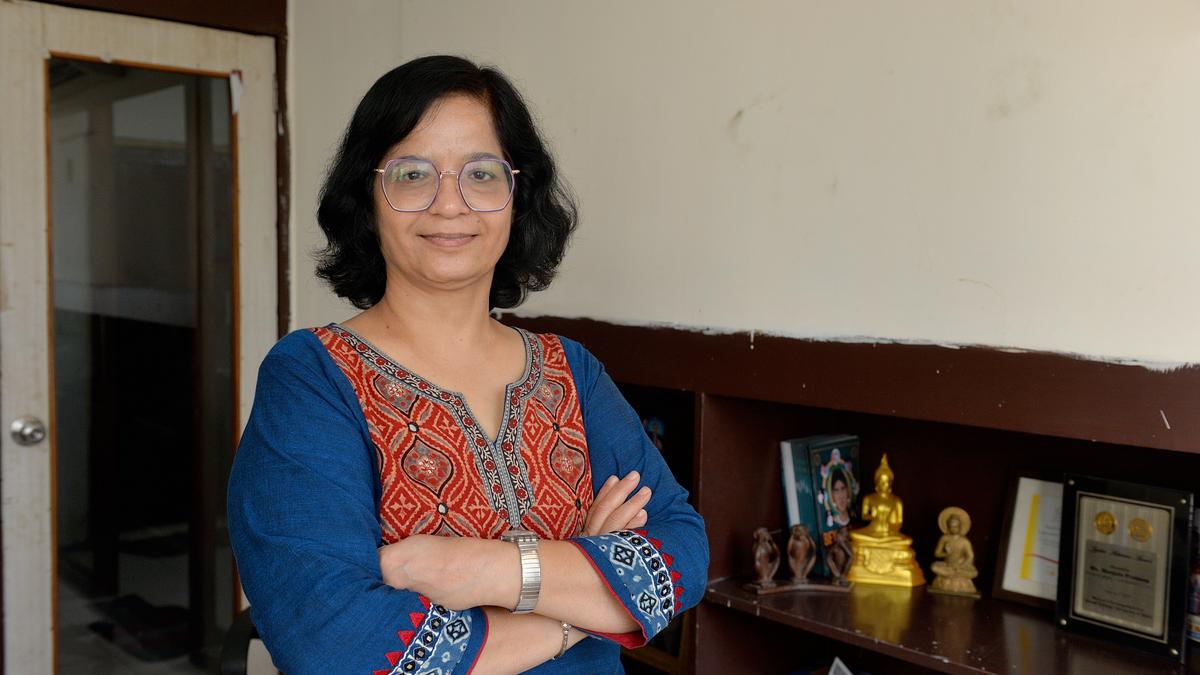
Column | Manjula Pradeep’s circle of care
The Hindu
Manjula Pradeep, a feminist and Dalit rights activist, fights for justice and dignity through legal battles and community empowerment.
It was 1993 and Manjula Pradeep’s fingers were flying over an electronic typewriter as she tried to make sense of the evidence, testimony and haunting postmortem report of a young Dalit man who had died of custodial torture. The victim’s mother had brought the case to Navsarjan Trust, Gujarat’s leading anti-caste grassroots organisation where Pradeep was a freshly minted postgraduate in social work. She had just joined as the NGO’s first female employee.
“I couldn’t understand some terms in the postmortem report and somebody asked me to read a medical jurisprudence textbook,” she says. “That was when I realised I needed to become a lawyer.”
For 30 years, Pradeep has been at the heart of the feminist and Dalit rights movement in Gujarat. As a lawyer and activist, she has been involved in many key legal cases that have shaped India’s modern history, playing a role in the battles for dignity and justice fought by Dalit men and women against an oppressive state. Pradeep, 55, never looks away, instead she holds survivors in a supportive embrace.
Another case that impacted her deeply occurred in 2008, when a teenager was raped repeatedly by six professors in a college. “The case was very important in my life,” she says. “We got a conviction in one year.” Fifty-six girls testified in court, and the public prosecutor, the judge and the investigating officer were all women. “After that, at Navsarjan, we handled many cases of sexual violence involving marginalised girls,” she says.
When members of a Dalit family who were skinning dead cattle were flogged by Hindus in Una, Gujarat, in 2016, it pushed Pradeep to become the first in her family to convert to Buddhism. The survivors later converted, too. Her deep involvement in the case was the last straw for a government that was allergic to anyone shining a spotlight on caste crimes. Pradeep, by then executive director at Navsarjan, had to leave the organisation after the backlash from the state, among other things.
Nine years later, she remains in close contact with the Una survivors — Vashram, Ramesh, Ashok and Bechar — all with the last name Sarvaiya. “If you make a commitment, you have to help the family until the end,” she says. She tracks their health issues, shows up in court to support them, and helps raise money for them. “Vashram wants something meaningful to be built at the place where he was beaten,” she says. “He’s put together a small troupe of children who sing songs of Ambedkar and dance during Navaratri festival.” Vashram has the support of Lalji Sarvaiya, whose brother Piyush was burnt alive by an upper caste mob. Six years later, in 2018, the 11 accused received a sentence of imprisonment until death. Pradeep was the social worker on this case, too.
Despite all her years of deep community involvement, she says it can feel very lonely sometimes. “Akeli hoon [I’m alone]. I feel bad sometimes, looking for resources, wondering how to change people’s understanding of movement-based work,” she says, adding that though the anti-caste movement has more resources now, the community connect hasn’t grown deeper. “We still have to organise ourselves, build more solidarities. Many are divided based on regional identity/ sub-castes and that is not good for the movement.”


The government plans to amend the FCRA, introducing new regulations for NGO asset management and accountability for key functionaries.

The draft policy for “Responsible Digital Use Among Students”, released on Monday by the Department of Health and Family Welfare, has recommended that parents set structured routines with clear screen-time rules and prioritise privacy, safety, and open conversation with children on digital well-being.

Police Observer Sushant Kumar Saxena conducts surprise inspection at Shencottai police station, reviewing warrants and security arrangements ahead of elections.

Andhra Pradesh government to launch key projects in April, focusing on industrial growth and infrastructure development, says Nara Lokesh.

Lok Sabha refers the Corporate Laws (Amendment) Bill to a JPC amid opposition concerns over CSR provisions dilution.

SHG members in Kanniyakumari use snakes and ladders to raise election awareness and boost voter turnout.

Government accelerates consultations for early implementation of the Women’s Reservation Act to ensure women’s representation in 2029 elections.

CM A. Revanth Reddy distributes ₹1 crore insurance cheques to families of deceased Electricity department employees, enhancing financial security for workers.

The Bengaluru Traffic Police (BTP) registered 634 cases of drunk driving during a week-long special enforcement drive conducted across the city between March 16 and March 22.

GHMC intensifies action against property tax defaulters, seizing properties and offering a One Time Settlement scheme for payments.

CCB arrests three drug peddlers in Mangaluru, seizing ₹2.5 lakh worth of MDMA and other valuables.

TVK's 28 candidates in Puducherry include former BJP MLAs, a sitting Independent, and a retired police IG.

BRS submits notice on private member bill to Speaker