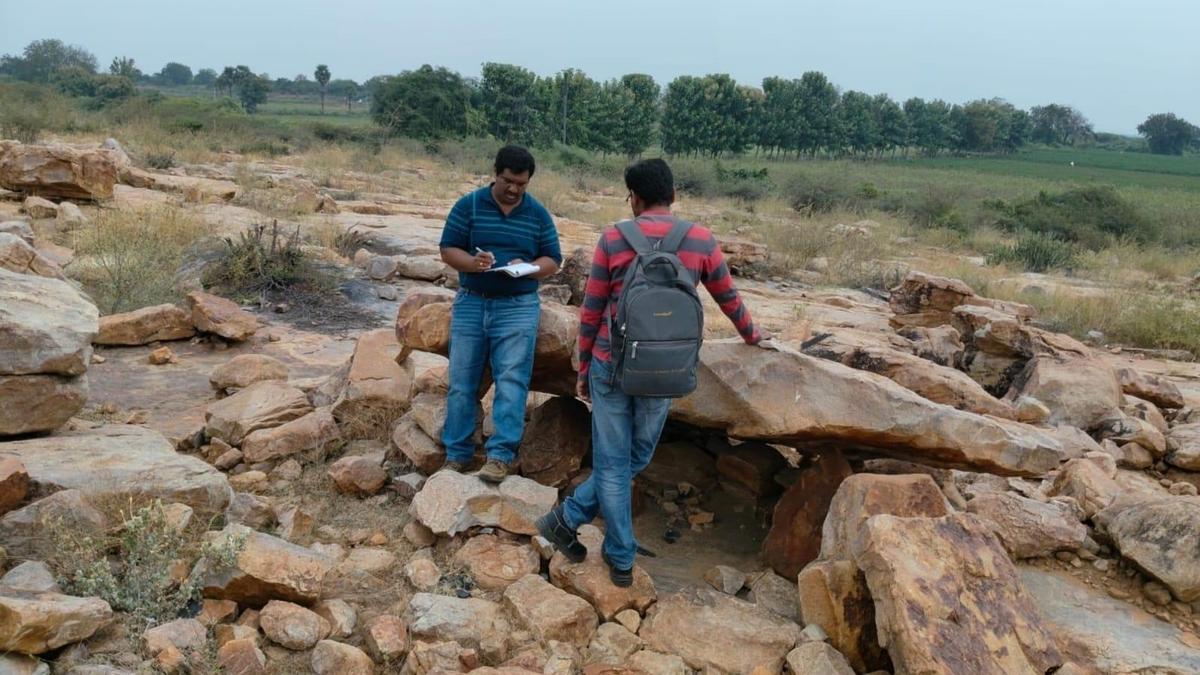
Cluster of megalithic burials identified in Palnadu, Andhra Pradesh
The Hindu
Archaeologists discover unique megalithic burials in Palnadu, Andhra Pradesh, revealing insights into ancient funerary practices and cultural evolution.
A distinctive cluster of megalithic burials featuring rare dolmens with deliberately sloping capstones has been identified at Pedda Anupu Chenchu Colony in Palnadu district of Andhra Pradesh, pointing to a locally evolved variant of South India’s megalithic tradition in the Lower Krishna Valley.
The finding emerges from recent field investigations by Dr. Sai Krishna Esarapu, Assistant Archaeologist with the Archaeological Survey of India (Hyderabad Circle), and Dr. Yadava Raghu, Assistant Professor of History at Sri Sathya Sai University for Human Excellence, Kalaburagi. The site, located barely 100 metres from the Chenchu tribal hamlet of Pedda Anupu and about five kilometres from the historic Nagarjunakonda complex, was surveyed in detail on November 30, 2025.
Researchers documented nearly 60 to 70 megalithic burials, including dolmens, cists with cairn packing, an oblong cist, a stone circle and a small anthropomorphic stone measuring about a metre in height. The most striking feature is the sloping capstone dolmens, where the front opening is elevated while the rear rests close to the ground — a departure from the conventional horizontal capstones commonly seen across the Deccan. Capstones at the site range between 2.5 and 3.15 metres in length.
The site lies on exposed quartzite bedrock of the Bairekonda Formation, part of the Cuddapah Supergroup, dating back nearly 1.6 billion years. According to the researchers, this geological context would have influenced both settlement patterns and construction techniques of the megalithic communities inhabiting the semi-arid margins of the Lower Krishna basin.
Significantly, traces of a disturbed Buddhist site were also noticed adjacent to the megalithic remains, including a broken ayaka pillar and large rectangular bricks damaged by farming activity. The archaeological evidence suggests continuous or overlapping human activity from the megalithic period to the Ikshvaku-era Buddhist phase, roughly spanning 1200 BCE to 300 CE.
The researchers have urged greater public awareness to protect the site, emphasising its importance in understanding regional cultural adaptations and ancient funerary practices.


The government plans to amend the FCRA, introducing new regulations for NGO asset management and accountability for key functionaries.

The draft policy for “Responsible Digital Use Among Students”, released on Monday by the Department of Health and Family Welfare, has recommended that parents set structured routines with clear screen-time rules and prioritise privacy, safety, and open conversation with children on digital well-being.

Police Observer Sushant Kumar Saxena conducts surprise inspection at Shencottai police station, reviewing warrants and security arrangements ahead of elections.

Andhra Pradesh government to launch key projects in April, focusing on industrial growth and infrastructure development, says Nara Lokesh.

Lok Sabha refers the Corporate Laws (Amendment) Bill to a JPC amid opposition concerns over CSR provisions dilution.

SHG members in Kanniyakumari use snakes and ladders to raise election awareness and boost voter turnout.

Government accelerates consultations for early implementation of the Women’s Reservation Act to ensure women’s representation in 2029 elections.

CM A. Revanth Reddy distributes ₹1 crore insurance cheques to families of deceased Electricity department employees, enhancing financial security for workers.

The Bengaluru Traffic Police (BTP) registered 634 cases of drunk driving during a week-long special enforcement drive conducted across the city between March 16 and March 22.

GHMC intensifies action against property tax defaulters, seizing properties and offering a One Time Settlement scheme for payments.

CCB arrests three drug peddlers in Mangaluru, seizing ₹2.5 lakh worth of MDMA and other valuables.

TVK's 28 candidates in Puducherry include former BJP MLAs, a sitting Independent, and a retired police IG.

BRS submits notice on private member bill to Speaker