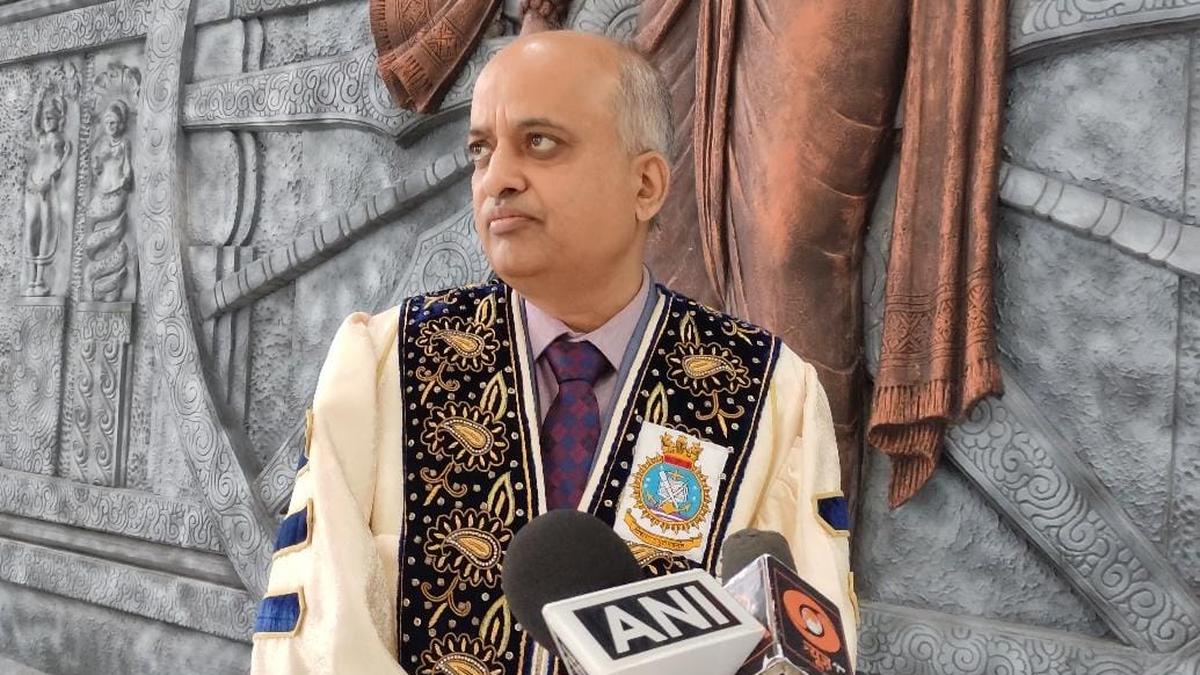
BrahMos chief stresses tri-sector collaboration to equip Navy cadets for tech-driven warfare
The Hindu
BrahMos Aerospace DG emphasizes collaboration for hands-on engineers in Indian Navy, praising Navy's adaptation to emerging technologies.
The Director General of BrahMos Aerospace, Jaitheerth E. Joshi, has emphasised the urgent need for a robust collaboration between defence research, academic institutions and industry to create hands on ready engineers, particularly for the Indian Navy and defence services.
Speaking to The Hindu, on sidelines of 25th convocation Ceremony held at Indian Naval Academy in Kannur on Friday (May 30, 2025), Dr. Joshi underlined the transformative role of emerging technologies, artificial intelligence and machine learning in modern warfare and praised the Navy’s proactive steps in adapting to these domains.
Highlighting the unique training needs of naval engineers, who often operate without ground support, Dr. Joshi said “Naval cadets trained in engineering must be prepared for on board roles without base service support. Whehter it’s rectification, testing or maintenance, they must operate independently. Our plan is to make self sufficient through advanced training modules.”
The vision he noted would be realised through training intiative run in coordination with the centres of excellence created by DRDO at IITs, NITs and institution like the Defence Institute of Armament Technology, along with close coordingation the Naval Academy.
Applauding the INA’s academic partnership with Jawaharlal Nehru University, he stressed that academic societies like the Indian Society for Non Destructive Testing and the Institute of Electronics, in collaboration with premier engineering institutions, can enhance skill development and bridge the gap between theoretical knowledge and practical defence needs.
“This will provide intensive internships and hands on training tailored to their respective engineering domains,” he said, citing a plan to assign mechanical engineer to missile or armament clusters and electronic gratuates to electronic warfare units. He described the initiative as tri-sector collaboration between academia, Research and Development and Industry.
Dr. Joshi also detailed a structured research and production model where academia handles initial research (Technology Readiness level (TRL) 1-3), applied resarch (TRL-4-6) is jointly undertaken with industry and advanced production stages (TRL-79_ are led by private manufacturers. “ This synergy ensures faster innovation and production readiness,” he said.


The government plans to amend the FCRA, introducing new regulations for NGO asset management and accountability for key functionaries.

The draft policy for “Responsible Digital Use Among Students”, released on Monday by the Department of Health and Family Welfare, has recommended that parents set structured routines with clear screen-time rules and prioritise privacy, safety, and open conversation with children on digital well-being.

Police Observer Sushant Kumar Saxena conducts surprise inspection at Shencottai police station, reviewing warrants and security arrangements ahead of elections.

Andhra Pradesh government to launch key projects in April, focusing on industrial growth and infrastructure development, says Nara Lokesh.

Lok Sabha refers the Corporate Laws (Amendment) Bill to a JPC amid opposition concerns over CSR provisions dilution.

SHG members in Kanniyakumari use snakes and ladders to raise election awareness and boost voter turnout.

Government accelerates consultations for early implementation of the Women’s Reservation Act to ensure women’s representation in 2029 elections.

CM A. Revanth Reddy distributes ₹1 crore insurance cheques to families of deceased Electricity department employees, enhancing financial security for workers.

The Bengaluru Traffic Police (BTP) registered 634 cases of drunk driving during a week-long special enforcement drive conducted across the city between March 16 and March 22.

GHMC intensifies action against property tax defaulters, seizing properties and offering a One Time Settlement scheme for payments.

CCB arrests three drug peddlers in Mangaluru, seizing ₹2.5 lakh worth of MDMA and other valuables.

TVK's 28 candidates in Puducherry include former BJP MLAs, a sitting Independent, and a retired police IG.

BRS submits notice on private member bill to Speaker