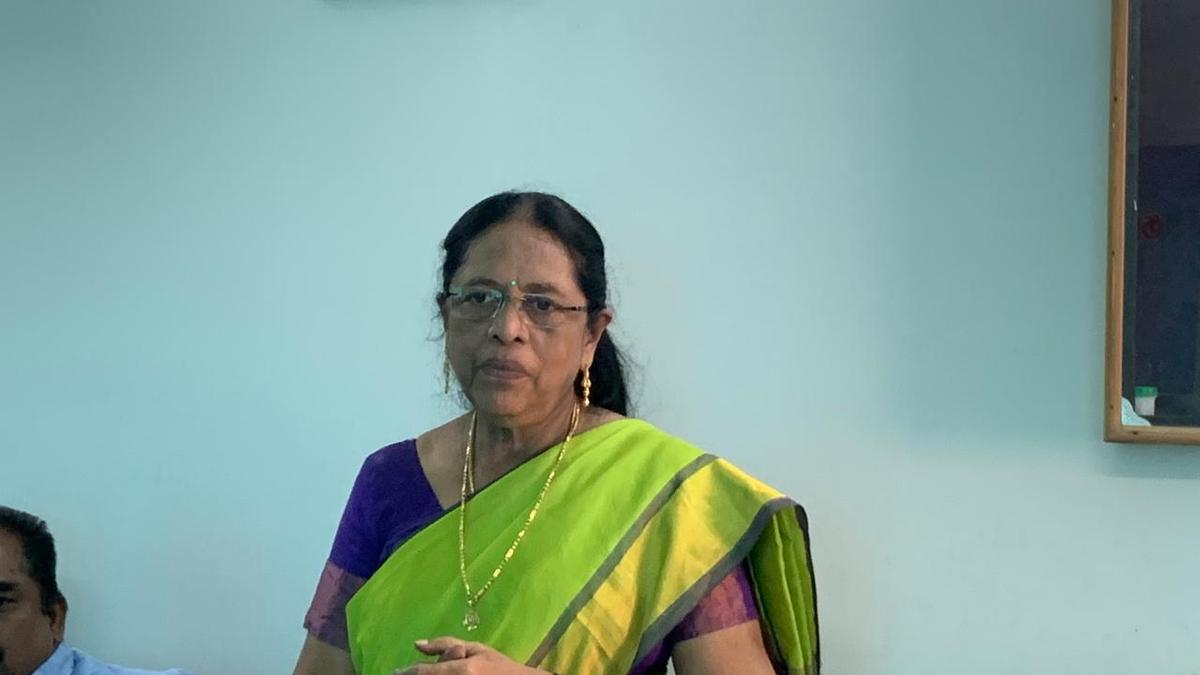
An earnest effort to stamp out child labour
The Hindu
Child rights activist Virgil D. Sami founded Arunodaya Centre to eradicate child labour through education and community empowerment.
“The image of the children coated in metal dust with yellow eyes, wearing only a trouser, is seared into my brain,” says Virgil D. Sami, 67, executive director of Arunodhaya Centre. She knew then that she should continue working with children to eradicate child labour. “From a very young age, I was interested in social work. I joined the NSS at school, and then I went for my Masters in Social Work,” says the Chennai-based child rights activist.
In 1979, while searching for a job, she met Lore Termehr, a German national who wanted to work with child labourers. “In those times, child labour wasn’t considered a problem. So we started a survey of children on the street who were rag-pickers or domestic workers. We worked with them to bring them out of it,” she adds. But the process was gradual as they needed to have access to education. They started evening schools so that the children would work in the morning.
When the Supreme Court ordered a survey of child labour, Ms. Virgil co-founded a network for child workers in Asia. This brought together organisations working to eradicate child labour for global solutions. “It was in 1992 when Lore wanted to retire, and I was at the crossroads. I realised that I wanted to stay. I wanted to show that child labour should be eliminated at any cost,” she adds.
She founded Arunodaya Centre. The 1979 survey showed that nearly 53% posts in the metal factories were filled with children. “We started at Korukkupet because I wanted to create a model life: child labour can be eradicated in the face of poverty. Korukkupet also had a lot of metal factories and there was no non-governmental organisation there. The remote area lacked transport and amenities,” she says.
Arunodaya Centre started with the children working in factories. Nearly 500 children would attend the evening school. “Within a year of its launch, a lot of children were brought out of work and enrolled in a bridge school. Five bridge schools were started initially and the number went up to 10. From the bridge schools, the students were enrolled in mainstream schools,” she says.
This shift had its own issues. For example, some teachers refused to work with them and the other students could not accept them. But the Tamil Nadu government’s Education Department stepped in and helped, she says. Today, Arunodaya Centre works with children, women, teachers, and the community to form their voice and find their space. “We believe in community empowerment and changing the attitude of the people. We have come to address various issues, from drug abuse among children to the attitude of parents,” she says. Arunodaya Centre has also started Children Nagar Sabhais for children to discuss issues that affect them and find solutions. “Children should be listened to, given space, and involved. We can see the change in their attitude,” she says.


The government plans to amend the FCRA, introducing new regulations for NGO asset management and accountability for key functionaries.

The draft policy for “Responsible Digital Use Among Students”, released on Monday by the Department of Health and Family Welfare, has recommended that parents set structured routines with clear screen-time rules and prioritise privacy, safety, and open conversation with children on digital well-being.

Police Observer Sushant Kumar Saxena conducts surprise inspection at Shencottai police station, reviewing warrants and security arrangements ahead of elections.

Andhra Pradesh government to launch key projects in April, focusing on industrial growth and infrastructure development, says Nara Lokesh.

Lok Sabha refers the Corporate Laws (Amendment) Bill to a JPC amid opposition concerns over CSR provisions dilution.

SHG members in Kanniyakumari use snakes and ladders to raise election awareness and boost voter turnout.

Government accelerates consultations for early implementation of the Women’s Reservation Act to ensure women’s representation in 2029 elections.

CM A. Revanth Reddy distributes ₹1 crore insurance cheques to families of deceased Electricity department employees, enhancing financial security for workers.

The Bengaluru Traffic Police (BTP) registered 634 cases of drunk driving during a week-long special enforcement drive conducted across the city between March 16 and March 22.

GHMC intensifies action against property tax defaulters, seizing properties and offering a One Time Settlement scheme for payments.

CCB arrests three drug peddlers in Mangaluru, seizing ₹2.5 lakh worth of MDMA and other valuables.

TVK's 28 candidates in Puducherry include former BJP MLAs, a sitting Independent, and a retired police IG.

BRS submits notice on private member bill to Speaker