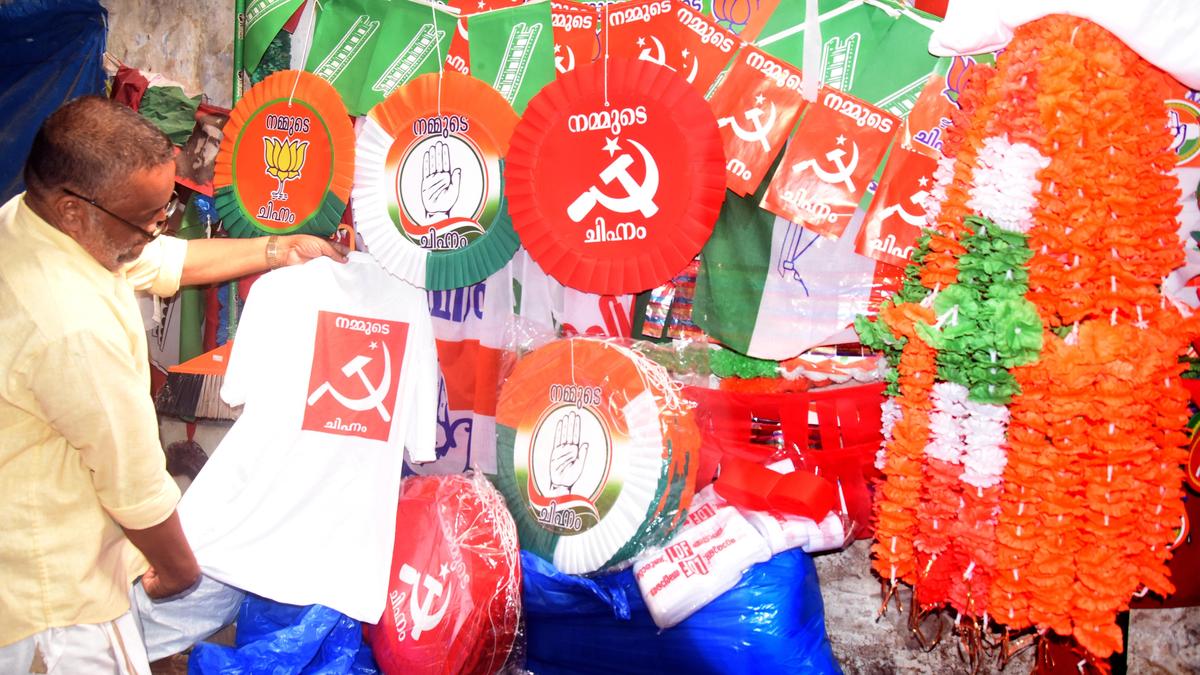
Women short-changed yet again as Kerala’s poll fronts refuse to change course
The Hindu
Kerala's political parties continue to marginalize women candidates, highlighting a troubling disconnect between gender demographics and representation.
As Kerala marches towards Assembly election, a stark and familiar contradiction has once again taken centre stage. Despite women outnumbering men in the final electoral rolls, the candidate lists released by the major political fronts tell a story of systemic exclusion.
Across the 140 constituencies, women remain a decimal point in a male-dominated power struggle, raising urgent questions about whether the State’s high literacy and social progress are merely veneer-deep when it comes to political empowerment. This persistent gender paradox suggests that while women are the primary drivers of Kerala’s high voter turnout, the winnability argument continues to be used by male-dominated party machineries to keep them away from the corridors of power.
The United Democratic Front (UDF) has faced sharp internal and external criticism for fielding only nine women out of 92 Congress candidates. When the candidates from constituent parties such as the Revolutionary Marxist Party and the Muslim League are also included, the total number of women candidates in the UDF reaches 12.
The situation is equally grim within the Left Democratic Front (LDF), which, despite its progressive rhetoric, has only nominated only 17 women across its constituent parties. While this 12% representation is a marginal improvement over previous years, it remains far below the threshold of meaningful empowerment, leaving the State’s legislative diversity stagnant. The National Democratic Alliance (NDA) has fielded around 14 women, and the overall narrative across all fronts remains one of exclusion.
Since the first Kerala Assembly in 1957, only 100 women have ever been elected to the house, a sobering statistic that highlights a systemic glass ceiling. While Kerala often stands as a beacon for human development, the gap between social indicators and political representation remains a stark irony, R.M. Amritaraj, a specialist in women’s studies at the Kerala Institute of Local Administration, points out.
“Despite Kerala’s celebrated achievements in health, literacy, sex ratio, and exceptionally low maternal and infant mortality rates, a significant representation gap persists. Although it is the only Indian State where women outnumber men, this demographic strength has never translated into political power; women have yet to cross the 10% threshold in either the State Assembly or Parliament,” he says.


Karnataka has entered a state of demographic transition where a large working-age population will no longer be enough to drive economic growth, and future gains will depend on how productively people are employed, the ‘State of Working India 2026’ report said.

Key demands in Sulur Assembly constituency include reviving the powerloom sector, addressing farmers' needs, and protecting River Noyyal.

Kodihalli urges Karnataka CM to allocate ₹10,000 crore revolving fund for seamless procurement of farm products under MSP scheme.

Kerala's political parties continue to marginalize women candidates, highlighting a troubling disconnect between gender demographics and representation.

The High Court of Karnataka on Tuesday ordered the issue of a notice to the State government on a PIL petition, which had complained about disturbances caused to people residing in the localities around the National Public School situated in Rajajinagar 5th block due to use of loudspeakers with high volume in the school and parking of school buses in residential areas.

China is extensively mapping ocean floors to enhance submarine warfare capabilities against the U.S. and allies across key oceans.

AIADMK's 2026 manifesto promises free rations, women's benefits, education reforms, and economic growth initiatives for Tamil Nadu.

The vehicle towing drive will soon resume in the city to ease traffic congestion. The Bengaluru Traffic Police (BTP), in coordination with the Greater Bengaluru Authority (GBA), is set to relaunch the vehicle towing drive across the city shortly to tackle traffic congestion and illegal parking.

Panic buying, not shortage, is leading to long queues at Hyderabad petrol pumps.

District Collector urges collective action against TB during World TB Day rally, highlighting screening efforts and patient support initiatives.

DMK finalises seat-sharing for the 2026 Tamil Nadu Assembly elections, contesting 175 seats with allies DMDK and VCK.

Collector V. Saravanan and Police Commissioner Kamini promote voter awareness through outreach programs and traditional events in Tiruchi.

Mysuru DC stresses precautionary measures to reduce road accidents, urging officials to identify and address high-risk areas.