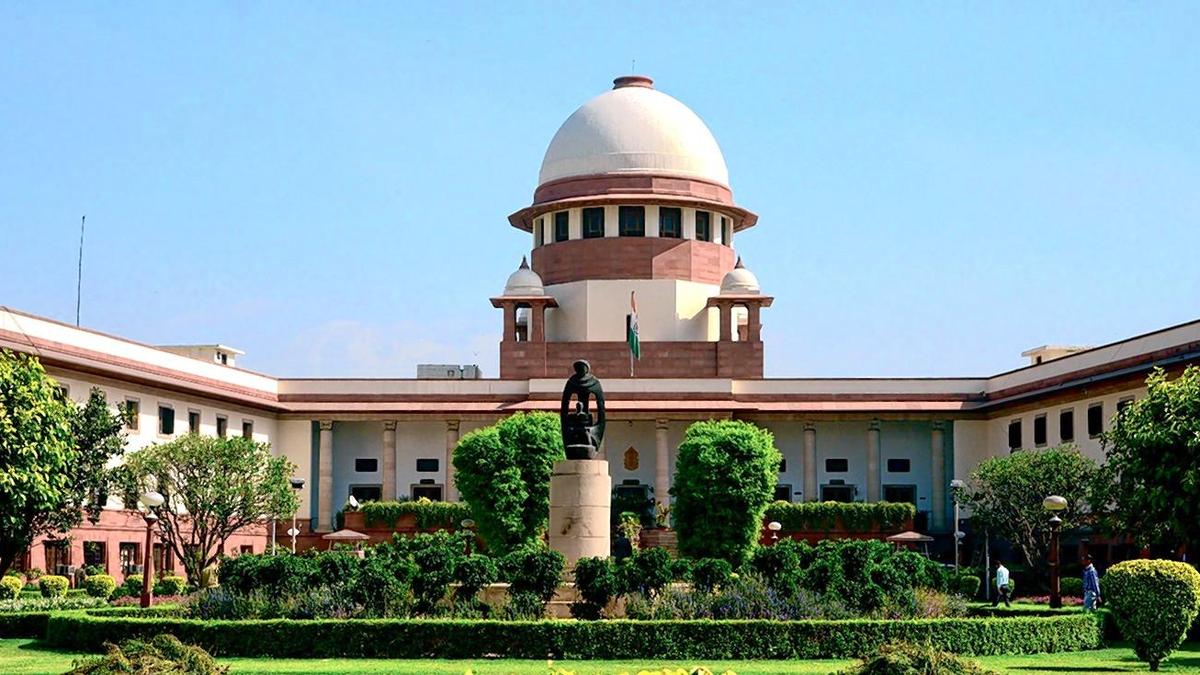
Court cannot sit in judgment on a community’s belief, says Travancore Devaswom Board
The Hindu
The Travancore Devaswom Board asserts that courts should respect community beliefs in its Supreme Court submission on Sabarimala's entry issue.
The Travancore Devaswom Board (TDB), which manages the Sabarimala temple in Kerala, filed written submissions in the Supreme Court on Tuesday (March 24, 2026) saying that beliefs and practices of a community have to be judged on the basis of the subjective belief of that community.
The Board’s submissions come ahead of the court’s review hearing from April 7 on the entry of women of menstrual age into the shrine.
“The Supreme Court is bound to accept the belief of the community, and it is not for the court to sit in judgment on that belief,” the TDB said.
Recently, the Kerala government had delicately moderated its earlier cast-iron stance in the Supreme Court in favour of entry of women of menstrual age into the shrine. The State government, in written submissions filed before the Supreme Court on March 14, said a judicial review of whether the age-old restriction on entry for women between menarche and menopause was an essential religious practice must not be guided by either reason or sentiment alone.
The State had said the court, instead, must carry out a studied assessment if the belief – that women of that age group should not appear before the temple deity, Lord Ayyappa in the celibate or Naishtika Brahmachari form – was a “genuine and conscientiously” held one.
The written submissions of senior advocate A.M. Singhvi filed by advocate P.S. Sudheer for the TDB, said any additional derogation of the right to freedom of religion on the ground of “essentiality”, as engrafted by “some judgments”, was impermissible.


Perundurai's industrial growth faces challenges of pollution, water scarcity, and healthcare, impacting residents ahead of the 2026 elections.

The Travancore Devaswom Board asserts that courts should respect community beliefs in its Supreme Court submission on Sabarimala's entry issue.

Karnataka cancels Deendayal Upadhyay event at KSOU due to protocol violations, citing inconsistency with university objectives.

Illegal pickle unit busted in Hyderabad, one arrested; unhygienic stock worth ₹3 lakh seized

Karnataka has entered a state of demographic transition where a large working-age population will no longer be enough to drive economic growth, and future gains will depend on how productively people are employed, the ‘State of Working India 2026’ report said.

Key demands in Sulur Assembly constituency include reviving the powerloom sector, addressing farmers' needs, and protecting River Noyyal.

Kodihalli urges Karnataka CM to allocate ₹10,000 crore revolving fund for seamless procurement of farm products under MSP scheme.

Kerala's political parties continue to marginalize women candidates, highlighting a troubling disconnect between gender demographics and representation.

The High Court of Karnataka on Tuesday ordered the issue of a notice to the State government on a PIL petition, which had complained about disturbances caused to people residing in the localities around the National Public School situated in Rajajinagar 5th block due to use of loudspeakers with high volume in the school and parking of school buses in residential areas.

China is extensively mapping ocean floors to enhance submarine warfare capabilities against the U.S. and allies across key oceans.

AIADMK's 2026 manifesto promises free rations, women's benefits, education reforms, and economic growth initiatives for Tamil Nadu.

The vehicle towing drive will soon resume in the city to ease traffic congestion. The Bengaluru Traffic Police (BTP), in coordination with the Greater Bengaluru Authority (GBA), is set to relaunch the vehicle towing drive across the city shortly to tackle traffic congestion and illegal parking.

Panic buying, not shortage, is leading to long queues at Hyderabad petrol pumps.