Industry thrives, but pollution and water scarcity haunt Perundurai constituency
The Hindu
Perundurai's industrial growth faces challenges of pollution, water scarcity, and healthcare, impacting residents ahead of the 2026 elections.
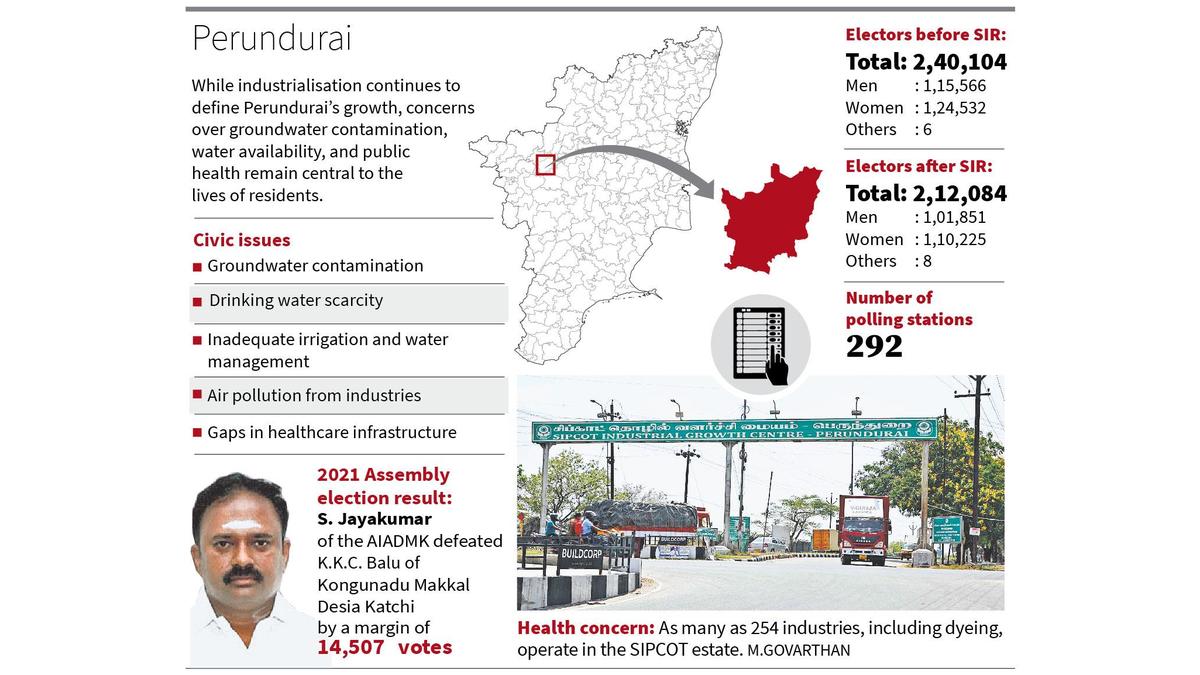
Industrial growth has brought economic activity to Perundurai constituency, but it has also deepened the crisis of pollution and water scarcity, with residents continuing to struggle for safe drinking water and reliable irrigation.
The constituency sustains over one lakh migrant labourers engaged in the SIPCOT Industrial Estate, the Special Economic Zone complex, textile mills, construction, powerloom units, and the hospitality sector, which form the backbone of the local economy. However, residents in surrounding villages say the benefits of industrialisation have come at a cost, as they continue to face environmental degradation.
Groundwater contamination remains a major concern. As many as 254 industries, including dyeing, bleaching, and tannery units, operate in the 2,663-acre SIPCOT estate. Effluents discharged by industries into Nalla Odai have mixed with nearby waterbodies and entered Odaikattur Lake and Punjai Palatholuvu Lake, all located within a 12-km radius of SIPCOT. Water samples from these sources show total dissolved solids (TDS) levels exceeding 5,000 mg/l, indicating severe deterioration in water quality over the years. This has led to serious health issues, including cancer, said S. Chinnasamy, coordinator of the Perundurai SIPCOT Affected People’s Welfare Association.
Tests conducted by the Tamil Nadu Pollution Control Board in 2025 across 37 groundwater sources under the Chennimalai Panchayat Union revealed high levels of TDS, nitrate, calcium, and magnesium. Authorities have installed red-marked boards in these locations declaring the water unfit for consumption. Residents say waterbodies have been affected for three decades, impacting both drinking water supply and agriculture. “Except for placing boards, groundwater remains contaminated,” said P. Kamatchi, a resident.
Following prolonged protests by residents and farmers, a CETP project estimated at ₹136.76 crore was sanctioned for SIPCOT. Though the foundation stone was laid last year, work began only recently and is expected to be completed within 18 months. However, concerns over air pollution persist, with coal continuing to be widely used in industrial boilers. Residents have also been demanding an increased supply of protected Cauvery water to meet drinking and domestic needs, Mr. Chinnasamy added.
The Athikadavu–Avinashi Irrigation, Groundwater Recharge and Drinking Water Supply Scheme has helped improve groundwater levels by refilling around 200 waterbodies. Farmers acknowledge the relief provided, particularly for irrigation. However, residents have sought the inclusion of at least 25 more waterbodies under the scheme to address persistent shortages. With the Lower Bhavani Project canal benefiting only a limited number of villages, agriculture remains dependent on rainfall.


Perundurai's industrial growth faces challenges of pollution, water scarcity, and healthcare, impacting residents ahead of the 2026 elections.

The Travancore Devaswom Board asserts that courts should respect community beliefs in its Supreme Court submission on Sabarimala's entry issue.

Karnataka cancels Deendayal Upadhyay event at KSOU due to protocol violations, citing inconsistency with university objectives.

Illegal pickle unit busted in Hyderabad, one arrested; unhygienic stock worth ₹3 lakh seized

Karnataka has entered a state of demographic transition where a large working-age population will no longer be enough to drive economic growth, and future gains will depend on how productively people are employed, the ‘State of Working India 2026’ report said.

Key demands in Sulur Assembly constituency include reviving the powerloom sector, addressing farmers' needs, and protecting River Noyyal.

Kodihalli urges Karnataka CM to allocate ₹10,000 crore revolving fund for seamless procurement of farm products under MSP scheme.

Kerala's political parties continue to marginalize women candidates, highlighting a troubling disconnect between gender demographics and representation.

The High Court of Karnataka on Tuesday ordered the issue of a notice to the State government on a PIL petition, which had complained about disturbances caused to people residing in the localities around the National Public School situated in Rajajinagar 5th block due to use of loudspeakers with high volume in the school and parking of school buses in residential areas.

China is extensively mapping ocean floors to enhance submarine warfare capabilities against the U.S. and allies across key oceans.

AIADMK's 2026 manifesto promises free rations, women's benefits, education reforms, and economic growth initiatives for Tamil Nadu.

The vehicle towing drive will soon resume in the city to ease traffic congestion. The Bengaluru Traffic Police (BTP), in coordination with the Greater Bengaluru Authority (GBA), is set to relaunch the vehicle towing drive across the city shortly to tackle traffic congestion and illegal parking.

Panic buying, not shortage, is leading to long queues at Hyderabad petrol pumps.