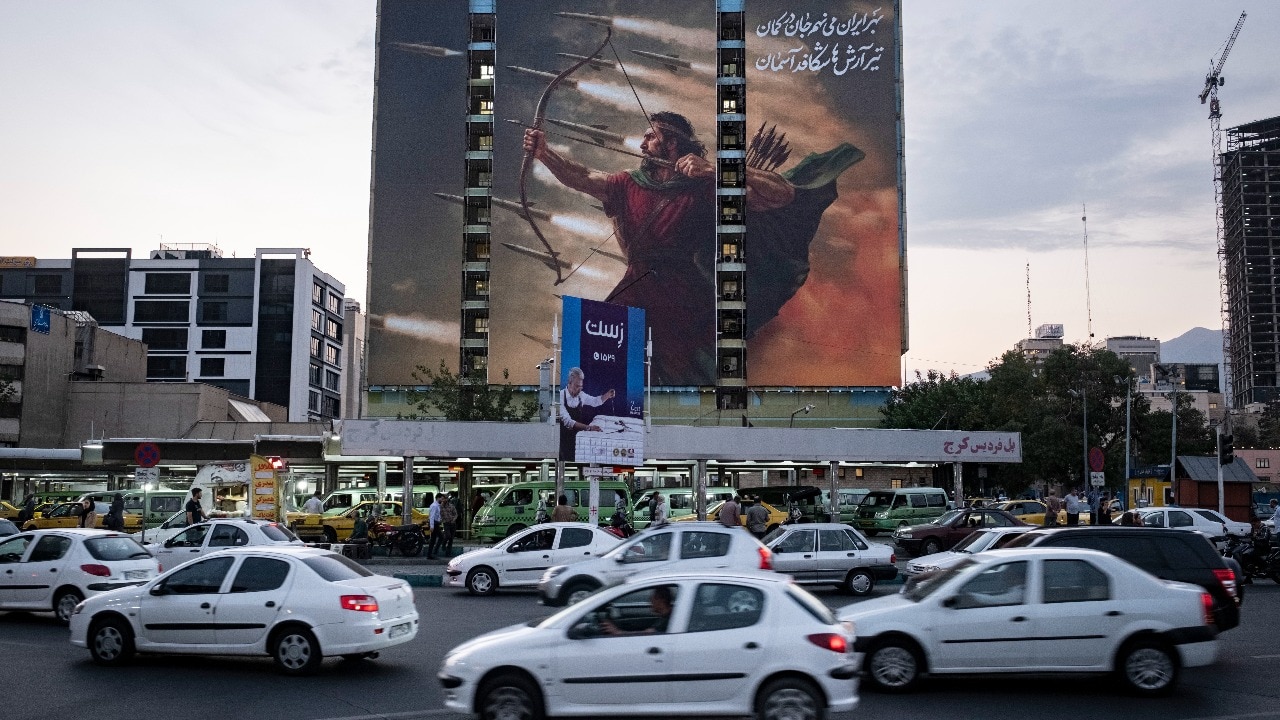
Why an Iran at war draws strength from pre-Islamic Persian warriors
India Today
Images of pre-Islamic Zoroastrian kings and warriors have been unveiled in Iran, evoking courage and resilience. Many say the Ayatollah regime in Iran revives the country's Persian identity during conflicts with Israel and the US. But this Persian heritage has always run deep, and is visible from time to time, in both dissent and unity.
Wearing a Faravahar locket, a Zoroastrian symbol of a guardian spirit, would be considered haraam by the Muslim community globally. But that's not the case in Iran — the world's largest Shia Muslim nation, with over 90% of its population following Islam. Experts of the Persian culture say the Zoroaster insignia is sold openly across Iran, and even worn by many Shias. That's how multifaceted cultural identity is in the country. Today, amid the war with Israel and the US, these Persian roots have seemingly strengthened Iran's resolve.
The Faravahar is just one of the examples of Iran's Persian roots showing through. Images of Achaemenid soldiers, from one of ancient Persia's greatest empires; statues and posters of the legendary archer Arash, a symbol of sacrifice; and Rostam, a hero from Persian mythology — all have appeared in Iran, from billboards to TV programmes, or in the form of statues.
Before the Arab conquest of Iran, the land saw a thousand-year rule by Zoroastarian empires, beginning with the Achaemenid Empire of Cyrus the Great. These pre-Islamic empires were among the biggest of their times. And while the Caliphates merged Iran with the Arabian empire, the Zoroastrian roots remained deep.
Persian heritage in Iran runs so deep it surfaces in both dissent and unity. A Farahavar symbol at a Zoroastrian temple in Iran's Yazd, one of the oldest continuously inhabited cities in the world. (Image: Unsplash)
For centuries, the Zoroastrian heritage and symbols remained key for Iranians to assert their distinct identity from the Arabs. Even the Shahs of Iran used the old Persian empires to justify their rule in Iran from 1925 to 1979, when the Iranian Revolution was used to usher in the Ayatollah regime.
In recent years too, whenever Iranians have protested against the clerical regime, slogans have been raised in support of the Shah's rule, which was overthrown in 1979 during the Enqelab-e Eslami, aka the Islamic Revolution. In some such protests, crowds were dotted with symbols like the Lion and Sun flags, also rooted in Iran's pre-Islamic identity.


A video posted by Shivani Shukla has received over 4 million views, showing her parents waving and communicating through a CCTV camera she installed to check on them after moving to another city.

Amid a dire energy crisis triggered by the choking of the Strait of Hormuz, Islamabad has cancelled the celebrations and the parade scheduled for Pakistan Day. The March 23 observance will now be marked with "simplicity and dignity", said Pakistani PM Shahbaz Sharif's office, as fuel shortages and soaring costs hit the people hard.

A video featuring an Indian couple meeting briefly at a metro station in the UK has drawn attention to the realities faced by couples working opposite shifts abroad.


With Dhurandhar: The Revenge set for a March 18 release, the internet is abuzz with jokes and memes, especially about the film's nearly four-hour runtime.


A couple's decision to stage their pre-wedding photo shoot in a pond has gone viral, with the shoot's unusual setting sparking amusement online.

The President of Finland joined other global voices to suggest that India should mediate in the Iran-US-Israel war. Here's why India, a major economy with warm ties with Washington, Jerusalem, and Iran, and a heritage of non-alignment and strategic autonomy, might be the best bet to broker peace.

A Shillong school choir's lively rendition of Legends by The Score has gone viral, with students blending instruments and vocals in a classroom performance that won hearts online.

To support his argument, he also referred to the death of the former Supreme Leader, Ayatollah Ali Khamenei, in a US-Israeli strike on February 28. "Even the (Supreme) Leader was martyred, yet the system continued its work," he said.

Dr Pratibha Nikhar Juneja shares a heartfelt account of treating her former medical college teacher, describing the moment as both special and deeply meaningful.

The instruction from the university came as China seeks to boost birth rates, which dropped to a record low in 2025.

The Department of Homeland Security (DHS) is using posters with images of India's Taj Mahal to promise free tickets and a cash payout of $2,600 to undocumented immigrants who voluntarily deport themselves from the US. Ironically, a monument for love has been turned into one of hate for immigrants.