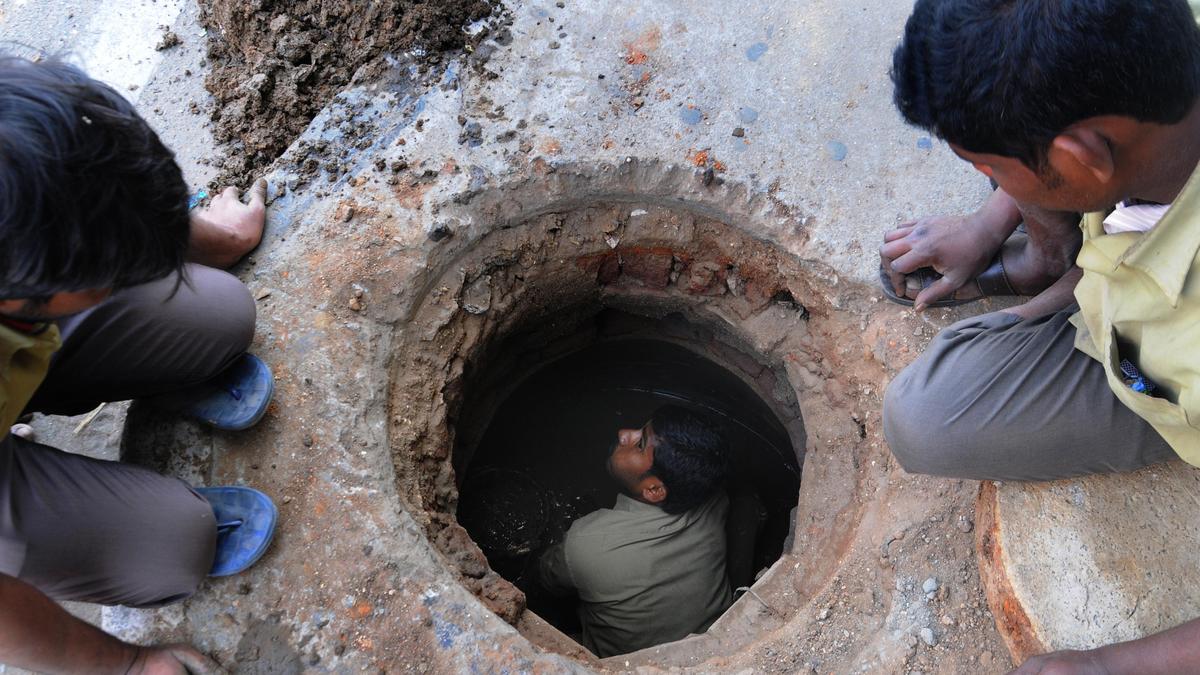
The human cost of sanitation
The Hindu
Explore the hidden struggles and systemic failures impacting Karnataka's manual scavengers under the 2013 Prohibition Act.
Under the Prohibition of Employment as Manual Scavengers and their Rehabilitation Act, 2013, a manual scavenger is defined as a person engaged in manually cleaning human excreta from an “insanitary latrine, railway track or other notified spaces” before the excreta decomposes.
While Karnataka has officially identified around 7,400 manual scavengers after the enactment of the Prohibition of Employment as Manual Scavengers and their Rehabilitation Act, 2013, the exercise, meant to be a turning point in their life, has failed to help them have a sustained livelihood.
In cases without identification, statutory entitlements become inaccessible. Under Section 13(1)(b) of the Act, identified manual scavengers are entitled to ₹40,000 as initial cash assistance, followed by skill development training and financial support for alternative livelihoods. But, even this limited assistance is not there. Former workers argue that even where compensation is disbursed, it does little to provide security.
In this series, we trace the unseen lives of the State’s sanitation workers, capturing the human cost, systemic failures, and hidden labour that keeps the sanitation network functioning.


Nephrologist Georgi Abraham receives the Karl D. Nolph Lifetime Achievement Award for his impact on kidney care in India.

Seven individuals in Erode district received the Community Conservation Leadership Award for their exceptional contributions to environmental and wildlife protection.

Explore the hidden struggles and systemic failures impacting Karnataka's manual scavengers under the 2013 Prohibition Act.

At India’s first heritage hotel, Ajit Bhawan in Jodhpur, chefs are reviving the palace’s recipes by slow cooking meat in the mud, sourcing ingredients from nearby villages and highlighting simple flavours — proving that true luxury lies in patience

Telugu tourists stranded in Bahrain may soon be relocated to Dammam, Saudi Arabia, for their journey back to India.

Smart water management system launched in Erode enhances drinking water quality and efficiency with IoT technology at 16 tanks.

T20 World Cup 2026 semi-final LIVE: Follow The Hindu's blog on the T20 World Cup 2026 semi final match between South Africa and New Zealand.

Mettur Dam's water level is at 86.72 feet, with inflow at 162 cusecs and discharge at 2,500 cusecs.

Eerie silence grips Nanguneri following a caste-related double murder, igniting tensions among local communities and police investigations.

Telangana man injured near Abu Dhabi airport; parents urge government for his safe return amid regional conflict.

The Hindu's Daily Quiz on March 4, 2026

Kerala researchers develop land-based nurseries for coral conservation, aiming to enhance growth before reintroducing corals to their natural habitat.

Japan and the U.S. plan to include a nuclear power project in a $550 billion investment package to enhance energy security.