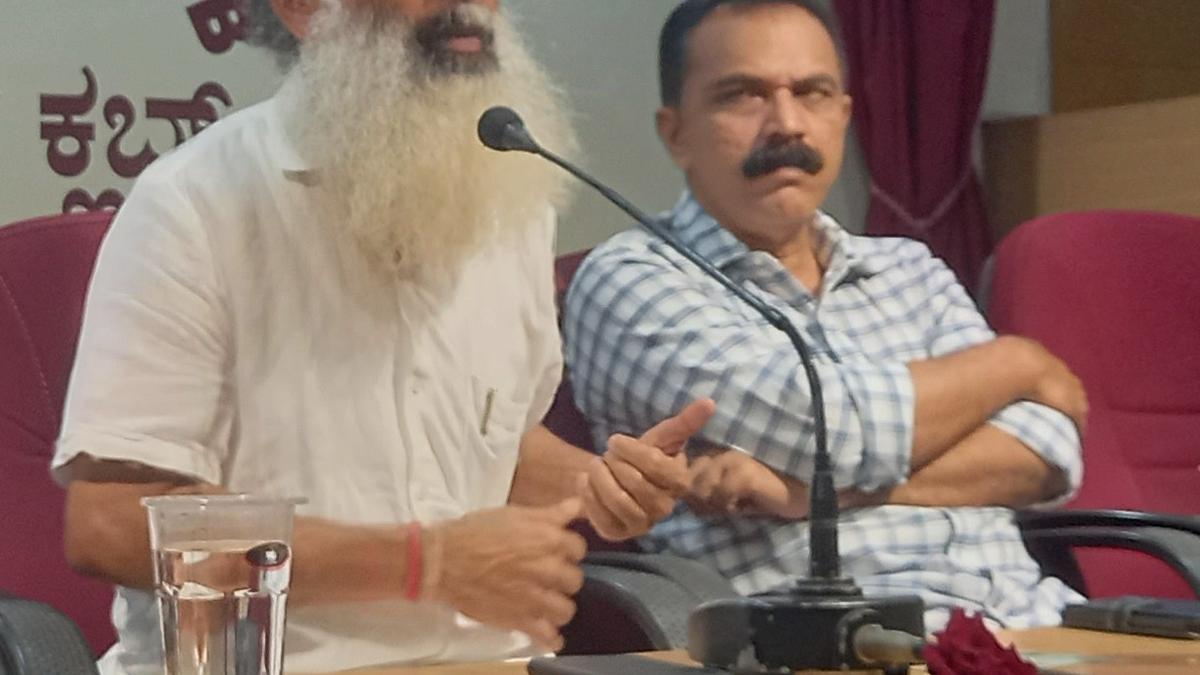
‘It is necessary to have combination of shrubs, flowers, timber and canopy in building forest’
The Hindu
Expressing his opposition to the plain adoption of Japanese botanist Akira Miyawaki’s system of planting, industrialist-turned-green activist Radhakrishna K. Nair said it is necessary to plant local saplings that include shrubs, flowers, timber and canopy in an area.
Expressing his opposition to the plain adoption of Japanese botanist Akira Miyawaki’s system of planting, industrialist-turned-green activist Radhakrishna K. Nair said it is necessary to plant local saplings that include shrubs, flowers, timber and canopy in an area.
Mr. Nari, 53, a native of Sullia taluk in Dakshina Kannada, is credited with developing 121 urban forest patches across the country, including the Smriti Vana in 470 acres of Bhujia Hills in Bhuj region of Gujarat. He said it is necessary to maintain the combination that creates biodiversity.
“With my system of planting, which I call as Bharath dense forest, many barren land portions have turned green,” he said.
Speaking at the 20th ‘Press Club Guest of Honour’ programme organised by the Mangaluru Press Club on Tuesday, Mr. Nair referred to greening for developing Smriti Vana, which is in homage to 13,000 victims of the Gujarat earthquake. As many as 5.25 lakh saplings have been planted.
“There are 50 check dams in which more than 1,000 species of fish are found. More than 100 species of birds are noticed here. If you protect nature, nature has the capacity to recreate itself,” he said.
Mr. Nair said he took up greening in 2012 after noticing the cutting down of massive trees in Umargam in Gujarat, where he moved from Sullia and set up a garment export unit. So far, he has set up 121 dense urban forest patches and the 122nd forest patch is coming up in Pali in Rajasthan.
As many as 72 urban forest patches, including one in a chemical dumpyard, are in Mumbai. A dumping yard in Vijayawada has been turned green, he said.


GHMC intensifies action against property tax defaulters, seizing properties and offering a One Time Settlement scheme for payments.

CCB arrests three drug peddlers in Mangaluru, seizing ₹2.5 lakh worth of MDMA and other valuables.

TVK's 28 candidates in Puducherry include former BJP MLAs, a sitting Independent, and a retired police IG.

BRS submits notice on private member bill to Speaker

CPI-M accepts DMK's five-seat offer for Tamil Nadu Assembly elections, prioritizing INDIA bloc unity over seat demands.

Ricky Rai, son of former underworld operative Muthappa Rai, on Monday appeared before the Bengaluru Traffic Police for questioning in connection with a case involving a Lamborghini performing dangerous stunts at Anil Kumble Circle on March 21.

The Dispur election heats up as 'CongBJP' defections shape a high-stakes contest between veteran candidates from BJP and Congress.

Bengaluru's M. Chinnaswamy Stadium conducts readiness drill ahead of IPL 2026, ensuring upgrades and technical preparations are complete.

First-level randomisation of EVMs completed in Nagapattinam for upcoming elections, ensuring transparency and security.

A district-level committee in Krishnagiri has been formed to assess and verify seizure claims of goods and cash.

Minister Anam Ramanarayana Reddy pledges government support for local fishermen and farmers facing challenges in Andhra Pradesh.

MP M. Sribharat urges collective efforts to revive Visakhapatnam Steel Plant, highlighting key reforms for crucial recovery and growth.

141 candidates have filed nominations for Kozhikode's Assembly elections, with scrutiny on March 24 and campaigning intensifying.