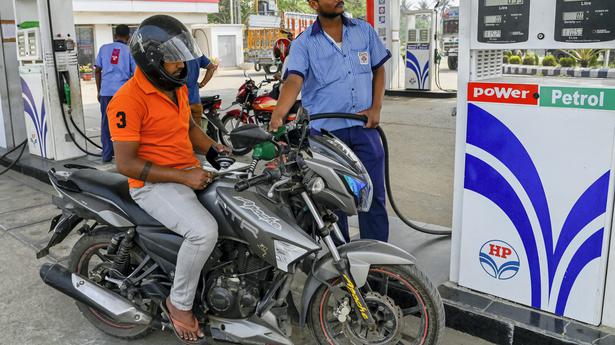
Is the fuel pricing policy problematic?
The Hindu
After a long pause, retail fuel prices have been inching up over the past week and have crossed the
After a long pause, retail fuel prices have been inching up over the past week and have crossed the ₹100-litre mark again in several parts of the country, while LPG cylinder prices have been hiked by ₹50. India officially has a deregulated pricing regime, but in recent years, this practice has been put on hold during election campaigns. Is the fuel pricing policy problematic? D.K. Srivastava and S.C. Sharma discuss the question in a conversation moderated by Vikas Dhoot:
S.C. Sharma: The story of dismantling oil prices starts from 1997. In 1995-96, India had an import dependency of about 65%-70%, so the government thought of moving from an administered price mechanism on a cost-plus basis to market-determined consumer prices for petrol, diesel and other fuels. The Nirmal Singh Committee made recommendations in late 1996 and it was decided that the oil pricing mechanism would be dismantled gradually from 1997 till 2002, from 75% in the first year to 100% by April 2002. Ram Naik, the Petroleum Minister in 2002, announced full dismantling as oil prices were comfortable.
From 2004, oil prices started moving up, and the United Progressive Alliance government restored the cost-plus pricing system to protect consumers. From an average price close to $48 a barrel in 2006, prices moved up each year and peaked at $143 a barrel in 2008. The average price was $69 then. In 2009, prices moved up to $89, and stayed between $100 and $120 till 2014. The government did not pass on the entire price burden to consumers, and subsidised prices for transport fuels, LPG and kerosene through a mechanism to provide for oil marketing companies’ under-recoveries. Till 2009-10, the government had issued ₹1,42,203 crore in oil bonds, but it started providing cash subsidies thereafter till 2014-15. Oil prices came down to about $50 per barrel in 2015, which was a happy situation for the National Democratic Alliance government, which again started implementing the market price mechanism. The prices remained at a low average level of $50-$60 per barrel, so the market price mechanism could be implemented easily without giving much discomfort to the consumers.
The current high prices are largely due to two factors. The higher level of excise on transport fuels has led to higher VAT levies in States, which have in turn increased the prices. The Rupee has depreciated and the share of energy imports has gone from 70% to 86%-87%. The OPEC countries not releasing production quotas since COVID-19, and the Ukraine-Russia crisis, are also key factors for the high prices.
D.K. Srivastava: The broader lesson is that the government has not been able to stick to either the earlier regime or the current regime whenever global price pressures have gone above a certain threshold. When the variations are within a certain range, the mechanism has worked, but the moment there is added pressure on global crude prices, there are political economy reasons as well as sound economic reasons for the government to deviate from the stated policy either temporarily or in a more regular way. Even as a de-administered pricing regime was introduced, it was partial to begin with, and there were repeated deviations as soon as global prices rose. So, when prices cross a threshold, we give up. Right now, we say ‘temporarily’, but we have to really revisit this issue because the Indian economy has become vulnerable to global crude price pressures. In fact, if those prices are passed on fully to consumers and industrial users, they will generate major economic effects. High retail inflation now will lead to an adverse income effect, which will lead to a subdued consumption expenditure recovery. After COVID-19, the economy has not been able to recover fully and investment has not taken off because private final consumption expenditure has not fully recovered and there is a very strong adverse income effect. This is having an adverse impact on inflation and growth and the government is now faced with a very serious problem. If it allows this effect to be passed on fully, then post-COVID-19 economic recovery will take more time, because it has to allow consumption expenditure to recover to pre-COVID-19 levels. And if it does not do so, then there are obviously serious fiscal costs. So, who is going to bear the burden of these costs: the Central government or State governments? This is a critical and a long-term issue, because we are not able to manage a meaningful de-administered price over a long period of time and we make short-term compromises again and again.
DKS: Yes, in the short run, the tax buoyancy and the prospects for 2022-23 provide certain fiscal legroom to absorb a reduction in excise duty on petroleum products. This kind of buoyancy is also there for States through the VAT on petroleum products, so if the Central and States can come together, coordinate and balance the burden of adjustment among themselves, then there is room to absorb some of the costs. But this is only for the current period. The corporate income tax reforms, the expected reform on personal income tax and the GST reforms all proved to have a revenue-adverse impact, so, the capacity of the Central government to absorb increases in global crude prices became limited even before we hit the COVID-19 threshold. GST is still not revenue-neutral, corporate income tax has still not fully recovered, and if investment does not take place, the expected buoyancy won’t occur. Let us take recourse to the fiscal space available in the short run, but we have to recognise that the tax-to-GDP ratio, particularly of the Central government, has not touched the old peak levels after these reforms. So we continue to live with major constraints.
SCS: The government has to choose between healthy revenue generation and giving a fillip to the economy through lower prices. The contribution of the petroleum sector to the exchequer in 2014-15 was ₹ 1,72,065 crore, which went up to ₹4,53,820 crore largely due to enhanced and excessive excise duties. The excise today on petrol is around ₹29 and for diesel, it is ₹23-24. The States have also benefitted with VAT collections having risen. So, it’s a dual effect for consumers. Over the last 25-30 years, one should have diversified revenue generation from different sectors, but if you depend only on the oil sector, it makes a difference to growth and inflation because everyone depends on oil.


Explore North East India with South Star Rail's three unique 14-day train tour packages from Mangaluru, starting April 25.

A woman and her son sustained burn injuries in a gas cylinder fire in Bagalkot, Karnataka, and were hospitalised.

Directed by Nicholas Kharkongor, the show also stars Angira Dhar, and Ranveer Brar in pivotal roles

T.N. CM Stalin blames Centre's delimitation focus for diverting attention from the cooking gas shortage crisis.

UDF plans to challenge Kerala BJP chief Rajeev Chandrasekhar over alleged asset concealment and criticizes CPI(M) for corruption.

Telangana's Civil Supplies Commissioner assures no fuel shortage, with 20,000 kilolitres of petrol available

Delhi Assembly faces second bomb threat in two days amid Budget session; security measures intensified, but no suspicious items found.

Protect your eyes this summer with simple habits like wearing sunglasses, staying hydrated, and maintaining proper hygiene.

Hyderabad Collector assures no fuel shortage, urges public to ignore rumors and avoid panic buying.

Learn how elderly and disabled voters can easily cast their ballots from home in the 2026 Assembly Elections.

Parliament Budget Session LIVE: Track updates on the Parliament Budget Session as the Transgender Bill moves to the Rajya Sabha. Follow The Hindu for the latest updates on the Budget Session on March 25, 2026.

Congress leaders in Kerala accuse LDF and NDA of a secret deal to undermine their influence in the upcoming Assembly elections.

Agnikul Cosmos successfully test-fires a revolutionary 3D printed booster engine, enhancing launch efficiency and scalability in space transportation.