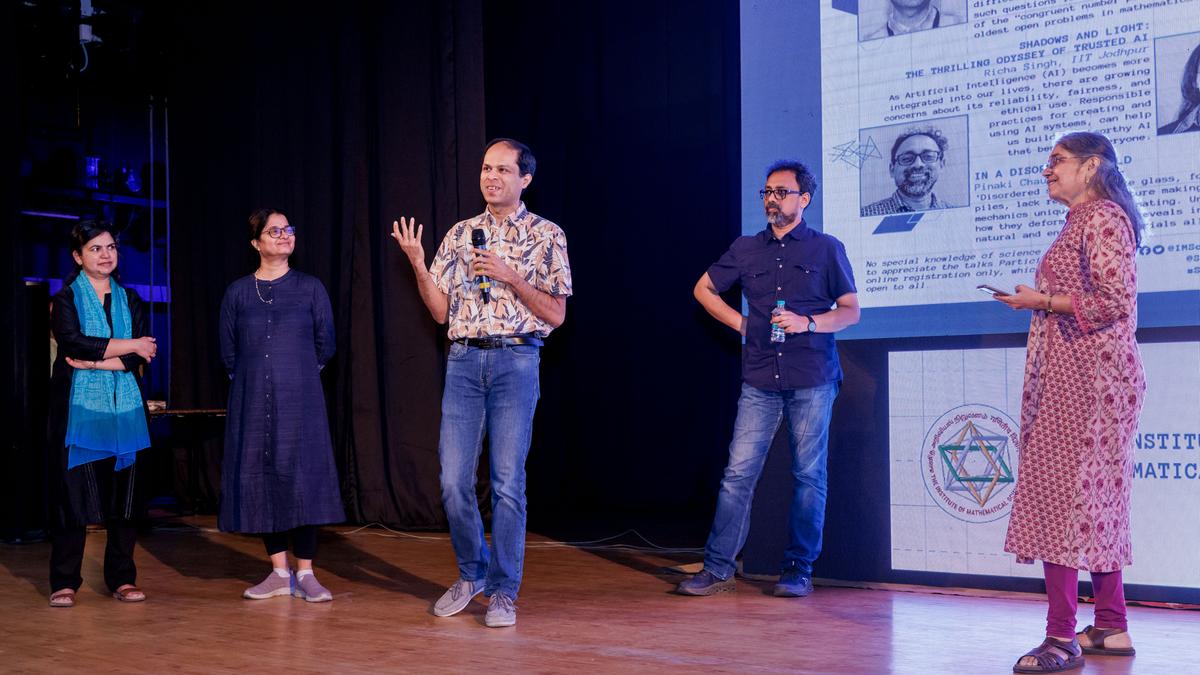
At Science At The Sabha in Chennai, delve into AI, neutrons, numbers and more
The Hindu
From the universe’s many wondorous objects to a fascinating pattern of numbers, and whether AI can possess superhuman strength, Science At The Sabha will have fascinating talks for participants of all ages
Have questions about science kept you up at night?
Sure, it might be fun to scroll for answers online, but the Institute of Mathematical Sciences (IMSc) has a more enriching disquisition at hand. At the Music Academy on March 29, Sunday, the ninth edition of Science At The Sabha, organised by the institute will have four talks for the public. You do not need to be a science enthusiast or possess any specialised knowledge to appreciate the talks, which will delve into everything from neutron stars to AI. The event is open for all, and free to attend.
“Every year, the idea is to invite eminent scientists working in India across various fields and have them talk about the work going on in their labs or research they are interested in. We want science to be accessible to the general public, and see an audience across a range of ages, from eight to 80 years,” says Varuni P , Project Scientific Officer, IMSc.
This year, the sessions begin with Debarati Chatterjee from the Inter-University Center for Astronomy and Astrophysics delving into neutron stars in her talk Gravitational waves: Listening to the Cosmic Symphony. Early developmental processes and behavioural tendencies will take the centrestage in the talk From Fish to Feelings: How Early Life Shapes Who we Become by Amrutha Swaminathan from the Indian Institute of Science Education and Research Thiruvanthapuram.
In S Viswanath’s talk on Tthe Secret Lives of Everyday Numbers, the mathematics professor from the Institute of Mathematical Sciences will help the audience discover a ‘miraculous algorithm’ and find answers to all your musings about AI and its superhuman abilities in the talk AI-Deus ex Machina?, by B Ravindran from IIT Madras.
Sitabhra Sinha, Professor, Physics and Computational Biology and Dean, Computational Biology PhD program says, “ We strongly believe that apart from doing cutting edge research in science, the science community has a responsibility to speak to the people about their work; explain what they are doing, why and what makes it interesting. There are certain topics that have always held wonder like astronomy for instance and every year, we have a mix of topics that are appealing as well as current,” he says. With an audience across age groups expected, he says that children in particular have always been the ones to ask the most fascinating questions to the speakers. “They come in with no preconceived notions and are eager to learn,” he adds.


A Sikh organisation has lodged a complaint against the makers of the film alleging that the movie’s promotional material has hurt the religious sentiments of the Sikh community

Speculation over Congress' Chief Ministerial candidate in Kerala persists despite party leaders' attempts to quell the discussions ahead of elections.

A fake dentist operating illegal clinic in Hyderabad's Old Neredmet has been arrested for endangering public health.

Explore the concept of Force Majeure and its implications amid ongoing geopolitical conflicts affecting global gas exports.

Malavika Sarukkai’s latest production Beeja explores humanity, Nature and healing through the language of dance.

Hindustani expert N Rajam and Mandolin Rajesh are among the National Awardees of the Sree Ramaseva Mandali’s Chamarajpet Ramanavami this year

Explore exclusive interviews with Tamil Nadu political leaders ahead of the 2026 Assembly election to aid informed voter decisions.

Explore North East India with South Star Rail's three unique 14-day train tour packages from Mangaluru, starting April 25.

A woman and her son sustained burn injuries in a gas cylinder fire in Bagalkot, Karnataka, and were hospitalised.

Directed by Nicholas Kharkongor, the show also stars Angira Dhar, and Ranveer Brar in pivotal roles

T.N. CM Stalin blames Centre's delimitation focus for diverting attention from the cooking gas shortage crisis.

UDF plans to challenge Kerala BJP chief Rajeev Chandrasekhar over alleged asset concealment and criticizes CPI(M) for corruption.

Telangana's Civil Supplies Commissioner assures no fuel shortage, with 20,000 kilolitres of petrol available