Iran can sink US aircraft carriers, says Khamenei. What weapon can it use?
India Today
Iran's Supreme Leader, Ali Khamenei, stated the country possesses a dangerous weapon capable of sending US aircraft carriers to the bottom of the sea. While he did not mention the exact weapon, Iran does possess a vast arsenal of hypersonic and subsonic missiles that it could use against US warships, should need arise.
In a speech on February 17, the Supreme Leader of Iran, Ayatollah Ali Khamenei, stated, "An aircraft carrier is a dangerous machine, but even more dangerous than that is the weapon capable of sending it to the bottom of the sea." His remarks were in response to reports of the US deploying the aircraft carriers USS Abraham Lincoln and USS Gerald R. Ford, along with their respective battle groups to within striking distance to Iran.
So what is the weapon, according to Khamenei, will Tehran use to send US aircraft carriers to the bottom of the sea? Unfortunately, the Ayatollah refrained from naming one singular weapons system, instead framing his message as a rhetorical one, designed to emphasise Iran's claimed anti-ship capabilities, and its claimed ability to dominate the Strait of Hormuz with its area denial capabilities.
Nevertheless, we can still theorise what weapon Khamenei was talking about, based on the information available on various weapon systems used by Iran, from hypersonic missiles allegedly capable of reaching Mach 15, to cheaper, but still lethal subsonic anti-ship cruise missiles.
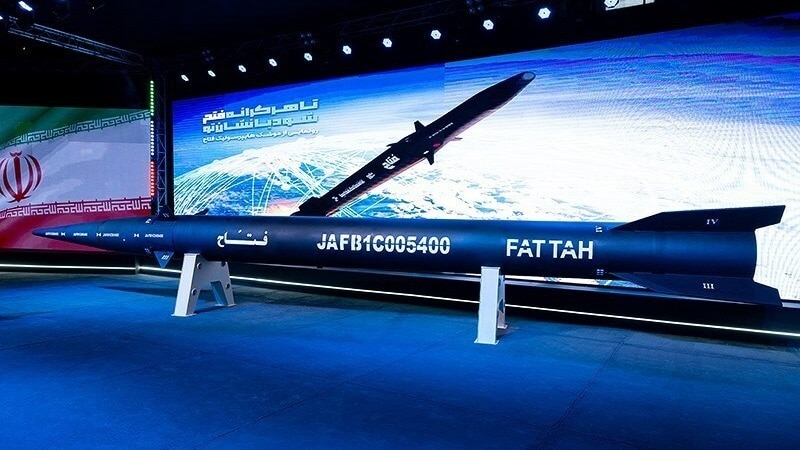
The most formidable weapon in Iran's arsenal that can be utilised against a US Navy Carrier Battle Group is the Fattah class of hypersonic missiles.
Developed by the Islamic Revolutionary Guard Corps (IRGC), the first of the Fattah class is the Fattah-1, that was unveiled in June 2023. According to a report by the press agency, Associated Press(AP), the Fattah-1 is a medium-range ballistic missile (MRBM) with a reported range of 1,400 km (870 miles) and speeds of Mach 13–15. It features a solid-fuel booster and a manoeuvrable re-entry vehicle (MaRV) with thrust vector controls designed to evade anti-missile defences in its terminal phase (the final phase of a missile's flight before impacting its target).
Then there is also the Fattah-2, a newer iteration that was unveiled in November 2023, which analysts suggest may incorporate a hypersonic glide vehicle (HGV) design, departing from the original MaRV configuration. A hypersonic glide vehicle is an advanced manoeuvrable warhead that uses its aerodynamic construction to travel along an unpredictable flight trajectory, making it more difficult for missile defence systems to detect and destroy them.


India has become the twelfth nation to sign Pax Silica, a US-led coalition designed to secure the global silicon supply chain from mine to microchip. The world's technology order may never look the same again.


"BRICS is representing the global South—half of humanity." Brazil's President Luiz Inácio Lula da Silva reveals why this alliance terrifies the West and how it will reshape the 21st century world order.


A US influencer shared a unique hack to wash underwear using a hotel coffee maker, which sparked mixed reactions over hygiene concerns and travel convenience.

AI pivotal for global growth but should be regulated to protect women, children: Brazil's Lula

Two boats collided near Dhari Devi Temple on the Alaknanda River in Uttarakhand, captured in a now-viral video which sparked urgent calls for improved boating safety measures.

A tragic mountaineering accident on Austria's highest peak ended in a fatality and a rare criminal conviction for manslaughter.

A nearly 7-foot Indian rat snake was found resting on top of an air-conditioning unit at an airport in Mumbai, causing panic among locals and viewers in a now-viral video shared on social media.

A wedding in Uttar Pradesh was called off after a dispute over the groom's family beating up the bride's pet dog led to a violent clash between families.

After a dismal performance in the recent Bangladesh election, Nahid Islam, NCP convenor and anti-Sheikh Hasina protest leader, has resorted to allegations as if to justify the party's poor show. Nahid claimed that the election results had been manipulated, and the victorious BNP colluded with India and Hasina's Awami League.

In a post on X, Kunal Kapoor, known for his films such as Rang De Basanti and Aaja Nachle, said, "The man who cleans our cars asked me for a loan. And our house help of many years told us she might leave next year."

Tarique Rahman's 1st India move: Restores visa services in Delhi