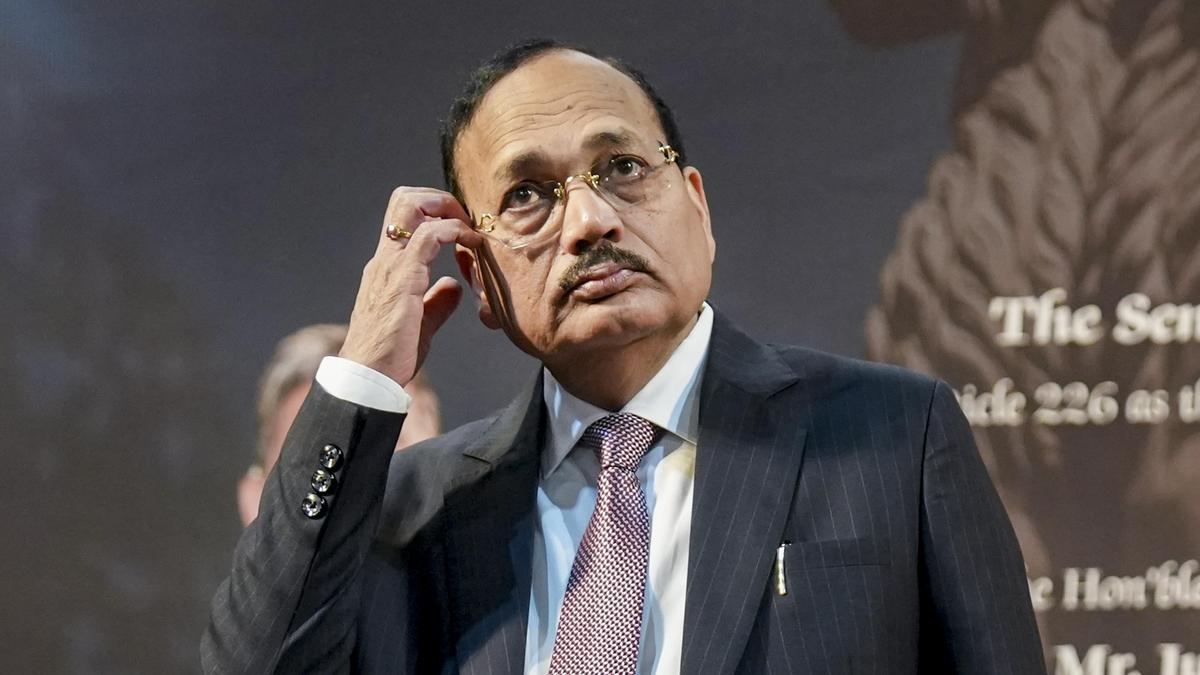
India-France partnership lifeline amid geopolitical tension: CJI Surya Kant
The Hindu
CJI Surya Kant emphasizes the vital India-France partnership amid geopolitical tensions at the Indo-French Legal and Business Conference.
Chief Justice of India (CJI) Surya Kant has said that the forces of disruption and geopolitical tension threaten to destabilise the very framework of international cooperation, and in such a world, the France-India partnership is not a luxury but a lifeline.
Speaking at the Indo-French Legal and Business Conference on Friday (January 30, 2026), the CJI said the relationship between the two countries has long transcended the purely diplomatic and is instead a multi-dimensional architecture, encompassing everything from the sanctity of the defence and security cooperation to a shared pursuit of sustainable growth and advanced technologies.
"We have witnessed a remarkable acceleration in our bilateral trade, which has more than doubled over the last decade, surging from $6.4 billion in 2009-10 to an impressive $15.11 billion in the last fiscal year," he said.
Speaking on the topic of "Cross-Border Dispute Resolution: Courts, Arbitration and India-France Year of Innovation 2026", Justice Kant said, "The relationship between France and India is not a creation of convenience, it is a bond forged over centuries. Today, standing on the shoulders of this history, we face a world transformed by uncertainty. The forces of disruption and geopolitical tension threaten to destabilise the very framework of international cooperation. In such a world, the France-India partnership is not a luxury; it is a lifeline."
He added that united by the shared belief in democracy, the rule of law and the pursuit of a peaceful and just global order, both countries possess complementary strengths.
"As we stand at the precipice of the Year of Innovation 2026, we are no longer just building the nest, we are mapping the sky in which we fly," he said, adding that as India and France enter a new phase of innovation this year, they do so supported by a dispute-resolution architecture that is not reactive, but anticipatory, not adversarial, but principled, and not merely efficient, but enduring.


CM announces Cabinet Sub-Committee on Musi rejuvenation; rehabilitation for all displaced

Ramanathapuram identifies 145 polling stations as sensitive, ensuring security with paramilitary forces ahead of assembly elections, says DEO.

BJP Puducherry president V. P Ramalingam files nomination for Raj Bhavan, joined by Union Minister Mandaviya and Khushbu Sundar.

History-sheeter 'Thoppai' Ganesh shot dead by police in Chennai after attacking officers during attempted escape.

The government plans to amend the FCRA, introducing new regulations for NGO asset management and accountability for key functionaries.

The draft policy for “Responsible Digital Use Among Students”, released on Monday by the Department of Health and Family Welfare, has recommended that parents set structured routines with clear screen-time rules and prioritise privacy, safety, and open conversation with children on digital well-being.

Police Observer Sushant Kumar Saxena conducts surprise inspection at Shencottai police station, reviewing warrants and security arrangements ahead of elections.

Andhra Pradesh government to launch key projects in April, focusing on industrial growth and infrastructure development, says Nara Lokesh.

Lok Sabha refers the Corporate Laws (Amendment) Bill to a JPC amid opposition concerns over CSR provisions dilution.

SHG members in Kanniyakumari use snakes and ladders to raise election awareness and boost voter turnout.

Government accelerates consultations for early implementation of the Women’s Reservation Act to ensure women’s representation in 2029 elections.

CM A. Revanth Reddy distributes ₹1 crore insurance cheques to families of deceased Electricity department employees, enhancing financial security for workers.

The Bengaluru Traffic Police (BTP) registered 634 cases of drunk driving during a week-long special enforcement drive conducted across the city between March 16 and March 22.