How the G20 evolved Premium
The Hindu
The G20 is perhaps the only inclusive forum that can set the agenda for global peace and harmony
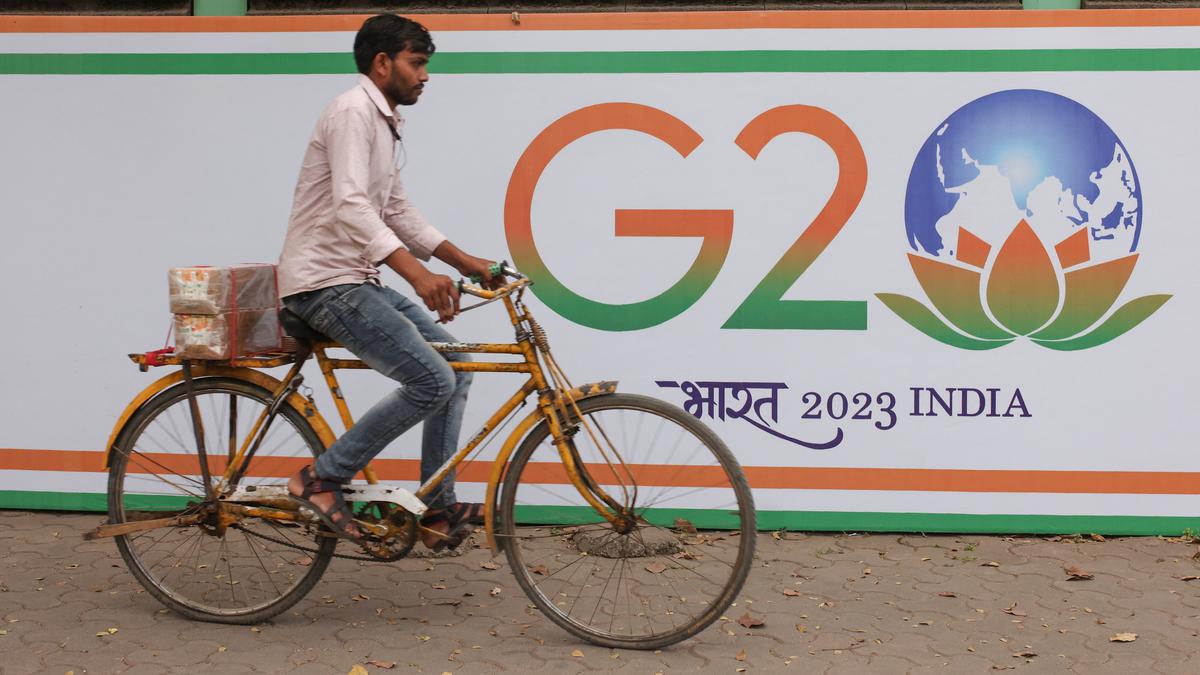
India’s assumption of the 18th G20 (Group of Twenty) presidency underpins a new epoch for the grouping. For the first time, the ‘Troika’ will be comprised of three emerging market economies – Indonesia, India, and Brazil. The G20 chair is part of a rotating three-member group of immediate past, current, and succeeding presidencies, referred to as the Troika to ensure continuity in the agenda as there is no permanent G20 secretariat. The G20 summits are convened under a system of rotational presidencies and are selected from a different regional grouping of countries. In fact, South Africa’s elevation to the G20 presidency in 2025 will not only consolidate the voice of the Global South but will also mark the completion of one full circle for rotational presidencies among member countries. India has planned to hold the Summit in New Delhi on September 9-10, 2023.
India has taken over the G20 presidency on the occasion of the country completing 75 years of its independence and becoming the fifth-largest economy in the world. Thus, with an avowed objective of showcasing its rich cultural heritage and economic prowess to the outside world, it is setting unique precedence by holding more than 200 meetings in over 50 cities spread across country and not confining to a select few large cities.
The run-up to the Summit entails a preparatory process with several ministerial and working group meetings and discussions channeled on two tracks– the Finance Track and the Sherpa Track. In the Finance Track, discussions are centered on building consensus on attendant issues related to fiscal and monetary policies, macroeconomic coordination, financial inclusion, international taxation, and investment. The deliberations under the Sherpa Track are both complementary and supplementary to those undertaken in the Finance Track as the scope of discussions expands to subjects like digital economy, trade, and investment, anti-corruption, agriculture, health, energy and environment, among others.
With the G20 becoming a subject of intense debate and discussion in India, it is important to reflect on its history and evolution.
To those unfamiliar with the G20 process, it is less well-known that the G20 was conceived in 1999 in the aftermath of the 1997 Asian financial crisis to discuss matters related to international economic and financial stability and align policies among the most significant and relevant industrialized and developing economies. Until then, the group of advanced countries– the Group of Seven (G7)– was the main forum that discussed international issues ranging from global financial governance to anti-corruption and terror financing, with the view to build consensus and policy response among developed countries. However, the Asian financial crisis brought to the fore the criticality and centrality of developing countries to maintain the multilateral order owing to their deep integration into the global economic systems and cross-border capital flows. Since the immediate context was to mitigate the ill effects of the contagion caused by the Asian financial crisis, the beginning of the G20 (with the addition of 12 economies to the G7 countries) was underpinned by the coming together of their Finance Ministers and central bank governors to discuss how a coordinated response to the emergent crisis and future crises could be made.
Since then, the G20 has seen several points of inflection. The first happened in 2008 in the aftermath of the global financial crisis that emerged in the U.S. when the forum was elevated to the summit level with the participation of heads of state or government. The initial summits, held in the U.S., the U.K., and Canada focused on developing a coordinated response to the financial crisis and the consequent economic slowdown, including discussions on monetary and fiscal policy measures, preventing a reversion to protectionist policies and reforming of the Bretton Woods institutions. Other issues such as strengthening trade and investments were discussed in the larger context of their impact on ensuring financial stability and economic growth. Issues like food security which were discussed at the G7 level till then also found their way in the G20 agenda.
The next pivotal moment was during the South Korean presidency in 2010 when development issues were introduced as a priority in the G20 agenda. In the subsequent years, as the effects of the global financial crisis waned and financial sector stability was restored to an extent, the mandate of the Sherpa Track expanded. Many new working groups were added to reflect the widened ambit. Successive presidencies — France, Mexico, Russia, Australia, Turkey, and China — focused on various issues reflecting their respective priorities and relevance to the G20 community.


CM announces Cabinet Sub-Committee on Musi rejuvenation; rehabilitation for all displaced

Ramanathapuram identifies 145 polling stations as sensitive, ensuring security with paramilitary forces ahead of assembly elections, says DEO.

BJP Puducherry president V. P Ramalingam files nomination for Raj Bhavan, joined by Union Minister Mandaviya and Khushbu Sundar.

History-sheeter 'Thoppai' Ganesh shot dead by police in Chennai after attacking officers during attempted escape.

The government plans to amend the FCRA, introducing new regulations for NGO asset management and accountability for key functionaries.

The draft policy for “Responsible Digital Use Among Students”, released on Monday by the Department of Health and Family Welfare, has recommended that parents set structured routines with clear screen-time rules and prioritise privacy, safety, and open conversation with children on digital well-being.

Police Observer Sushant Kumar Saxena conducts surprise inspection at Shencottai police station, reviewing warrants and security arrangements ahead of elections.

Andhra Pradesh government to launch key projects in April, focusing on industrial growth and infrastructure development, says Nara Lokesh.

Lok Sabha refers the Corporate Laws (Amendment) Bill to a JPC amid opposition concerns over CSR provisions dilution.

SHG members in Kanniyakumari use snakes and ladders to raise election awareness and boost voter turnout.

Government accelerates consultations for early implementation of the Women’s Reservation Act to ensure women’s representation in 2029 elections.

CM A. Revanth Reddy distributes ₹1 crore insurance cheques to families of deceased Electricity department employees, enhancing financial security for workers.

The Bengaluru Traffic Police (BTP) registered 634 cases of drunk driving during a week-long special enforcement drive conducted across the city between March 16 and March 22.