When an Institute of Technology preserves precious Madras heritage Premium
The Hindu
IIT Madras preserves Madras heritage through its unique Heritage Centre, showcasing history, culture, and natural beauty creatively.
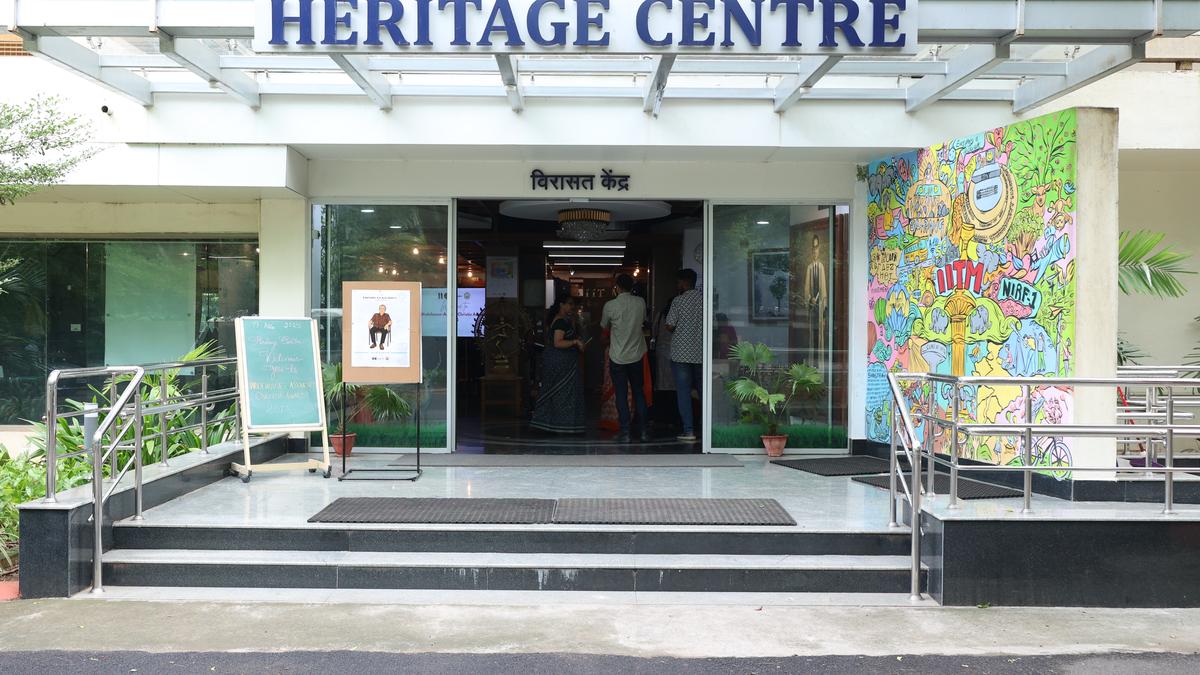
It has been raining educational institutions on me. Last fortnight, I was at the Sri Kanyaka Parameswari College and last week, I was at the Indian Institute of Technology Madras (IIT M). The latter had invited me to the 20th-year celebrations of the institute’s Heritage Centre. One common feature was that at both places, I was gifted caricatures of myself, and both credited me with more hair than I possess. But be that as it may, I came away filled with a great sense of happiness. The Heritage Centre is a facility that is doing great work, as befitting the centre of excellence that the IIT is.
Having worked for over 25 years now on compiling the history of institutions, I have frequently been struck by how much of the past is lost owing to faulty record-keeping. Government departments and institutions, which should lead by example, sadly are the worst-off. Most documents and photographs vanish, many because of lack of continuity or sheer disinterest of those at the helm. Then come shifting of premises, the great fire (which happens at some point or the other), and then the great flood, which happens all too often these days. Thankfully, the great plague is a matter of the past. And then comes wilful destruction, to “save space” or because someone up top said it was all a waste anyway. And lastly, there is stonewalling – everything is top secret, one that can be used to build deadly missiles.
In all my years, I have come across very few government institutions and undertakings that have been exceptions. The Reserve Bank of India, I know for sure, is one. The State Bank of India is another. And now that I have seen IIT M’s Heritage Centre (IITMHC), I am proud to add it to the list. Incidentally, it is the only IIT to have such a facility. It was the brainchild of R. Natarajan, the eighth director of IIT M (1995-2001). He strongly felt that the institution needed a central repository for its archives of all types – built, natural, cultural, and I am sure of other kinds that the institution must have. The task of creating such a facility was entrusted to Prof. Ajit Kumar Kolar and in 2006, it was inaugurated by Prof. A Ramachandran, second Director of IIT.
So what does the IITMHC do? It serves as a centre for material of heritage value and historic significance generated within IIT Madras. Photographs are the first that come to mind and of these, there are plenty. Then come the campus newsletters, the full collection of which is now available. In addition, it brings out its own journal titled Glass Panels. As the centre is on the ground floor of the administrative block of IIT M, it is also the place from where visitors begin their tour of the campus. The HC has its own battery-operated vehicle to take people around. Within the premises is a small exhibition facility that highlights various aspects of IIT M. Most importantly, and unlike most other exhibitions in India, the exhibits are rotated, thereby keeping curiosity and interest alive.
What I found most fascinating was the attention given to the natural beauty of the IIT M campus – and the compiling has been done most creatively. The collection of Lepidoptera was made by hand-painting the features of each specimen, rather than by the usual practice of pinning the insects onto a board. I was also thrilled when the first instalment of their latest project was unveiled – featuring birds’ eggs. The specimens were all 3D-printed and then painted, under guidance from the Bombay Natural History Society. The dimensions of each egg were exactly as per the naturally occurring ones. Thus, not one nest had been destroyed in the process. As the event progressed, I could not help noticing the monkeys frolicking in the portico, some looking in. And while returning, I halted my car for deer crossing.
The oral history project of IITMHC is another commendable initiative. That way, the memories of people are preserved for posterity. In 2011, IITMHC brought out Campaschimes, a lavishly produced coffee-table book to commemorate fifty years of IIT M (which happened in 2009). Written by Kumaran Sathasivam, who heads IITMHC, it is a delightful account of the genesis and growth of IIT M to its present stature. The present faculty-in-charge is Prof. Arun Menon, who as my earlier writings will show, has played an active role in studying the structural stability of buildings such as Gokhale Hall.


Mamata Banerjee ends her protest but vows to continue fighting for voter rights amid allegations against the Election Commission.

T.M. Krishna explores evolving meanings of national symbols at his book launch, challenging perceptions and historical narratives in Chennai.

Deloitte launches ConnectSafe, India's first cybersecurity facility in Bengaluru, focusing on safeguarding critical infrastructure and human lives.

Harish Rao flays Congress for undermining democratic systems in Telangana

The developments in the Anthropic case have serious implications for AI development and national security calculus worldwide

Yelagiri Hills faces its first forest fire of the season, prompting patrol teams to prevent future incidents amid rising temperatures.

Women entrepreneurs in Puducherry received training on digital marketing and business promotion tools to enhance their market competitiveness.

Explore K.K. Venugopal's memoir, "An Accidental Lawyer," a journey of self-discovery and reflections on his legal career.

GVMC projects Visakhapatnam's water demand will rise to 726 MLD by 2040 due to significant upcoming developments.

Thousands of devotees take part in ‘pookuzhi’ festival in Natham

FATF report highlights rising use of stablecoins in money laundering and terrorism financing by state-linked actors.

Researchers unveil India's first comprehensive checklist of fireflies, documenting 92 species to enhance understanding and conservation efforts.

Experts gather at a seminar hosted by Assam Rifles to discuss evolving security challenges in Northeast India.