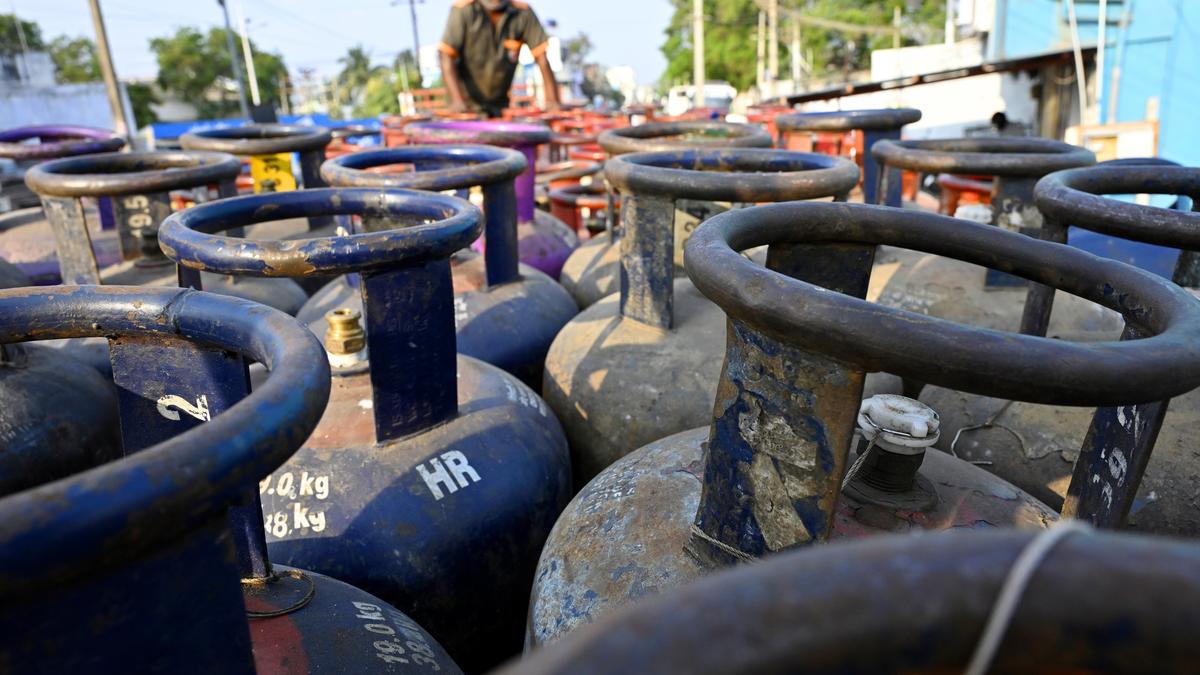
How the U.S.-Israel conflict with Iran is exposing India’s LPG dependence
The Hindu
West Asia conflict threatens India’s LPG supply as import dependence rises. Price hikes, supply disruptions and subsidy cuts could strain oil marketing companies.
The war between the U.S.-Israel and Iran has put stress on the country’s liquefied petroleum gas (LPG) supply, which was already heavily import dependent and in need of government aid previously.
Just last year, the Centre paid India’s three public sector oil marketing companies (OMCs) — Indian Oil Corporation, Bharat Petroleum Corporation, and Hindustan Petroleum Corporation — ₹30,000 crore to subsidise their losses for selling cooking gas at a time of soaring prices globally.
The centre had then stated that its purpose was to shield consumers from rising global LPG prices by absorbing the cost through the OMCs. However, the grant was announced before the war broke out, and with the conflict escalating, India now faces the possibility of disruptions to LPG supplies and higher global prices.
In just a week after the conflict began, on March 7, domestic LPG prices were raised by ₹60 per cylinder. Brent crude briefly rose to nearly $120 a barrel, crossing $100 per barrel for the first time since Russia’s invasion of Ukraine in 2022.
On March 9, the Ministry of Petroleum and Natural Gas issued an order directing all domestic oil refining companies, including petrochemical complexes, to maximise the production of LPG and make the entire output available exclusively to IOCL, HPCL and BPCL. Refiners have been barred from diverting any output for other petrochemical production. OMCs have been directed to supply LPG solely to domestic consumers.
This comes just a month after the Union budget cut the LPG subsidy allocation by 27%, from ₹15,121 crore to ₹11,085 crore. The Ministry of Petroleum and Natural Gas received ₹30,443 crore for 2026-27.


Mamata Banerjee ends her protest but vows to continue fighting for voter rights amid allegations against the Election Commission.

T.M. Krishna explores evolving meanings of national symbols at his book launch, challenging perceptions and historical narratives in Chennai.

Deloitte launches ConnectSafe, India's first cybersecurity facility in Bengaluru, focusing on safeguarding critical infrastructure and human lives.

Harish Rao flays Congress for undermining democratic systems in Telangana

The developments in the Anthropic case have serious implications for AI development and national security calculus worldwide

Yelagiri Hills faces its first forest fire of the season, prompting patrol teams to prevent future incidents amid rising temperatures.

Women entrepreneurs in Puducherry received training on digital marketing and business promotion tools to enhance their market competitiveness.

Explore K.K. Venugopal's memoir, "An Accidental Lawyer," a journey of self-discovery and reflections on his legal career.

GVMC projects Visakhapatnam's water demand will rise to 726 MLD by 2040 due to significant upcoming developments.

Thousands of devotees take part in ‘pookuzhi’ festival in Natham

FATF report highlights rising use of stablecoins in money laundering and terrorism financing by state-linked actors.

Researchers unveil India's first comprehensive checklist of fireflies, documenting 92 species to enhance understanding and conservation efforts.

Experts gather at a seminar hosted by Assam Rifles to discuss evolving security challenges in Northeast India.