AI and the national security calculus Premium
The Hindu
The developments in the Anthropic case have serious implications for AI development and national security calculus worldwide
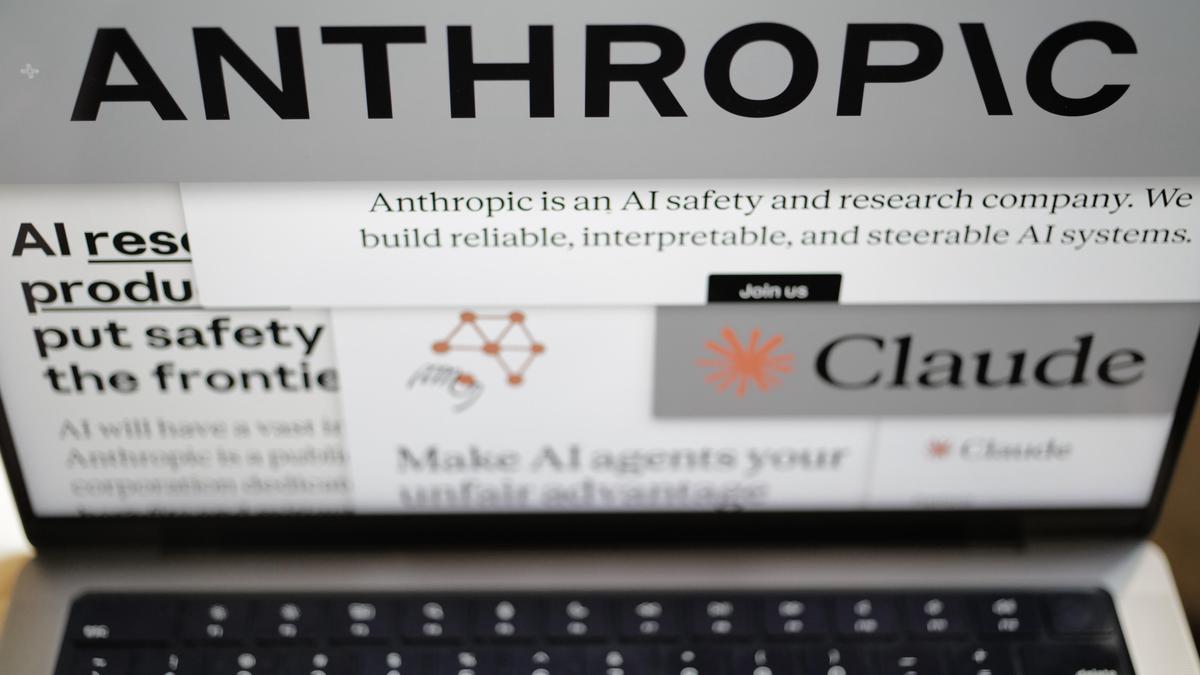
Anthropic, an American Artificial Intelligence (AI) lab, is asking for three Chinese AI labs (DeepSeek, MoonshotAI, and MiniMax) to be treated as national security threats. The AI models of Anthropic and other American labs have also reportedly been used by the U.S. military in the Iran attacks to fast-track the “kill chain” from target identification to legal approval and strike.
The Pentagon has labelled Anthropic a “supply chain” risk — a designation associated with foreign adversaries, for raising concerns about how its technology is being used in military operations. This decision is now being challenged in court. These developments over the course of a few weeks have serious implications for AI development and national security calculus worldwide.
The Chinese AI labs have been accused of distilling frontier models from American AI companies. In a nutshell, this involves taking a stronger AI model’s outputs to teach a weaker model. The attacks were sophisticated and used deceptive techniques to mask the identity and intent of the distillers. Anthropic claims that this happened on an industrial scale — “16 million exchanges with Claude through approximately 24,000 fraudulent accounts, in violation of our terms of service and regional access restrictions”.
Generative AI is often equated with nuclear technologies, with the aim of containing the proliferation of the technology. However, it is a dual-use general-purpose technology that is more comparable to semiconductors than nuclear weapons. Unlike nuclear technologies, where governments drive research and development efforts, cutting-edge AI research happens in the private sector for civilian applications. It just so happens that the same technology also has military applications.
Nuclear non-proliferation works because fissile material is rare, controlled and traceable. The same is not true for mathematical AI models. The fact that DeepSeek was able to achieve comparable performance of frontier models at a fraction of the cost after export controls were imposed is proof that restrictions are not effective. The nuclear narrative asks us to treat querying an AI model as equivalent to weapons proliferation.
Anthropic’s argument that a distilled model will be used less responsibly lies on weak foundations. Models from frontier American AI labs such as Anthropic, OpenAI, Google and xAI could be used by the U.S. military for applications such as surveillance, cyberwarfare and lethal autonomous weapons systems. In fact, when Anthropic recently raised concerns about the kinds of uses its models were put to, it faced the threat of being removed from defence systems and designated as “supply chain risks”. Its rival, OpenAI, however, has accepted a permissive contract for military uses, highlighting a race to the bottom, given the competitive pressure to serve government clients. When their own models are being put to such uses, the argument that distilled models will not have guardrails collapses.


Thousands of devotees take part in ‘pookuzhi’ festival in Natham

FATF report highlights rising use of stablecoins in money laundering and terrorism financing by state-linked actors.

Researchers unveil India's first comprehensive checklist of fireflies, documenting 92 species to enhance understanding and conservation efforts.

Experts gather at a seminar hosted by Assam Rifles to discuss evolving security challenges in Northeast India.

George Russell's victory at the 2026 Australian GP signals Mercedes' resurgence, showcasing thrilling battles and strategic missteps from rivals.

Tenders invited for a 1,200 TPD waste-to-energy plant at Vellalore to process waste from Coimbatore and Tiruppur.

Union Cabinet grants international status to Madurai airport, enhancing global connectivity and boosting tourism and trade in Tamil Nadu.

Students should be careful about what they write in their social media accounts, as companies now look closely on job aspirants activity on the social media, said motivational speaker and cyber crime expert G. Ananth Prabhu, in Mangaluru on Tuesday.

Bhupender Yadav affirms government's commitment to Aravalli conservation and illegal mining crackdown, considering a Supreme Court-directed committee.

Tamil Nadu State Planning Commission advocates for legal protections and social security measures to enhance gig workers' welfare and sustainability.

Explore the legal challenges surrounding MGR’s 1984 election victory from a hospital bed in this insightful analysis by The Hindu.

Karnataka High Court halts work on Sharavathi hydroelectric project over environmental concerns until further notice.

Describing the international status accorded to Madurai Airport as a good news, Virudhunagar MP B. Manickam Tagore has exuded hope that this development will increase international flight connectivity from Madurai.