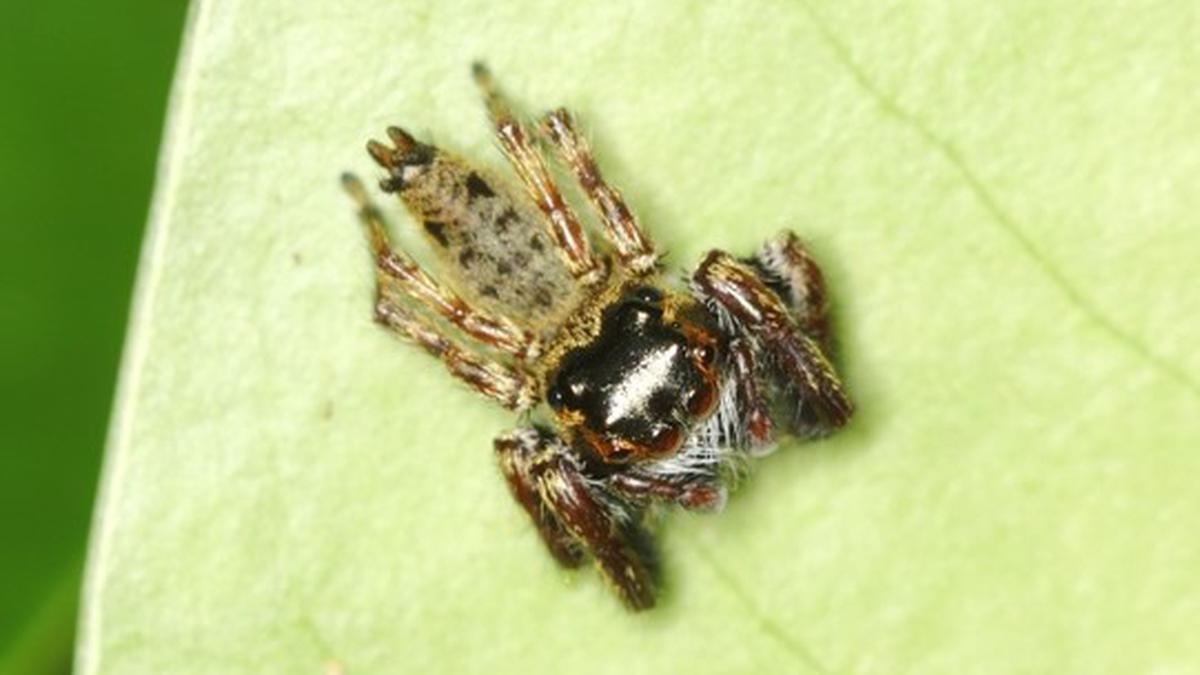
Western Ghats throws up a new species of jumping spiders
The Hindu
New species of jumping spider discovered in Western Ghats; named Pancorius sebastiani after late spider taxonomist P.A. Sebastian. Males & females exhibit reddish brown carapace, yellowish abdomen with black patches & chevron-shaped markings. Data shows only two states have reported high numbers of Salticidae species, while others have few. Biodiversity hotspots in India neglected & less explored, leading to gaps in species distribution.
As scientific explorations continue to unravel the secrets of biodiversity-rich Western Ghats, a new species of jumping spiders has been discovered from the Shendurney Wildlife Sanctuary.
A group of researchers comprising Asima A. of the Department of Zoology in Kerala University, the head of the department G. Prasad, and John T.D. Caleb of the Department of Anatomy, Saveetha Institute of Medical and Technical Sciences, Chennai, has reported the findings that have been published in the peer-reviewed journal Arachnology brought out by the British Arachnological Society.
The new species, which belongs to the jumping spider genus Pancorius Simon, 1902, and Salticidae family, has been named Pancorius sebastiani after the late spider taxonomist P.A. Sebastian in recognition of his valuable contributions towards Indian arachnology.
The Pancorius genus of Asian jumping spiders is primarily distributed in southeast Asia. While its distribution was hitherto limited to the east and northeastern regions in India, the new species is the first to be reported from the south. The distribution, the researchers point out, appears to be discontinuous, raising doubts if they are limited to those regions.
The males and the females of Pancorius sebastiani exhibit reddish brown carapace, yellowish abdomen with black patches and chevron-shaped markings posteromedially.
An analysis of Salticidae species in the country shows that only two States, West Bengal and Tamil Nadu, have reported high numbers, while the others including those harbouring biodiversity hotspots like the Western Ghats and northeastern India have relatively few numbers of species.
“The data clearly indicate that the biodiversity hotspots in India have been neglected and less explored. A greater proportion of the Indian landscape is yet to be surveyed systematically. This is one of the primary reasons for gaps in species distribution,” the researchers pointed out.


CPI-M accepts DMK's five-seat offer for Tamil Nadu Assembly elections, prioritizing INDIA bloc unity over seat demands.

Ricky Rai, son of former underworld operative Muthappa Rai, on Monday appeared before the Bengaluru Traffic Police for questioning in connection with a case involving a Lamborghini performing dangerous stunts at Anil Kumble Circle on March 21.

The Dispur election heats up as 'CongBJP' defections shape a high-stakes contest between veteran candidates from BJP and Congress.

Bengaluru's M. Chinnaswamy Stadium conducts readiness drill ahead of IPL 2026, ensuring upgrades and technical preparations are complete.

First-level randomisation of EVMs completed in Nagapattinam for upcoming elections, ensuring transparency and security.

A district-level committee in Krishnagiri has been formed to assess and verify seizure claims of goods and cash.

Minister Anam Ramanarayana Reddy pledges government support for local fishermen and farmers facing challenges in Andhra Pradesh.

MP M. Sribharat urges collective efforts to revive Visakhapatnam Steel Plant, highlighting key reforms for crucial recovery and growth.

141 candidates have filed nominations for Kozhikode's Assembly elections, with scrutiny on March 24 and campaigning intensifying.

BJP's Vijayendra accuses Congress of using money to influence Bagalkot bypolls, urging voters to reject their tactics.

First randomization of electronic voting machines completed in Tirunelveli and Tenkasi districts for upcoming Assembly elections.

RPF seizes 10.12 kg of unclaimed cannabis worth ₹5.06 lakh from a train in Mangaluru.

Kolar's groundwater levels rise to 50-100 ft due to the K.C. Valley project, ensuring clean water and improved health outcomes.