West Bengal SIR test: reading the Supreme Court’s order
The Hindu
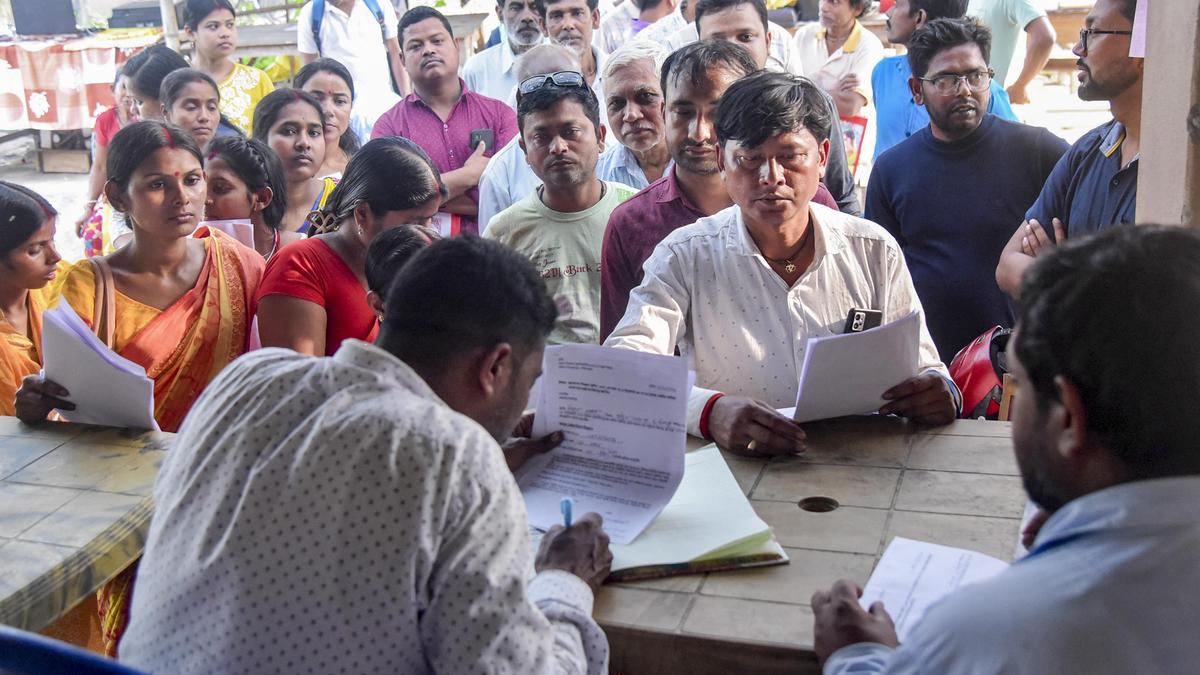
With 60 lakh cases verification pending adjudication under West Bengal SIR, the publication of final rolls has several implications.
On February 20, 2026, the Supreme Court, in an exceptional situation, invoked its powers under Article 142 of the Constitution and decided to deploy judicial officers in the State of West Bengal (“State”) to adjudicate and revisit cases and documents submitted under the category of “logical discrepancies” and “unmapped cases” for inclusion or exclusion of names from the electoral roll (“roll”). This course of action was adopted when the second phase of the SIR, being undertaken across 12 States/Union Territories, was nearing completion.
The Court intervened after the Election Commission of India (“ECI”) submitted before the court that, despite repeated requests, the State had not provided Group ‘A’ officers of the rank of SDO/SDM to carry out the quasi-judicial functions of Electoral Registration Officers (“EROs”). According to the ECI, instead of such officers, personnel at clerical levels and from Group ‘B’ and ‘C’ cadres were deployed. Consequently, making it untenable to entrust them with the adjudication of cases involving scrutiny of documents in a number of cases falling under the logical discrepancy and unmapped category, where the documents submitted raised doubts to their authenticity. The State, however, disputed this assertion before the Court.
Against this backdrop, the Supreme Court initially sought the assistance of judicial officers from the State of West Bengal and, by subsequent orders, facilitated the deployment of additional judicial officers from the neighbouring States of Odisha and Jharkhand (subject to the discretion of the Chief Justice of the Calcutta High Court), having regard to the nearly 60 lakh cases requiring adjudication.
At the same time, the Court directed the ECI to proceed with the publication of the final electoral roll as scheduled on February, 28, 2026, while clarifying that cases pending adjudication could be added subsequently through supplementary lists as and when decisions are rendered.
Earlier, on February 4, 2026, when the sitting Chief Minister of West Bengal chose to appear in person before the Supreme Court in the SIR matter, the hearing drew nationwide attention. While the presence of two constitutional authorities before the Court generated considerable public and media interest, the Supreme Court, through its orders, made it clear that it would not permit any impediment to the continuation of the SIR process.
During the second phase of the SIR in West Bengal, the State challenged the decision of the ECI to deploy Micro-Observers to assist the EROs/Assistant EROs, contending that such deployment was contrary to law. The ECI, however, justified the step on the ground that it was compelled to do so due to the non-availability of adequate Group ‘A’ officers of the rank of SDO/SDM despite repeated requests to the State.


Joint Collector S. Ilakkiya highlights women's vital role in public service and social contributions during Women’s Day celebrations in Vijayawada.

Vizag Port aims to become a net-zero maritime hub by 2047, focusing on renewable energy and zero-emission vessels.

Iran is seen as the great disrupter of West Asia and srael wants to end Iran’s proxy war which it sees as an existential threat

A lesson from this war is that national security cannot be bought or outsourced

CM Stalin asserts Tamil Nadu will never fall under BJP rule, emphasizing the DMK's commitment to the state's culture and development.

Madras High Court orders post-mortem of alleged custodial death in Sivaganga, amid ongoing protests by the victim's family.

BNP proposes citizen-led solutions to enhance Bengaluru's garbage collection and address persistent blackspots through improved coordination and participation.

Accusing Prime Minister Narendra Modi of “meekly surrendering to the U.S.”, Chief Minister Siddaramaiah on Monday demanded that the Prime Minister step down for the good of the nation.

JPC will meet with UGC, AICTE, and NCTE officials this week to discuss the Viksit Bharat Shiksha Adhishthan Bill.

NITI Aayog's V.K. Saraswat emphasizes India-Japan collaboration for future mobility and clean energy advancements at JIMS 2026.

Cuban diplomat reflects on the ties between Cuba and Kerala

The Book Review Literary Trust announces 2025 Short Story Contest winners, celebrating literary talent at the Nikhil Chakravartty Memorial Lecture.

Nambiyar Nagar residents face severe water shortages and inadequate transport, impacting daily life in the fishermen's community.