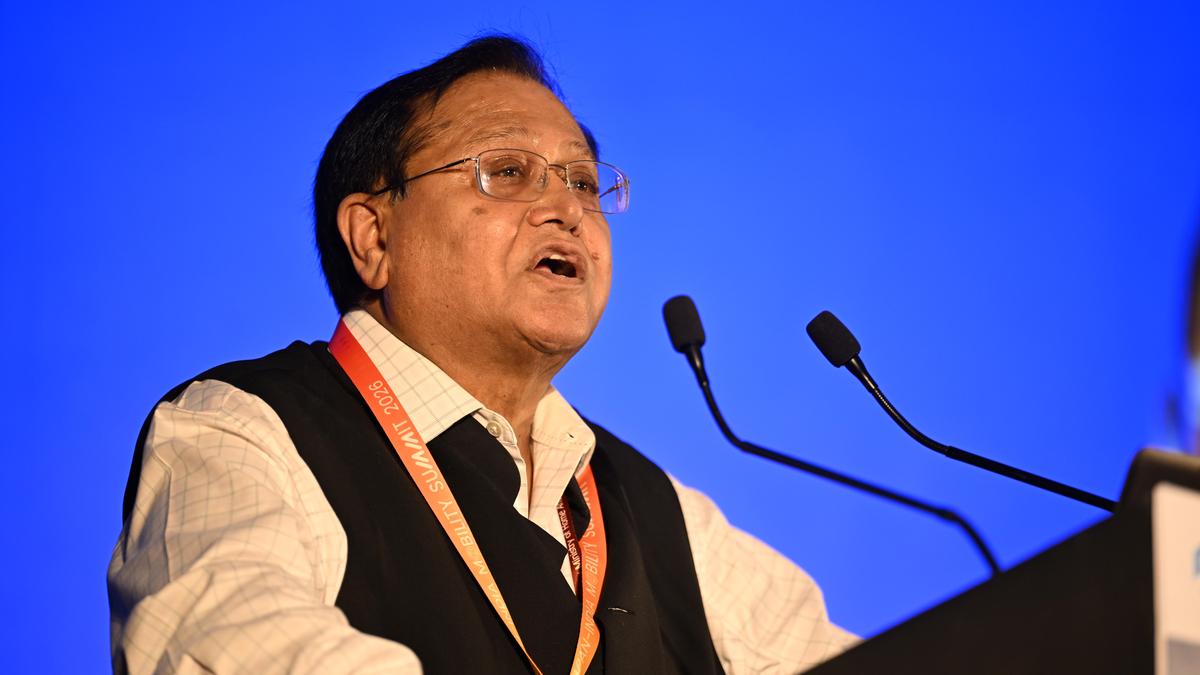
India should partner with Japan in its mobility, clean energy journey: NITI Aayog member
The Hindu
NITI Aayog's V.K. Saraswat emphasizes India-Japan collaboration for future mobility and clean energy advancements at JIMS 2026.
The arrival of Japan’s Suzuki in India in the early ’80s triggered a transformation in India’s automobile industry, which grew exponentially since then; and now, it is time that India worked closely with Japan again towards its journey to the new age mobility seeking to build newer pathways of energy sources, urged V.K. Saraswat, member, NITI Aayog here on Monday.
India and Japan brought complementary strengths to the future of mobility. While India offered scale, market growth and expanding capabilities in software and AI, Japan contributed advanced technological depth, engineering excellence and global leadership in safety and mobility systems, he said while speaking at the Japan-India Mobility Summit 2026 (JIMS 2026) held in the city.
Today, India has a huge manufacturing ambition supported by a policy commitment to diversify in the energy sector, he said.
“India can serve as a large-scale testbed for new technologies like hydrogen grid corridors, mobility as a service integration, grid interactive EV systems and so on,’’ he said.
Mr. Saraswat further said that Japan offered advanced technological support in mobility, power‑semiconductor leadership, and high‑speed rail engineering, and cited the Ahmedabad-Mumbai bullet train project as an example.
According to Mr. Saraswat, Japan’s expertise in safety engineering and signalling systems can significantly improve traffic management and road safety. Integration of smart mobility with smart urbanisation, integrating rail networks with urban growth models, offering valuable insights in establishing multimodal hubs and high-density planning, etc were possible under collaboration.


Nambiyar Nagar residents face severe water shortages and inadequate transport, impacting daily life in the fishermen's community.

Mamata Banerjee accuses CEC of threats to Bengal officials, demanding fair elections and voter inclusion amid ongoing protests.

AIOBCSA calls for OBC inclusion in Karnataka's Rohith Vemula Act to address discrimination in higher education.

Chennai Police Commissioner A. Arun announces comprehensive law and order measures for the upcoming Assembly election to ensure secure polling.

CM A. Revanth Reddy announces women’s stalls at restored lakes, emphasizing urban lake conservation and community development in Hyderabad.

Manipur BJP protests against Central and State leadership for inaction on MLA Vungzagin Valte's death and justice demands.

Chancellor Merz's party faces challenges after a narrow defeat in Baden-Württemberg amid a crucial year of German state elections.

Karnataka HC quashes rape case, emphasizing courts shouldn't serve personal vendettas over consensual relationships, highlighting legal boundaries.

Bengaluru Hotels Association warns of potential restaurant closures due to halted LPG supply, amid rising cylinder prices criticized by CM.

Two Karnataka climbers, Santhosh and Chinmayee, prepare to summit Mount Everest this April as part of a diamond jubilee expedition.

Chief Minister A. Revanth Reddy emphasizes the need for police adaptation to combat cybercrime and narcotics effectively.

Rajya Sabha members call for stricter air pollution laws and restructuring of the Environment Ministry to address climate challenges.

Sonam Wangchuk will focus on dialogue, not protests, for Ladakh's constitutional safeguards after his release from detention.