TNAU delivers advantageous alternative to GI-tagged Pusa basmati rice
The Hindu
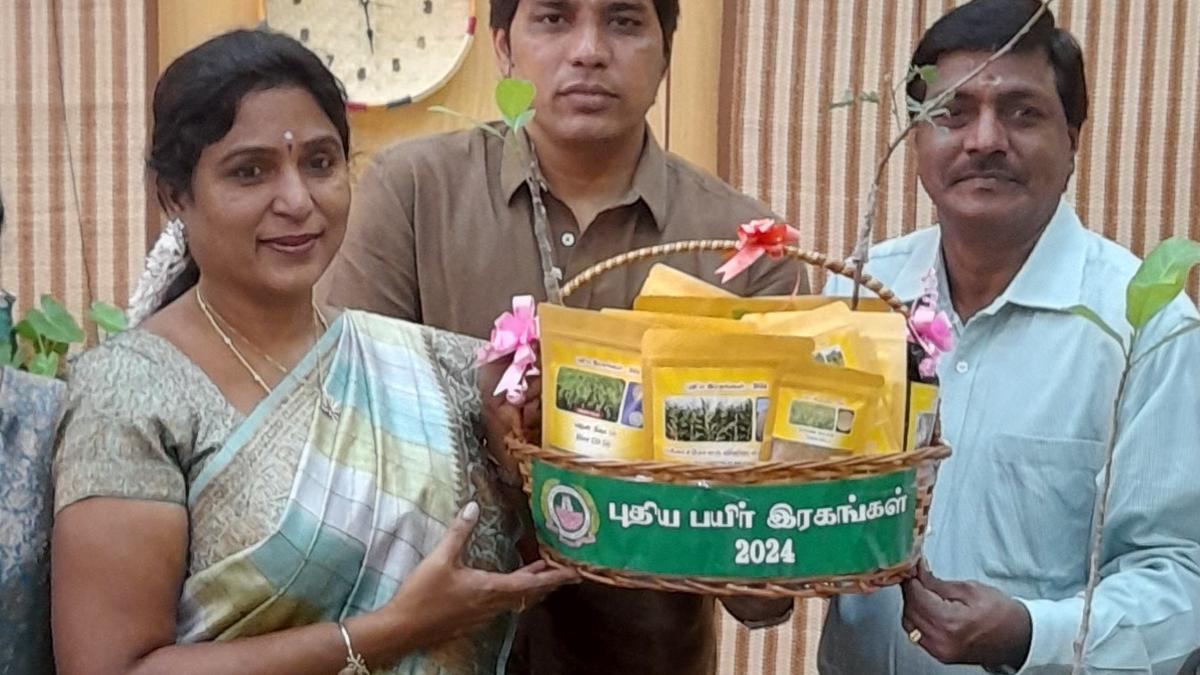
Tamil Nadu Agricultural University introduces new paddy and horticulture seed varieties with higher yields and unique properties.
Tamil Nadu Agricultural University (TNAU) has come out with an alternative to GI (Geographical Indication)-tagged Pusa - 1121, a paddy variety widely utilised for making biriyani.
Releasing a new paddy variety christened CO-58 on Saturday, Vice-Chancellor V. Geethalakshmi said it was as much aromatic as basmati rice, and had advantages.
With the parentage of improved white Ponni rice and Apo rice culture, the new non-basmati variety is also a long slender and aromatic rice with 17 % higher yield than basmati varieties, upto 5,858 kg per hectare.
Suitable for raising in late samba/thaladi season, the high-head rice recovery rate was 55.8 % compared to 20 to 30 % in other long slender basmati varieties. The semi-dwarf and non-lodging variety harboured three drought-tolerant QTLs (Quantitative Trait Loci) of Apo rice culture, and was cultivated over a duration of 120 to 125 days, the Vice-Chancellor said.
The other paddy variety released along with Rice CO-58 was Rice CORH 5, a two-line hybrid with the same cultivation duration for raising during samba/thaladi season. This medium slender grain variety delivered a yield of 6,467 kg per hectare, which was 10 % more than US 312 and 18 % more than ADT 39 paddy varieties.
Rice CORH 5 was suited for easy hybrid seed production, and possessed the properties of intermediate amylose content, gelatinisation temperature and soft gel consistency. It was also moderately resistant to brown plant hopper, stem borer, leaf blast, neck blast and grain discolorisation, Prof. Geethalakshmi said.
Another highlight among the new varieties of seeds was that of the release of Sweet Sorghum CO (SS) 33, the first of its kind in Tamil Nadu, compatible to 20 % ethanol mixing policy.


CCB arrests three drug peddlers in Mangaluru, seizing ₹2.5 lakh worth of MDMA and other valuables.

TVK's 28 candidates in Puducherry include former BJP MLAs, a sitting Independent, and a retired police IG.

BRS submits notice on private member bill to Speaker

CPI-M accepts DMK's five-seat offer for Tamil Nadu Assembly elections, prioritizing INDIA bloc unity over seat demands.

Ricky Rai, son of former underworld operative Muthappa Rai, on Monday appeared before the Bengaluru Traffic Police for questioning in connection with a case involving a Lamborghini performing dangerous stunts at Anil Kumble Circle on March 21.

The Dispur election heats up as 'CongBJP' defections shape a high-stakes contest between veteran candidates from BJP and Congress.

Bengaluru's M. Chinnaswamy Stadium conducts readiness drill ahead of IPL 2026, ensuring upgrades and technical preparations are complete.

First-level randomisation of EVMs completed in Nagapattinam for upcoming elections, ensuring transparency and security.

A district-level committee in Krishnagiri has been formed to assess and verify seizure claims of goods and cash.

Minister Anam Ramanarayana Reddy pledges government support for local fishermen and farmers facing challenges in Andhra Pradesh.

MP M. Sribharat urges collective efforts to revive Visakhapatnam Steel Plant, highlighting key reforms for crucial recovery and growth.

141 candidates have filed nominations for Kozhikode's Assembly elections, with scrutiny on March 24 and campaigning intensifying.

BJP's Vijayendra accuses Congress of using money to influence Bagalkot bypolls, urging voters to reject their tactics.