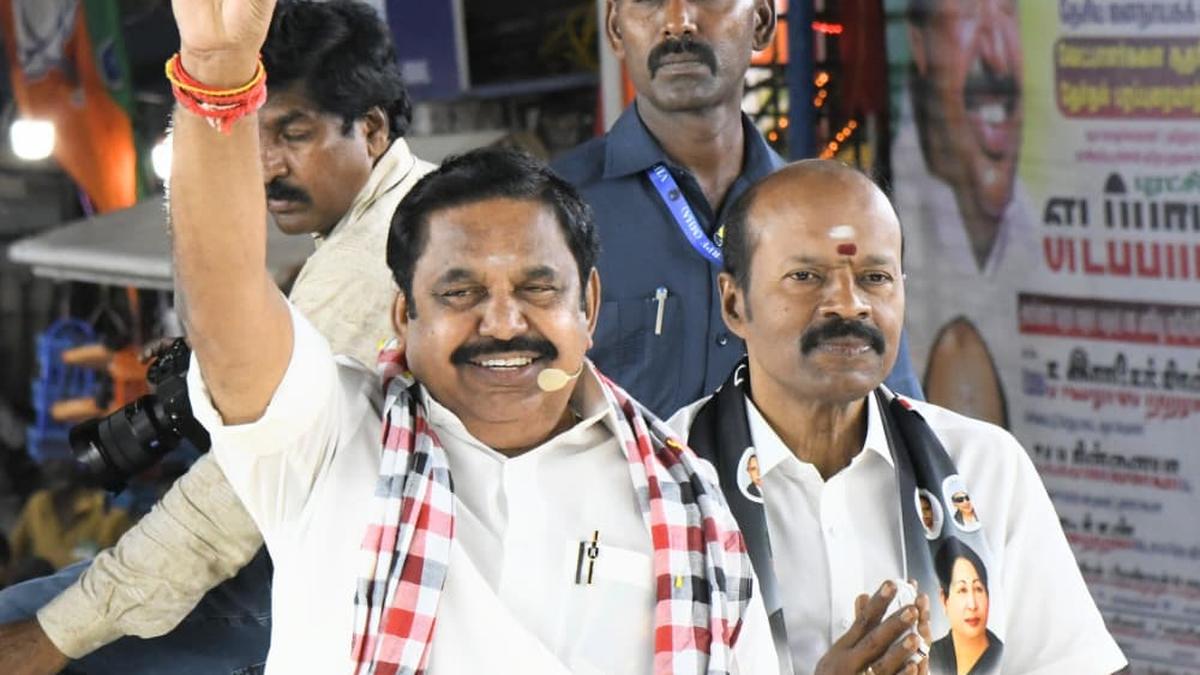
T.N. Assembly election: AIADMK releases second list of candidates, retains 30 sitting legislators
The Hindu
AIADMK announces second candidate list for 2026 Tamil Nadu Assembly elections, retaining 25 MLAs and including 16 women.
The AIADMK on Friday released its second list of candidates, numbering 127, for the upcoming Tamil Nadu Assembly election. Till now, the party has named 150 candidates including 23 in the first list.
According to the the second list released by party general secretary Edappadi K. Palaniswami, 25 sitting MLAs were retained and 10 others were dropped. The list also contained 16 women candidates. Prominent among those who did not figure in the list were former Ministers V. Saroja, V.M. Rajalakshmi, Vaigaichelvan, and ‘Ma Foi’ K. Pandiarajan, all of whom lost in the 2021 election.
Ex-Ministers on the list
Former Ministers who made it to the list included N. Thalavai Sundaram, M.C. Sampath, Be. Vee. Ramanah, V. Somasundaram, P. Balakrishna Reddy, Mukkur N. Subramanian, M.S.M. Anandan, Pollachi V. Jayaraman, S.P. Shanmuganathan, and S.T. Chellapandian. The sole AIADMK’s legislator in the Kancheepuram-Tiruvallur-Chengalpattu-Chennai belt, Maragatham Kumaravel, has been renominated for Madurantakam.
An interesting feature of the list was the inclusion of P. Saravanan, who in 2021 contested in the AIADMK-led front as a nominee of the BJP in Madurai (North). This time too, he is trying his luck from the same seat. Likewise, I. Mahendran, who has been chosen by the Dravidian major, contested in 2021 as the nominee of the Amma Makkal Munnetra Kazhagam (AMMK), now an ally of the AIADMK.
Later in the day, Mr. Palaniswami criticised the DMK president and Chief Minister M.K. Stalin for not being able to conclude the process of identification of constituencies for constituents of the DMK-led front.


Musi Riverfront Development Project: With the Telangana government ready to implement the project in Hyderabad, residents along the river are facing possible displacement and uncertainty over compensation. Once seasonal streams, the Moosa and Esi tributaries now flow with sewage and industrial effluents, raising questions about ecological restoration.

AIADMK announces second candidate list for 2026 Tamil Nadu Assembly elections, retaining 25 MLAs and including 16 women.

Bombay High Court dismisses plea for CBI probe against RIL and Mukesh Ambani, deeming it without merit and an abuse of process.

Explore the emotional coercion in voting through a modern campaign reminiscent of Krishnan Nambi's allegorical short story.

Heavy rain and thunder hit parts of Hyderabad Friday March 27, 2026 night, with forecasts for more rain in the coming days.

Tirumala Tirupati Devasthanams begins packing Talambralu for Sri Sita Rama Kalyanam, involving 600 volunteers and special rituals.

Prakash Karat urges unity to oppose US-Israel actions against Iran, emphasizing India's anti-imperialist legacy at CPI(M) seminar.

Explore Nanjil Nadan's "Vaaku Porukkikal," highlighting DMK leaders' connection to the people leading to their 1967 victory.

V.D. Satheesan accuses Kerala's CM Pinarayi Vijayan of exploiting communalism for electoral gain ahead of the 2026 Assembly polls.

Be ready for challenges, students told at Holy Mary Engineering College Silver Jubilee

Voters in Mettupalayam demand action to save the polluted River Bhavani.

Election officials in Vellore identify 416 vulnerable polling booths, implementing safety measures ahead of the Tamil Nadu Assembly elections.

Information on colleges, admissions, scholarships, events, MoUs, and more