Anger on the banks of the Musi
The Hindu
Musi Riverfront Development Project: With the Telangana government ready to implement the project in Hyderabad, residents along the river are facing possible displacement and uncertainty over compensation. Once seasonal streams, the Moosa and Esi tributaries now flow with sewage and industrial effluents, raising questions about ecological restoration.
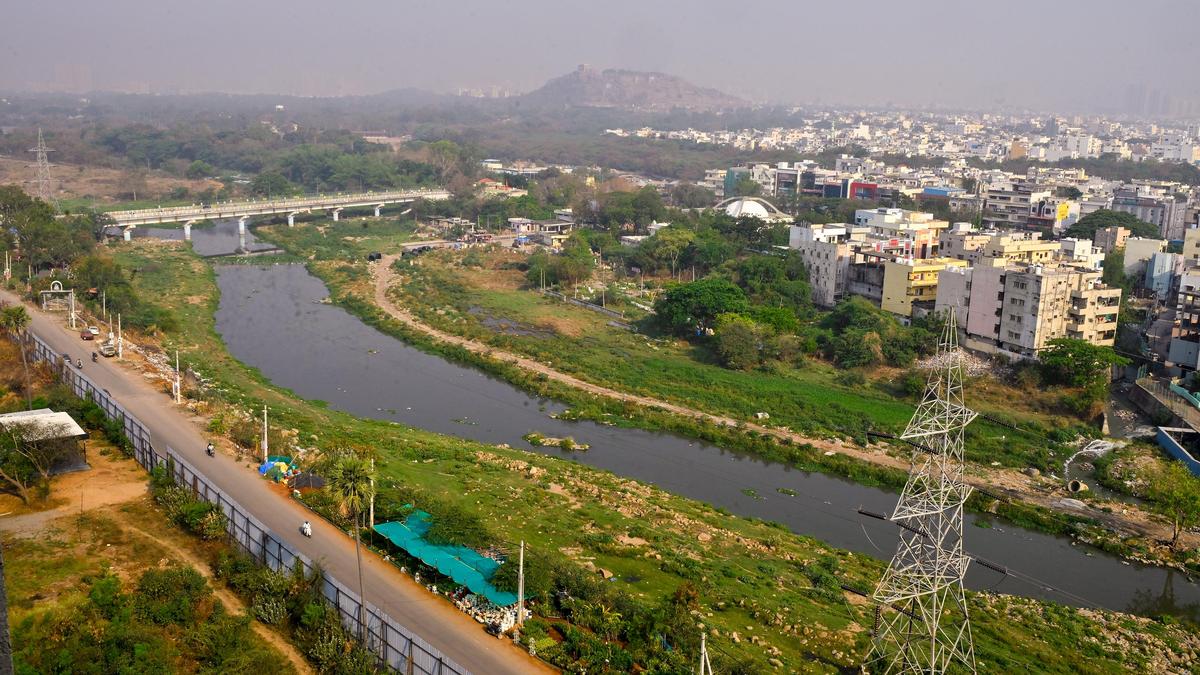
Thulasi Chandu, a journalist who runs her own YouTube channel, is one of the 417 occupants of the residential complex, Madhu Park Ridge, at Langar Houz. From her balcony, she gets a view of southern Hyderabad: the imposing 12th century Golconda Fort on one side and a sweeping view of greenery, which slowly gives way to a rising concrete jungle.
Down the slope of the plateau on which Madhu Park Ridge stands, the rivulet Moosa, a tributary of the Musi river, meanders through the landscape for 11.2 . Its course from the still-green Ananthagiri hills into Hyderabad is regulated by the Osman Sagar reservoir at the city’s edge, built after the catastrophic floods of 1908. On a closer look, however, what flows through Moosa is a dark, almost opaque stream of sewage and effluents discharged from surrounding establishments.
About 500 metres away, another stream, the Esi, flows from Himayat Sagar, another flood-control reservoir constructed after the floods.
These two rivulets merge a short distance further, and together with continuous downstream inflows of sewage and effluents through the city, they form the Musi, a seasonal river, which has become a sinuous channel of perennial pollution. From the Ananthagiri hills up to Wadapally village in Nalgonda, where it flows into the Krishna river, the Musi is 240-260 km long, with 55 km of it flowing through Hyderabad.
“The stench is unbearable and there are swarms of mosquitoes,” says Chandu. But neither is reason enough for her to leave her home, she insists.
Chandu is furious that the Telangana government is attempting to displace her and others along the stretch for its ambitious Musi Riverfront Development Project (MRDP). The government plans to turn the seasonal river into a perennial one, while developing leisure spaces and shopping areas, and reviving heritage structures along the banks. For people who have lived by the river for decades, however, this spells displacement.


Musi Riverfront Development Project: With the Telangana government ready to implement the project in Hyderabad, residents along the river are facing possible displacement and uncertainty over compensation. Once seasonal streams, the Moosa and Esi tributaries now flow with sewage and industrial effluents, raising questions about ecological restoration.

AIADMK announces second candidate list for 2026 Tamil Nadu Assembly elections, retaining 25 MLAs and including 16 women.

Bombay High Court dismisses plea for CBI probe against RIL and Mukesh Ambani, deeming it without merit and an abuse of process.

Explore the emotional coercion in voting through a modern campaign reminiscent of Krishnan Nambi's allegorical short story.

Heavy rain and thunder hit parts of Hyderabad Friday March 27, 2026 night, with forecasts for more rain in the coming days.

Tirumala Tirupati Devasthanams begins packing Talambralu for Sri Sita Rama Kalyanam, involving 600 volunteers and special rituals.

Prakash Karat urges unity to oppose US-Israel actions against Iran, emphasizing India's anti-imperialist legacy at CPI(M) seminar.

Explore Nanjil Nadan's "Vaaku Porukkikal," highlighting DMK leaders' connection to the people leading to their 1967 victory.

V.D. Satheesan accuses Kerala's CM Pinarayi Vijayan of exploiting communalism for electoral gain ahead of the 2026 Assembly polls.

Be ready for challenges, students told at Holy Mary Engineering College Silver Jubilee

Voters in Mettupalayam demand action to save the polluted River Bhavani.

Election officials in Vellore identify 416 vulnerable polling booths, implementing safety measures ahead of the Tamil Nadu Assembly elections.

Information on colleges, admissions, scholarships, events, MoUs, and more