Prakash Karat slams Centre for not condemning U.S.-Israel attack on Iran
The Hindu
Prakash Karat urges unity to oppose US-Israel actions against Iran, emphasizing India's anti-imperialist legacy at CPI(M) seminar.
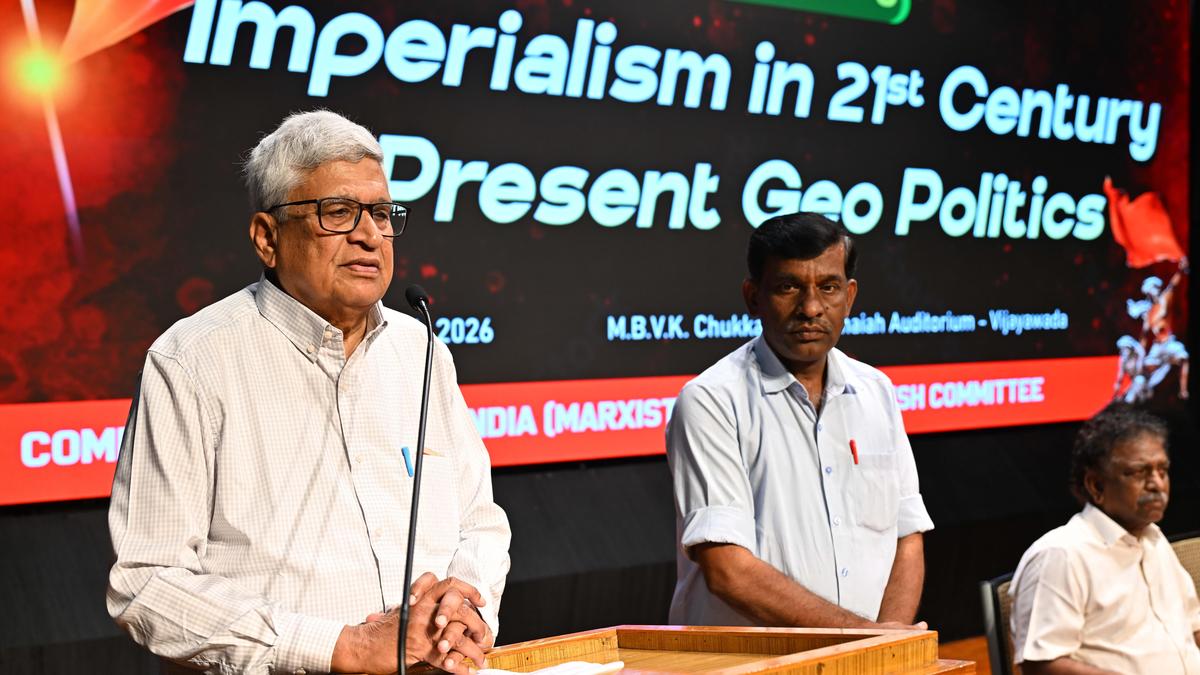
Calling for the preservation of India’s historic anti-imperialist legacy, CPI(M) former General Secretary Prakash Karat urged people to unite and protest against the ongoing US–Israel actions, particularly in Iran.
He was speaking at a seminar on “Imperialism in the 21st Century—International Developments” organised by the CPI (M) State Committee at MV Vignana Kendram on Friday (March 27, 2026). The meeting was chaired by State Secretary V. Srinivasa Rao.
Mr. Karat described the US–Israel military actions against Iran as “unjust and immoral,” and criticised the Government of India for not condemning the attacks. The Union government, led by Prime Minister Narendra Modi, had compromised India’s independent foreign policy by aligning closely with the United States, he alleged.
Referring to global economic trends, Mr. Karat said that after the collapse of the Soviet Union, liberal economic policies gained dominance worldwide. However, these policies are now facing a deep crisis, pushing imperialist countries to exploit developing nations as markets to sustain their economies.
He noted that China’s rise as a major economic power has posed a serious challenge to US global dominance. In response, the United States has increasingly resorted to military interventions in countries such as Iraq, Libya, and Syria.
On the Iran conflict, Mr. Karat said the ongoing war has disrupted global oil supplies, particularly through the Strait of Hormuz, creating economic strain across nations. While the US sought to pressure countries like China through these disruptions, he pointed out that China has secured alternative energy arrangements, including increased oil imports from Russia. Meanwhile, Russia has benefited by expanding its oil trade amid global tensions.


Musi Riverfront Development Project: With the Telangana government ready to implement the project in Hyderabad, residents along the river are facing possible displacement and uncertainty over compensation. Once seasonal streams, the Moosa and Esi tributaries now flow with sewage and industrial effluents, raising questions about ecological restoration.

AIADMK announces second candidate list for 2026 Tamil Nadu Assembly elections, retaining 25 MLAs and including 16 women.

Bombay High Court dismisses plea for CBI probe against RIL and Mukesh Ambani, deeming it without merit and an abuse of process.

Explore the emotional coercion in voting through a modern campaign reminiscent of Krishnan Nambi's allegorical short story.

Heavy rain and thunder hit parts of Hyderabad Friday March 27, 2026 night, with forecasts for more rain in the coming days.

Tirumala Tirupati Devasthanams begins packing Talambralu for Sri Sita Rama Kalyanam, involving 600 volunteers and special rituals.

Prakash Karat urges unity to oppose US-Israel actions against Iran, emphasizing India's anti-imperialist legacy at CPI(M) seminar.

Explore Nanjil Nadan's "Vaaku Porukkikal," highlighting DMK leaders' connection to the people leading to their 1967 victory.

V.D. Satheesan accuses Kerala's CM Pinarayi Vijayan of exploiting communalism for electoral gain ahead of the 2026 Assembly polls.

Be ready for challenges, students told at Holy Mary Engineering College Silver Jubilee

Voters in Mettupalayam demand action to save the polluted River Bhavani.

Election officials in Vellore identify 416 vulnerable polling booths, implementing safety measures ahead of the Tamil Nadu Assembly elections.

Information on colleges, admissions, scholarships, events, MoUs, and more