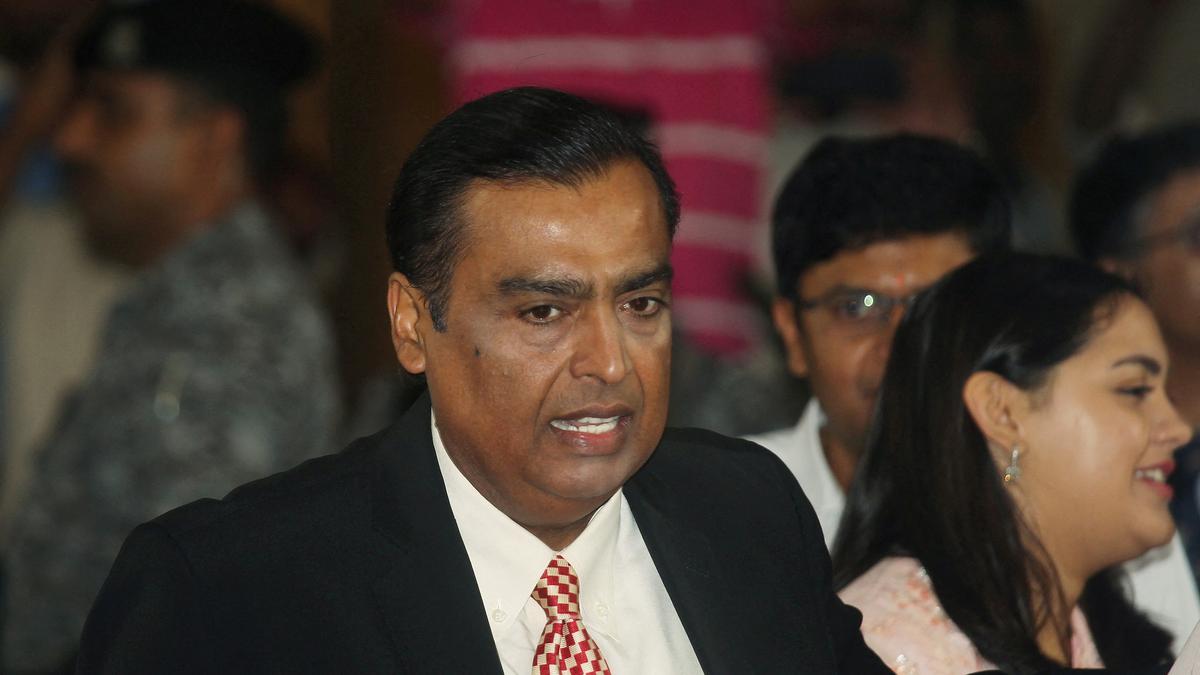
Bombay High Court dismisses plea seeking CBI probe against RIL, Mukesh Ambani
The Hindu
Bombay High Court dismisses plea for CBI probe against RIL and Mukesh Ambani, deeming it without merit and an abuse of process.
The Bombay High Court on Friday (March 27, 2026) dismissed a criminal writ petition seeking a direction to the Central Bureau of Investigation to register a first information report (FIR) against Reliance Industries Limited (RIL) and its officials over allegations of unauthorised extraction of natural gas from wells belonging to the Oil and Natural Gas Corporation (ONGC) in the Krishna Godavari Basin.
A Division Bench of Chief Justice Shree Chandrashekhar and Justice Suman Shyam found the petition, filed by Jitendra Punamchand Maru, to be without merit and motivated by oblique considerations. The court observed that the petitioner had failed to establish any public interest in the matter and noted the significant delay in approaching the court.
The petitioner had alleged that RIL, under a Production Sharing Contract (PSC) for exploration, engaged in sideways drilling into adjacent ONGC wells between 2004 and 2014 to extract gas without authority. The petition relied on a 2015 report by M/s. De Golyer and Macnaghten, which stated that RIL had tapped gas from ONGC wells, and findings of a committee headed by former Chief Justice A.P. Shah, which quantified the value of the extracted gas.
The CBI, in its affidavit, stated that the allegations appeared to pertain to a civil dispute. The agency informed the court that the petitioner’s complaint had been closed in September 2025. RIL, which was added as a respondent, contended that the petitioner had suppressed material facts and that the dispute was contractual in nature. RIL also pointed to an arbitral award in its favour from July 2018, noting that pending litigation over the award was before the Supreme Court.
The court overruled an objection from the petitioner’s counsel, Rajendra Desai, that RIL was not entitled to be heard at the stage of seeking FIR registration. The Bench noted that the facts in the petition were derived from a judgment of the Delhi High Court and observed that the petitioner could not offer an explanation for the delay of approximately 15 years in approaching the court.
In its judgment, the Bench stated that registration of a criminal case entails serious consequences and that a writ petition seeking such a direction must be examined for the petitioner’s bona fides. The court noted that the petitioner, who stated he was previously engaged in the sale of plastics and was not carrying on any business activity, could not demonstrate any public cause behind the petition.


Musi Riverfront Development Project: With the Telangana government ready to implement the project in Hyderabad, residents along the river are facing possible displacement and uncertainty over compensation. Once seasonal streams, the Moosa and Esi tributaries now flow with sewage and industrial effluents, raising questions about ecological restoration.

AIADMK announces second candidate list for 2026 Tamil Nadu Assembly elections, retaining 25 MLAs and including 16 women.

Bombay High Court dismisses plea for CBI probe against RIL and Mukesh Ambani, deeming it without merit and an abuse of process.

Explore the emotional coercion in voting through a modern campaign reminiscent of Krishnan Nambi's allegorical short story.

Heavy rain and thunder hit parts of Hyderabad Friday March 27, 2026 night, with forecasts for more rain in the coming days.

Tirumala Tirupati Devasthanams begins packing Talambralu for Sri Sita Rama Kalyanam, involving 600 volunteers and special rituals.

Prakash Karat urges unity to oppose US-Israel actions against Iran, emphasizing India's anti-imperialist legacy at CPI(M) seminar.

Explore Nanjil Nadan's "Vaaku Porukkikal," highlighting DMK leaders' connection to the people leading to their 1967 victory.

V.D. Satheesan accuses Kerala's CM Pinarayi Vijayan of exploiting communalism for electoral gain ahead of the 2026 Assembly polls.

Be ready for challenges, students told at Holy Mary Engineering College Silver Jubilee

Voters in Mettupalayam demand action to save the polluted River Bhavani.

Election officials in Vellore identify 416 vulnerable polling booths, implementing safety measures ahead of the Tamil Nadu Assembly elections.

Information on colleges, admissions, scholarships, events, MoUs, and more