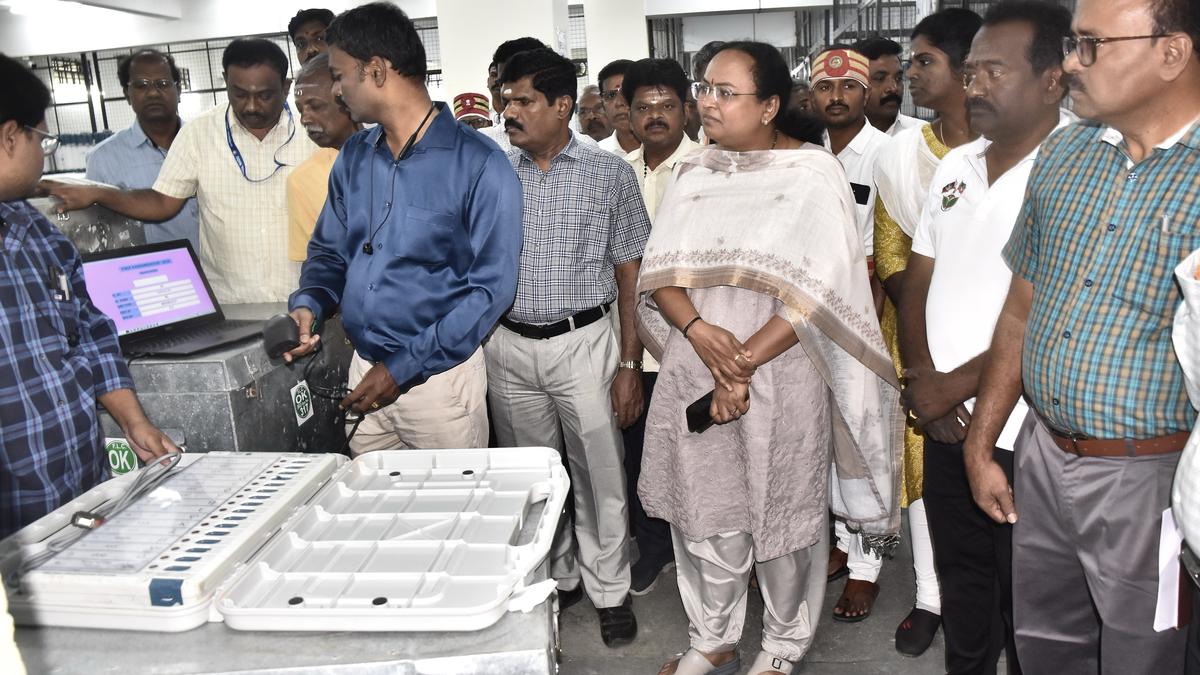
District election officials identify 416 vulnerable polling booths in Vellore, nearby districts
The Hindu
Election officials in Vellore identify 416 vulnerable polling booths, implementing safety measures ahead of the Tamil Nadu Assembly elections.
The district election officials have identified 416 vulnerable polling booths in Vellore, Ranipet, Tirupattur, and Tiruvannamalai districts as part of enforcing the Model Code of Conduct for Tamil Nadu Assembly elections, which will be held on April 23.
Election officials said that together, these districts have at least 21 Assembly constituencies including Katpadi, Vellore, Arakkonam, Sholinghur, Ranipet, Jolarpet, Tirupatur, Arani, Vandavasi, Cheyyar, Chengam, Tiruvannamalai, Ambur, and Vaniyambadi.
More than 6,000 polling booths within Tiruvannamalai district alone have 3,270 booths for its eight Assembly constituencies for the elections. “As most polling booths are government schools, steps to provide basic amenities are being done. The booths are under constant vigil by election officials and police,” said an election official.
Of the identified vulnerable booths, Vellore has the highest number with 137 booths, followed by Ranipet, 136, Tiruvannamalai, 80, and Tirupattur 63. Safety measures including web cameras, police personnel and status of strong rooms are also being taken.
As most of the polling booths are government schools, especially in remote rural areas, easy access to these polling booths, including levelling of the open area of the campus are also being done. Washrooms and water taps are readied.
A crackdown on history sheeters and repeat offenders is also being undertaken by the respective district police to ensure smooth and peaceful polling. The police have also initiated a visit to licenced arms holders, who have not voluntarily given the arms to the local police station. More than 1,500 licenced arms holders have been identified in these districts.


Musi Riverfront Development Project: With the Telangana government ready to implement the project in Hyderabad, residents along the river are facing possible displacement and uncertainty over compensation. Once seasonal streams, the Moosa and Esi tributaries now flow with sewage and industrial effluents, raising questions about ecological restoration.

AIADMK announces second candidate list for 2026 Tamil Nadu Assembly elections, retaining 25 MLAs and including 16 women.

Bombay High Court dismisses plea for CBI probe against RIL and Mukesh Ambani, deeming it without merit and an abuse of process.

Explore the emotional coercion in voting through a modern campaign reminiscent of Krishnan Nambi's allegorical short story.

Heavy rain and thunder hit parts of Hyderabad Friday March 27, 2026 night, with forecasts for more rain in the coming days.

Tirumala Tirupati Devasthanams begins packing Talambralu for Sri Sita Rama Kalyanam, involving 600 volunteers and special rituals.

Prakash Karat urges unity to oppose US-Israel actions against Iran, emphasizing India's anti-imperialist legacy at CPI(M) seminar.

Explore Nanjil Nadan's "Vaaku Porukkikal," highlighting DMK leaders' connection to the people leading to their 1967 victory.

V.D. Satheesan accuses Kerala's CM Pinarayi Vijayan of exploiting communalism for electoral gain ahead of the 2026 Assembly polls.

Be ready for challenges, students told at Holy Mary Engineering College Silver Jubilee

Voters in Mettupalayam demand action to save the polluted River Bhavani.

Election officials in Vellore identify 416 vulnerable polling booths, implementing safety measures ahead of the Tamil Nadu Assembly elections.

Information on colleges, admissions, scholarships, events, MoUs, and more