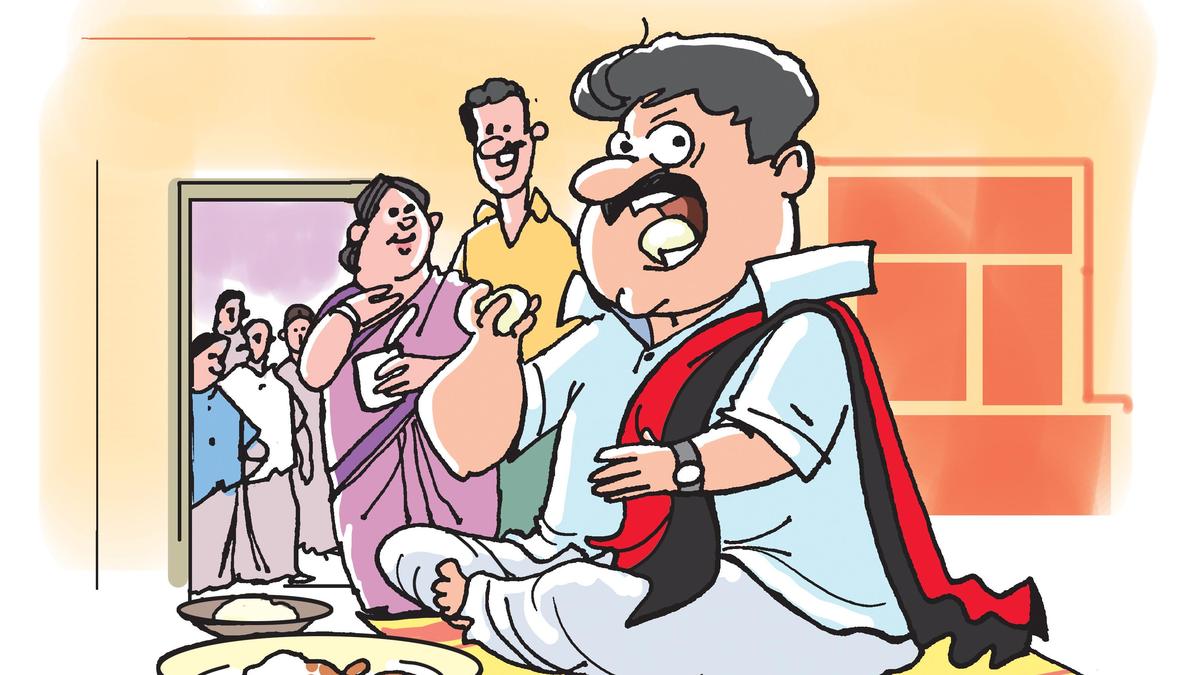
Capturing the political acumen of DMK men in a short story
The Hindu
Explore Nanjil Nadan's "Vaaku Porukkikal," highlighting DMK leaders' connection to the people leading to their 1967 victory.
The emergence of the Dravida Munnetra Kazhagam (DMK) in Tamil Nadu’s political landscape, and its victory in 1967 — sweeping aside Congress leaders, including K. Kamaraj and Chief Minister M. Bhaktavatsalam — can be understood through what the Italian communist leader Antonio Gramsci described as “organic intellectuals”.
Vaaku Porukkikal (Vote Scavengers), despite its rather harsh title, is a short story by Sahitya Akademi Award-winning writer Nanjil Nadan that explores how the then DMK leaders and candidates remained rooted in ground realities and represented the aspirations of the people. The story was published in Kanaiyazhi in 1981.
In the story, the contest is among three candidates. Ayyappan Pillai, son of a Congress man, Adhimoolam Pillai, is traditionally wealthy, owning acres of land, coconut groves, and other agricultural assets, and wears only khadi.
Parameswaran, a development economist, has worked as an economic adviser to a couple of African countries. His advantage lies in having two wives — one from his own community and the other from a Scheduled Caste community — who campaign for him in places where their presence is considered effective.
Kulasai Arivarasan, as the name suggests, is the DMK candidate, “a worker committed to his leader, who dedicated his life to Tamil and his body to the soil”. A former handloom worker, he has already spent two months in jail for a protest against price rise, and two weeks during the anti-Hindi imposition agitation. He missed earning the moniker, ‘MISA Arivarasan’, as he developed “heart problems” out of fear during the Emergency.
Adhimoolam Pillai does not enjoy goodwill even among his own community, and would not allow anyone to take a ride in his Ambassador car, even when he is travelling alone. However, during the election, his car carries relatives and friends — a person returning from the market with gunny bags of goods, a farmer returning from the field, and a mother returning from hospital after treatment for her child.


Musi Riverfront Development Project: With the Telangana government ready to implement the project in Hyderabad, residents along the river are facing possible displacement and uncertainty over compensation. Once seasonal streams, the Moosa and Esi tributaries now flow with sewage and industrial effluents, raising questions about ecological restoration.

AIADMK announces second candidate list for 2026 Tamil Nadu Assembly elections, retaining 25 MLAs and including 16 women.

Bombay High Court dismisses plea for CBI probe against RIL and Mukesh Ambani, deeming it without merit and an abuse of process.

Explore the emotional coercion in voting through a modern campaign reminiscent of Krishnan Nambi's allegorical short story.

Heavy rain and thunder hit parts of Hyderabad Friday March 27, 2026 night, with forecasts for more rain in the coming days.

Tirumala Tirupati Devasthanams begins packing Talambralu for Sri Sita Rama Kalyanam, involving 600 volunteers and special rituals.

Prakash Karat urges unity to oppose US-Israel actions against Iran, emphasizing India's anti-imperialist legacy at CPI(M) seminar.

Explore Nanjil Nadan's "Vaaku Porukkikal," highlighting DMK leaders' connection to the people leading to their 1967 victory.

V.D. Satheesan accuses Kerala's CM Pinarayi Vijayan of exploiting communalism for electoral gain ahead of the 2026 Assembly polls.

Be ready for challenges, students told at Holy Mary Engineering College Silver Jubilee

Voters in Mettupalayam demand action to save the polluted River Bhavani.

Election officials in Vellore identify 416 vulnerable polling booths, implementing safety measures ahead of the Tamil Nadu Assembly elections.

Information on colleges, admissions, scholarships, events, MoUs, and more