Should NOTA be included in all elections compulsorily? | Explained Premium
The Hindu
Vidhi Centre for Legal Policy advocates for compulsory NOTA option in all elections, challenging Election Commission's stance.
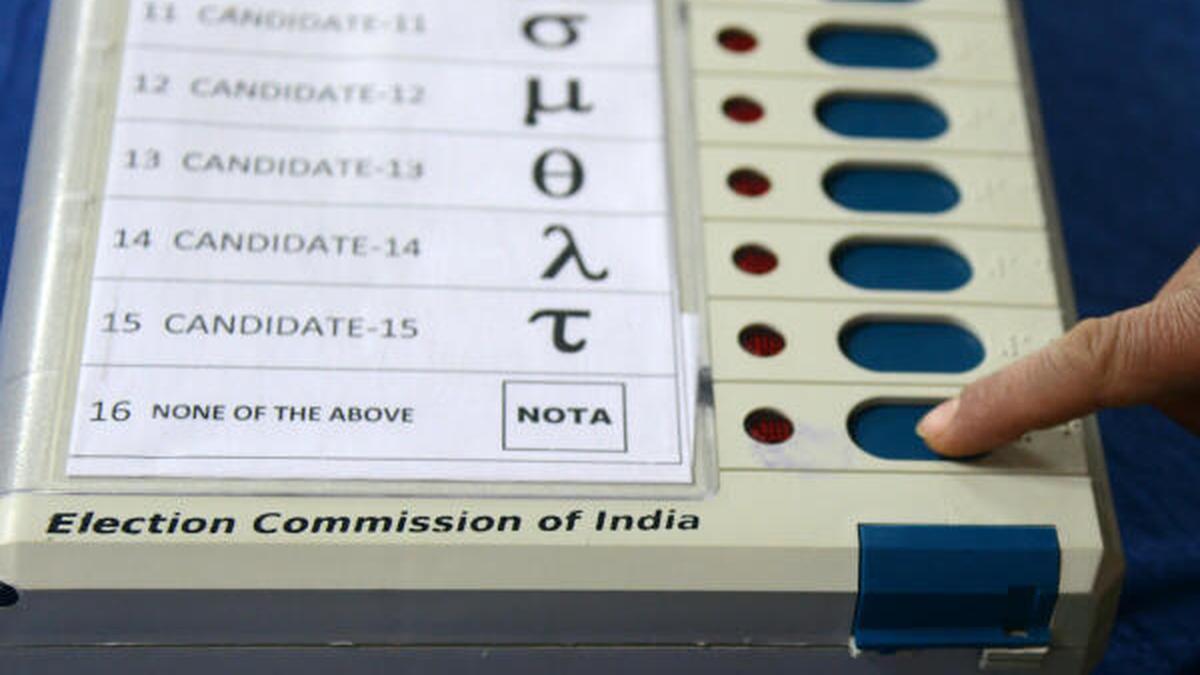
The story so far: Recently, the Vidhi Centre for Legal Policy filed a Public Interest Litigation (PIL) for including NOTA as an option compulsorily in every election, even if there is only one single candidate.
NOTA or the ‘None of the Above’ option was introduced in Indian elections for the first time in 2013 on the PIL filed by the People’s Union for Civil Liberties which sought a mechanism to “recognise the right of a voter not to vote, but still the secrecy of his having not voted is not maintained in its implementation...”
It is true that not many voters have opted for NOTA during the last national election and the other subsequent State-level elections. However, not holding an election in a constituency because there is only one candidate, would mean denying voters the chance of expressing their opinion (through NOTA) against that single candidate who will anyhow get elected unopposed. The Election Commission (EC) has argued against NOTA stating that it has not brought in the desired results as not many voters have opted for NOTA in past elections. But one should not forget that NOTA is a way through which our electoral system can become more responsive to people.
The EC is completely opposed to the idea of making NOTA a compulsory option in all constituencies even if there is only one candidate contesting the election. The Election Commission presented data that in all the Lok Sabha elections held since 1971, there have been only six uncontested elections. Another data point cited by the EC was that since 1952, there have been only nine cases of candidates getting elected unopposed. The EC’s lawyer said that, “the chance of election being uncontested has become a rarity which is also proven by statistical data; hence Supreme Court should not even entertain such a PIL”. They went on to argue that “treating NOTA as mandatorily contesting candidate in all direct uncontested elections does not find a place in the statues and same would require legislative amendments in the provisions of Representation of the People Act 1951, and the conduct of Election Rules 1961”.
Since it is such a rarity, the EC should not have its hands full. If the EC can conduct elections in such a large number of constituencies given its resources, holding elections in constituencies, with a NOTA option, even if there is only one candidate, should not amount to a lot of additional work.
It is true that looking in terms of per cent only little more than 1% of voters, voted for NOTA in the three Lok Sabha elections (2014, 2019 and 2024) held since NOTA was introduced. But given the size of the electorate in one Parliamentary constituency, each having on an average about 25 lakh voters, even these numbers are not small. There are many State assembly elections where little more than 1% opted for NOTA over the last decade, the highest being in Bihar with 2.48% during the 2015 Assembly election, followed by Gujarat with 1.8% during the 2017 Assembly elections. If one looks at the NOTA votes over the years in different States, one sees that it was slightly higher in the very first election held in the State after NOTA was introduced but declined in subsequent elections, although the trend is not linear.
Some reforms are needed. One can be by fixing the minimum per cent of votes to be polled by the candidate as a benchmark for getting elected depending upon the size of the constituency. The other method could be by giving legitimacy to NOTA votes and voters, by making a provision for re-election if certain percentage of voters opt for NOTA in an election.


Gaurav Gogoi files nomination for Jorhat Assembly seat, marking his electoral debut in the upcoming Assam elections.

A round-up of events and programmes held at colleges in Tiruchi and other Cauvery delta districts

CPI(M) and Congress clash over accusations of aiding BJP, threatening the LDF-UDF duopoly ahead of Kerala Assembly polls 2026.

Shivamogga veterinarians demand accountability for the death of trainee vet Dr. Sameeksha Reddy, citing systemic failures in zoo administration.

BJP launches 'Mana Ooru–Mana Jenda' campaign on April 6 to strengthen grassroots connections and promote development in Andhra Pradesh.

Anuradha Jonnalagadda took over as in-charge Vice-Chancellor of the University of Hyderabad, focusing on continuity during the transition.

Telangana government awaits committee report on TGSRTC staff absorption, with decisions to be made at an appropriate time.

Telangana's revised pay scale implementation for employees will take timer. The tenure of Pay Revision Commission extended. Govt likely to take decision on reccomendation based on its report.

Vizianagaram's SP A.R. Damodar highlights 20 accident-prone areas and urges drivers to prioritize safety with helmets and seat belts.

Kerala HC stays disqualification of SNDP Yogam leaders, reversing a single judge's order regarding financial and regulatory compliance issues.

Karnataka announces daily supply of 10,000 LPG cylinders to hotels, easing the commercial shortage for the hospitality industry.

Malayalam superstar Mohanlal will be reuniting with filmmaker Priyadarshan, it was announced recently. It will mark the 100th film of Priyadarshan and is backed by Mohanlal’s longtime collaborator, Antony Perumbavoor

Gautham Vasudev Menon loses Madras High Court appeal, ordered to pay ₹4.25 crore to R.S. Infotainment with interest.