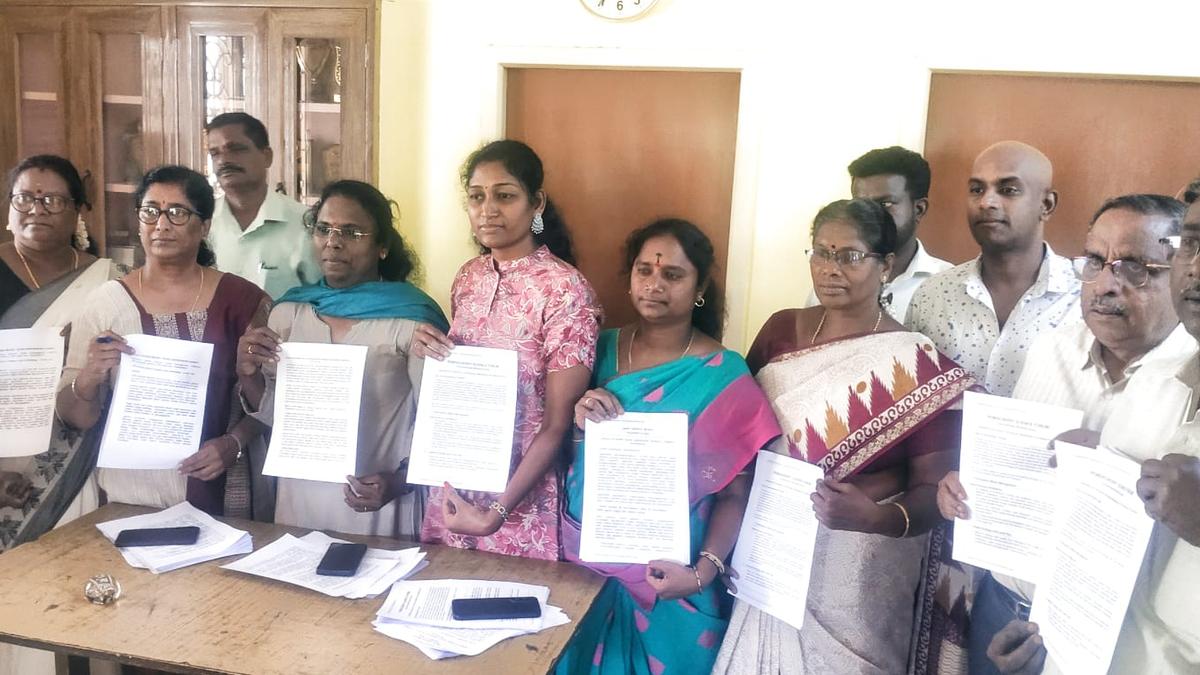
Science Forum urges political parties to focus on education and environment sectors in U.T.
The Hindu
Puducherry Science Forum urges political parties to prioritize education and environment in upcoming Assembly elections for sustainable development.
The Puducherry Science Forum (PSF) has urged political parties to prioritise education and environment sectors while drafting the manifesto to contest the April 9 Assembly elections.
In an appeal to all political parties and candidates, the PSF called for their commitment to one overarching principle of democratic decision making and citizen participation in environment policy and a set of priority areas including participatory water management, coastal ecology and land use, urban planning, biodiversity conservation, solid waste management and climate change.
The PSF wanted safe drinking water made available to all as a fundamental right and clear plans formulated with local participation for protection and restoration of natural drainage systems. It also sought strict segregation of sewerage from drinking water and stormwater networks to prevent contamination of waterbodies, and developing an adequate State-wide system for proper sewage disposal, segregation of bio-degradable and non-bio-degradable waste at household-level.
It also recommended designing protocols for e-waste management and recycling, strict enforcement of the ban on single-use plastics and establishing a bio-mining plant at the landfill sites.
According to the PSF, Puducherry has become increasingly vulnerable to a number of threats to its environment and development due to a combination of anthropogenic pressures, unscientific nature of urban planning and development policies and climate change.
It called for a community-managed system based on a scientific survey and mapping of all wetlands of Puducherry, including ‘eris’ (traditional irrigation tanks), lagoons, estuaries, backwaters, marshes, and associated seasonal and perennial waterbodies. The process should incorporate hydrological boundaries, catchment areas, inflow–outflow channels, and buffer zones essential for maintaining ecological integrity.


Musi Riverfront Development Project: With the Telangana government ready to implement the project in Hyderabad, residents along the river are facing possible displacement and uncertainty over compensation. Once seasonal streams, the Moosa and Esi tributaries now flow with sewage and industrial effluents, raising questions about ecological restoration.

AIADMK announces second candidate list for 2026 Tamil Nadu Assembly elections, retaining 25 MLAs and including 16 women.

Bombay High Court dismisses plea for CBI probe against RIL and Mukesh Ambani, deeming it without merit and an abuse of process.

Explore the emotional coercion in voting through a modern campaign reminiscent of Krishnan Nambi's allegorical short story.

Heavy rain and thunder hit parts of Hyderabad Friday March 27, 2026 night, with forecasts for more rain in the coming days.

Tirumala Tirupati Devasthanams begins packing Talambralu for Sri Sita Rama Kalyanam, involving 600 volunteers and special rituals.

Prakash Karat urges unity to oppose US-Israel actions against Iran, emphasizing India's anti-imperialist legacy at CPI(M) seminar.

Explore Nanjil Nadan's "Vaaku Porukkikal," highlighting DMK leaders' connection to the people leading to their 1967 victory.

V.D. Satheesan accuses Kerala's CM Pinarayi Vijayan of exploiting communalism for electoral gain ahead of the 2026 Assembly polls.

Be ready for challenges, students told at Holy Mary Engineering College Silver Jubilee

Voters in Mettupalayam demand action to save the polluted River Bhavani.

Election officials in Vellore identify 416 vulnerable polling booths, implementing safety measures ahead of the Tamil Nadu Assembly elections.

Information on colleges, admissions, scholarships, events, MoUs, and more