Organised Kannada lexicography comes to a standstill
The Hindu
State government rejects ₹10 crore proposal to revive Kannada lexicography, leaving the language stagnant for over two decades.
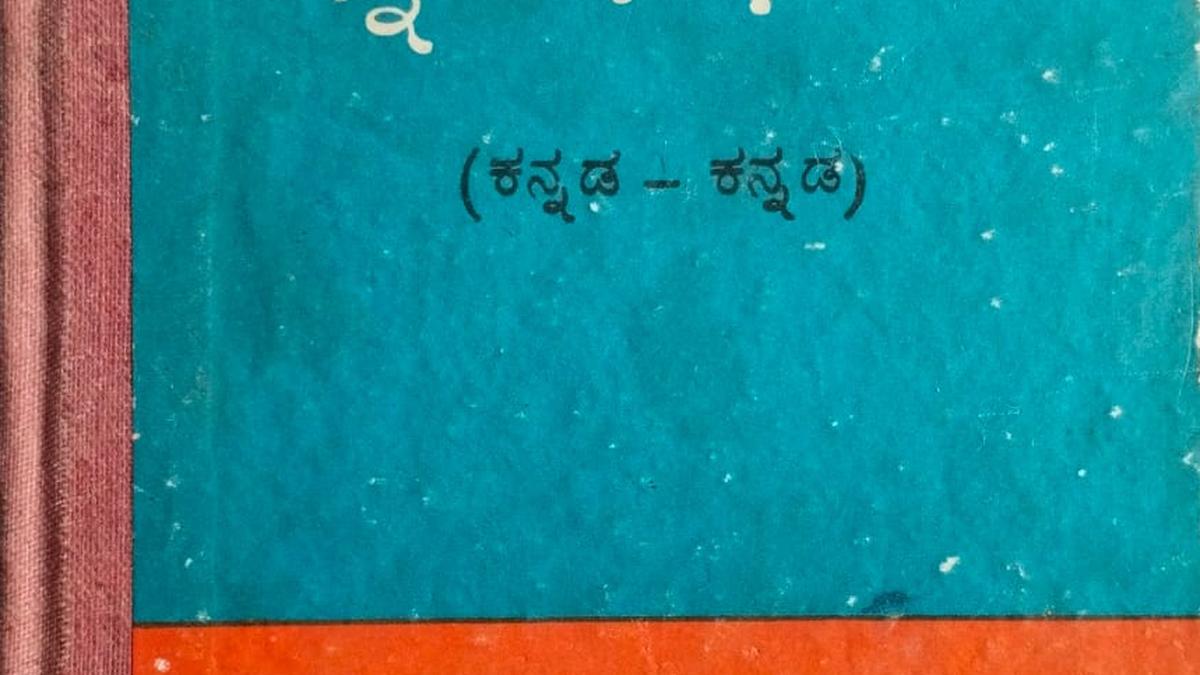
The eight-part seminal Kannada-Kannada dictionary published by Kannada Sahitya Parishat, work on which began before Independence, was last revised in 2001. Since then, the dictionary cell in Parishat has been shut down.
A recent proposal by the Parishat to reconstitute the cell and revise the dictionary, for which they sought financial aid of ₹10 crore, was rejected by the State government earlier this year, multiple sources confirmed.
The work on the 9,217-page dictionary began in 1916, and it was published in the 1970s, with a concise edition of 1,450 pages coming out in 1975. “The Parishat had a full-time dictionary cell with full-time employees and editors who were professional lexicographers. It was the only such effort made for a Kannada-Kannada dictionary in the State’s history. By 2003, all the employees in the cell retired, and it was shut down,” said N.S. Sridhar Murthy, convenor, Publication Division, Kannada Sahitya Parishat.
While there have been demands for a permanent institutional setup for Kannada lexicography, many have also argued that it should be removed from the Parishat and entrusted to institutions like the Kannada University, Hampi.
“Two decades is a very long time, during which time thousands of new words have come into use. Lexicography is always a dynamic and continuous process for any language and should not stop. For instance, Oxford Dictionary adds several words to its dictionary every year,” said senior lexicographer T.V. Venkatachala Sastry, who has worked on the Parishat dictionary for years.
In the nearly two-and-a-half-decades since 2001, other efforts have included revising the English-Kannada-Kannada dictionary of Mysore University, another seminal work of historical significance published in 2012, and many individual efforts, such as Prof. G. Venkatasubbaiah’s dictionary of idioms and phrases, cartoonist Panju Gangolli’s dictionary of Kundapura dialect of Kannada, and several dictionaries of technical terms in various fields.
Linguist and recent Sahitya Akademi awardee K.V. Narayana said that while lexicography has to be a continuous process, it is disastrous that organised work on Kannada lexicography stopped at a time when the language is in great flux.


Delhi HC delays jail time for Rajpal Yadav in cheque bounce cases after substantial payment; next hearing set for April 1.

Tamilaga Vettri Kazhagam chief Vijay dismisses reports of TVK likely joining the National Democratic Alliance (NDA) for the 2026 Assembly elections in Tamil Nadu, asserts there is no compromise in his party’s stand on “secular social justice” principles.

Dr. Rakesh Gupta urges states to identify remaining HIV cases in India to transform the nation into 'Suraksha India'.

A Supreme Court ruling warns Tamil Nadu candidates about government contract pitfalls ahead of the 2026 Assembly elections.

State Bank of India chairman Challa Sreenivasulu Setty laid the foundation for Telangana Grameena Bank’s new head office in Hyderabad, aimed at strengthening its administrative capacity and operations.

Excise inspector, teacher arrested by ACB in bribery and benami transactions case

Police and doctors emphasize helmet use for road safety, distributing helmets and promoting awareness to prevent injuries and save lives.

LDF candidate S. Jayamohan resigns as KSCDC chairman, prioritizing political morality and transparency during the election campaign.

A fresh debate over veteran politician G.T. Deve Gowda’s continuation in JD(S) and his candidature from the Chamundeshwari Assembly constituency in Mysuru has gripped political circles, even though the Legislative Assembly elections are more than two years away.

Delayed civic polls in Bengaluru have hindered air quality improvement efforts, costing the city ₹1,475.90 crore in potential funding.

Three arrested in Hyderabad for extorting investors using an illegal firearm during a police operation.

BMTC plans to enhance bus fare collection with 11,000 smart ETMs, improving efficiency and digital payment options for commuters.

Government disables over 3,100 Telegram channels and 800 websites for hosting pirated content, enforcing stricter anti-piracy laws.