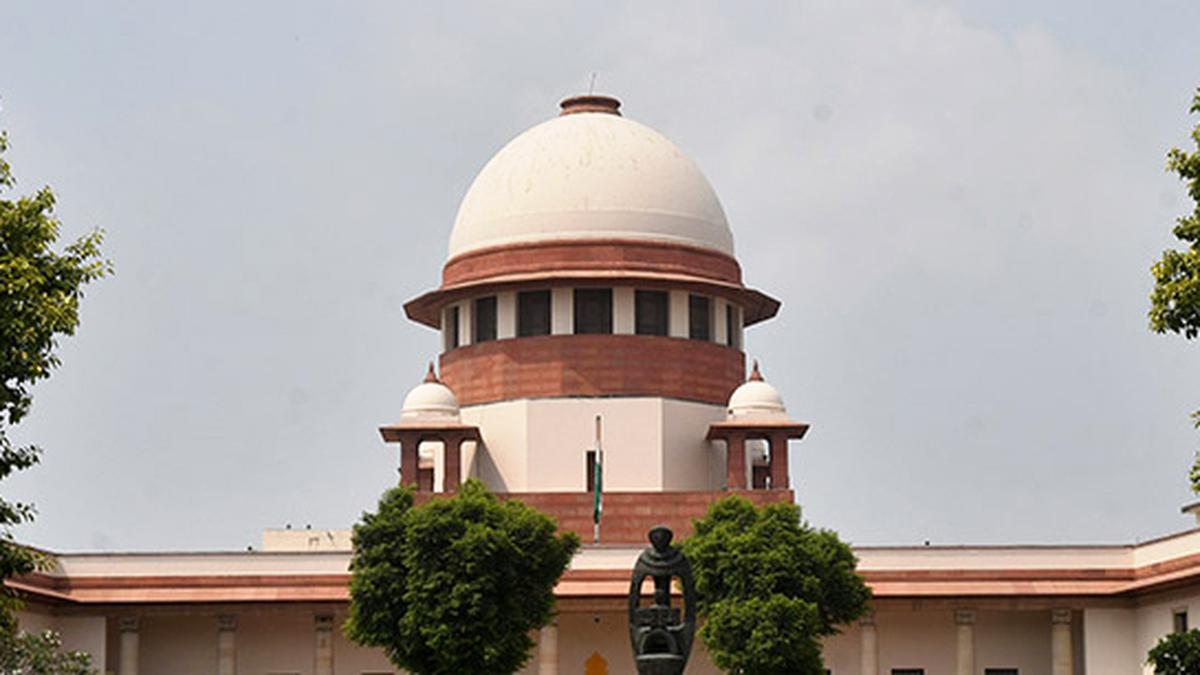
JMM bribery case: Govt. disagrees with majority view, tells SC immunity does not extend to bribes received outside House
The Hindu
Twenty-five years after a Constitution Bench of the Supreme Court inoculated MPs and MLAs who take kickbacks to vote or make speeches in a particular manner in the House from criminal prosecution, the Centre told a larger seven-judge Bench on Wednesday that the majority verdict in the infamous JMM bribery case was wrong and a lawmaker commits a crime the moment he accepts the pay-off, whether or not he makes good his promise in the House.
Twenty-five years after a Constitution Bench of the Supreme Court inoculated MPs and MLAs who take kickbacks to vote or make speeches in a particular manner in the House from criminal prosecution, the Centre told a larger seven-judge Bench on Wednesday that the majority verdict in the infamous JMM bribery case was wrong and a lawmaker commits a crime the moment he accepts the pay-off, whether or not he makes good his promise in the House.
“The offence of bribery is complete the moment there is an offer of bribe outside the House and you [MP or MLA] accept the money. It does not matter if the legislator performs his part of the bargain inside the House. Criminality is attached the moment the bribe is accepted. The performance of the MP or MLA — whether he casts his vote or makes a speech to favour a particular interest — is irrelevant,” Solicitor General Tushar Mehta, for the Centre, addressed the Bench headed by Chief Justice of India D.Y. Chandrachud.
Mr. Mehta said the government’s stand was in tune with the minority view of Justice (retired) S.C. Agarwal on the Bench in the Jharkhand Mukti Morcha (JMM) bribery case in 1998. Justice Agarwal had clearly held that the protective cloak of immunity around an MP or MLA would not extend to bribes received outside the House. The Solicitor General said the court should now focus more on the Prevention of Corruption Act rather than the question of immunity.
The Bench led by Chief Justice Chandrachud is reviewing the JMM bribery case (P.V. Narasimha Rao versus State) judgment. In focus are Articles 105(2) and 194(2) of the Constitution. Both constitutional provisions protect lawmakers from criminal or civil proceedings in any court “in respect of” anything said or any vote given by him or her in Parliament/State Legislative Assemblies. The majority verdict of the five-judge Bench in the JMM bribery case had held that bribe-takers were immune from prosecution provided they go ahead and cast their vote or give the speech, which was a parliamentary function.
Chief Justice Chandrachud agreed the majority view had turned the anti-corruption law on its head.
“The majority [in the 1998 judgment] said legislators would have immunity irrespective of the criminality attached to the taking of a bribe… the only exception they make is for a person who does not fulfill his part of the bargain. If a person [MP/MLA] accepts a bribe and votes, then there is immunity. If a person accepts the bribe and does not fulfill the bargain by abstaining from the vote or does not give the speech, he or she is liable to be punished,” Chief Justice Chandrachud pointed out.
Mr. Mehta said the immunity under Articles 105(2) and 194(2) was meant to protect the independence of the legislators inside the House.


Residents of Chettichavadi express concerns over deteriorating groundwater quality due to long-standing garbage dumping issues in Salem West.

Community Health Officers in Vijayawada protest for reduced workload and continued incentives amid growing dissatisfaction over salary changes.

Telangana faces 13,929 healthcare vacancies, primarily in doctors and nurses, as recruitment efforts aim to address the shortage.

For most patients with TB who are severely underweight, nutritional support is an essential and not optional part of treatment

Family of custodial death victims demands harsh punishment for nine convicted policemen to prevent future abuses of power.

Rajinikanth refutes TVK leader's claims about DMK threats preventing his political entry, expressing gratitude to supportive political figures.

CM announces Cabinet Sub-Committee on Musi rejuvenation; rehabilitation for all displaced

Ramanathapuram identifies 145 polling stations as sensitive, ensuring security with paramilitary forces ahead of assembly elections, says DEO.

BJP Puducherry president V. P Ramalingam files nomination for Raj Bhavan, joined by Union Minister Mandaviya and Khushbu Sundar.

History-sheeter 'Thoppai' Ganesh shot dead by police in Chennai after attacking officers during attempted escape.

The government plans to amend the FCRA, introducing new regulations for NGO asset management and accountability for key functionaries.

The draft policy for “Responsible Digital Use Among Students”, released on Monday by the Department of Health and Family Welfare, has recommended that parents set structured routines with clear screen-time rules and prioritise privacy, safety, and open conversation with children on digital well-being.

Police Observer Sushant Kumar Saxena conducts surprise inspection at Shencottai police station, reviewing warrants and security arrangements ahead of elections.