Habitat contiguity, the next course of action to protect the Nilgiri tahr Premium
The Hindu
Conservation efforts focus on increasing Nilgiri tahr populations and genetic diversity through habitat connectivity and protection measures.
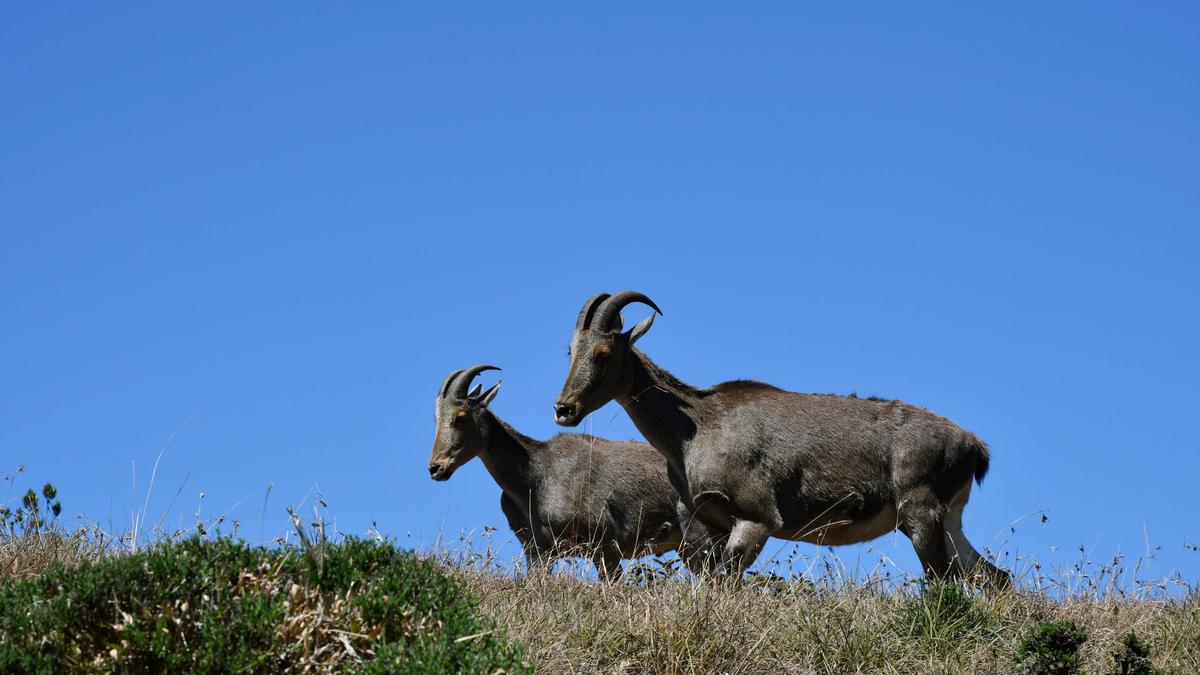
With the Nilgiri tahr (Nilgiritragus hylocrius) populations stabilising and even increasing in parts of the Western Ghats over the last few decades due to better conservation practices, wildlife biologists and experts state that the next course of action in protecting the species was ensuring habitat contiguity so that disparate populations across their geographical range can inter-breed, ensuring genetic diversity.
In the centenary volume (1877-1977) of the Nilgiri Wildlife and Environment Association, E.R.C. Davidar writes that according to historical records, the Nilgiri tahr was once widespread in the Nilgiris and the Western Ghats, their range even extending into Karnataka. The Nilgiri tahr, which probably numbered in the tens of thousands two centuries ago, have declined to a little over 3,000 in field surveys carried out between 2007 and 2011, with many small populations going extinct.
However, due to intensive conservation practices, their numbers have increased since Davidar’s (1978) estimate of 2,230 individuals, said Priya Davidar, a renowned conservation biologist. She said only two populations in Eravikulam and the Nilgiris have a large number of individuals, with the rest being much smaller, often represented by a single herd. “There are documented extinctions of these small populations,” she said.
Conservation biologists, such as Davidar, argue that the future of the Nilgiri tahr was linked to genetics and climate change, arguing that for the species to continue to survive in the coming decades, ensuring habitat contiguity between areas where the animals are found will be pivotal in maintaining genetic variability. “Genetic studies by Luis et al. (2016) indicate low levels of genetic variation across the Western Ghats populations, which increases their risk of extinction. The paper, Genetic Diversity and Population Structure of Nilgiri Tahr across the Western Ghats, which analysed 191 faecal samples from 100 tahr from across their distribution range in Kerala and Tamil Nadu states that, “The single largest Nilgiri tahr population (approx. 700 individuals) in the Eravikulam National Park also incidentally has the highest genetic diversity.”
“Genetic variation increases with population size, and the Nilgiri tahr has to be maintained in large, connected populations to decrease its risk of extinction. As many populations in the Western Ghats are small and isolated, it is subject to genetic drift and inbreeding. Genetic drift is a process by which small isolated populations lose genes due to random factors, and mating with relatives increases inbreeding, which adversely affects the survival of individuals,” Ms. Davidar said. A more recent paper in 2023 (Kanagaraj et al.) also predicts that the tahr could lose 55.5% of its habitat by 2070 due to climate change, causing an increased risk of extinction. “Habitat contiguity also provides opportunities for the Tahr to move to more suitable habitats under the scenario of human caused habitat loss and climate change,” argue experts.
However, other researchers believe that while in-breeding in isolated populations could be a matter of concern, that manifestations of genetic in-breeding depressions was not evident in Nilgiri tahr populations so far. “In the 1980s, a few individual animals from the Thiruvananthapuram Zoo were taken to the United States (U.S.) and were bred in captivity, with a few individuals also making their way into private ownership. In 2017, the descendants of this small population, were still alive and, seemingly, thriving in captivity, indicating that in-breeding may not be an immediate threat to the species,” said M.A. Predit, the associate co-ordinator for the Nilgiri Tahr Project, WWF-India.
Mr. Predit said of more immediate concern were anthropogenic pressures and communicable diseases, which he believes has wiped out populations in Megamalai and Vengoli in Parambikulam. “It could be that lack of genetic diversity could lead to individuals and herds being more at risk from communicable diseases such as foot-and-mouth disease but there needs to be further studies to come to this conclusion,” he said. He added that while ensuring genetic flow between populations of the tahr was important, that this could also increase the risk of communicable diseases spreading throughout the population.


“Judicial time is a valuable public resource. Every frivolous or misconceived invocation of constitutional jurisdiction results in diversion of time from genuinely deserving litigants,” said the Madurai Bench of the Madras High Court while imposing a cost of ₹50,000 on a man from Theni district who filed a petition with an unusual prayer: permission to conduct daily protests till the ‘World War’ ends.

The Mangaluru city police on Wednesday, arrested Pavan Acharya, 22, of Moodubelle village in Kaup Taluk in Udupi district, on the charge of posting inflammatory content on the social media.

Bengaluru corporations will present five separate budgets on March 27-28, focusing on infrastructure and community funding.

A humorous exchange in the Legislative Assembly highlights CM Siddaramaiah's choice of a Mysore silk shawl over a towel.

Karnataka's fiscal deficit is under control, better than neighboring states, says Chief Minister Siddaramaiah amid revenue challenges.

Capt. S. Divakar takes charge as MD and CEO of Dredging Corporation of India, following board approval for his appointment.

Nara Bhuvaneswari inaugurates a job mela in Kuppam, promoting job creation and welfare initiatives for local youth and women.

Walajah residents protest by hoisting black flags, threatening to boycott elections over poor civic amenities and infrastructure issues.

The Railway Ministry has decided to regularise the services of Surat-Mangaluru Junction-Surat bi-weekly Special Express along with nine other special trains.

Training held for zonal election officers in Thoothukudi

Defence Minister highlights BRO's vital role in enhancing border infrastructure, national security, and socio-economic growth in India.

Andhra University celebrates its 91st and 92nd convocations, honoring graduates and distinguished personalities for their contributions and achievements.

Coimbatore students receive earthen bowls to provide water for birds, promoting conservation on World Sparrow Day.