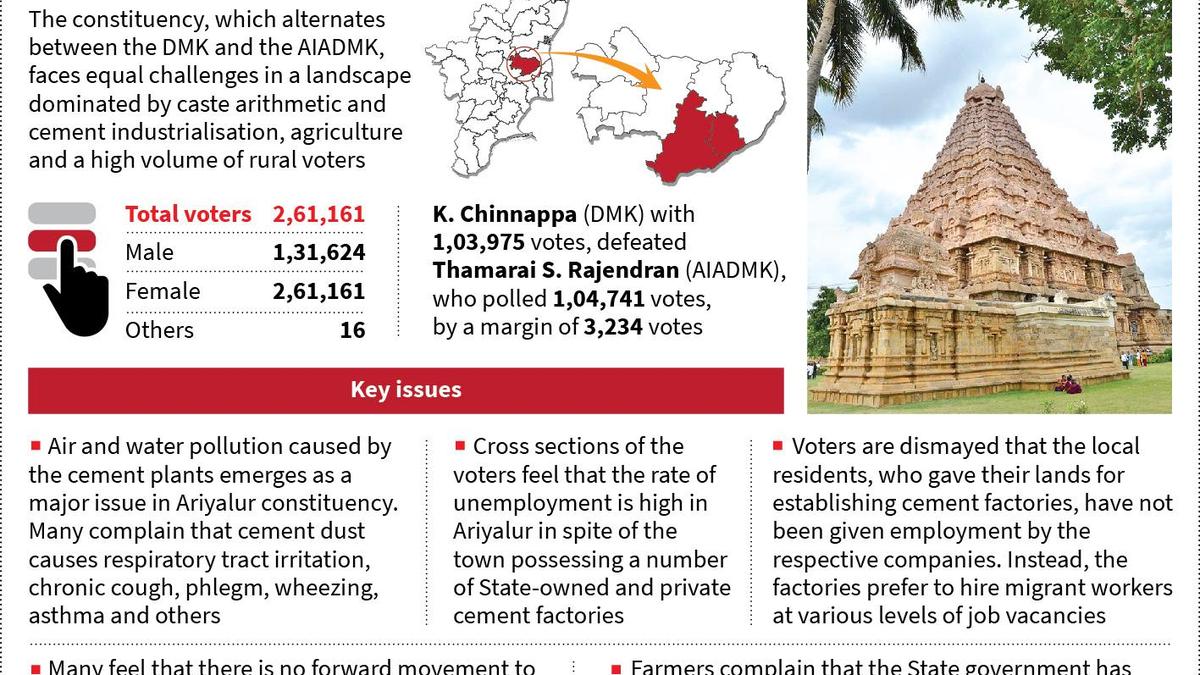
Constituency watch / Ariyalur constituency
The Hindu
Explore the historical and industrial significance of Ariyalur constituency, highlighting its challenges, agriculture, and political landscape.
Ariyalur has a rich historical legacy, primarily associated with the Chola dynasty. Sri Brihadeeswara Temple at Gangaikonda Chozhapuram, a UNESCO world heritage site, constructed about 1,000 years ago, still stands majestically as a testimony to the legacy.
Known for its vast limestone deposits, it has been a cement hub of the State for about 50 years, thanks to eight cement factories. It also has two sugar mills.
The first cement factory of Ariyalur came into being in 1976. When Tamil Nadu Cement Corporation began building the plant, it was considered a major boost to industrialisation in the region. It is true that several private giants, including Chettinad Cement and UltraTech, established their plants in Ariyalur. But it remains one of the most backward areas in the State.
Residents blame successive governments for failing to invest adequately and prioritise the district. They are of the view that if the constituency had produced powerful leaders, the profile of the district would have changed to a great extent.
Transport Minister S.S. Sivasankar (DMK), who was elected to the State Assembly from Kunnam constituency in 2021, Thamarai S. Rajendran (AIADMK), former Chief Whip, Thol. Thirumavalavan, MP and founder of Viduthalai Chiruthaigal Katchi are among the notable leaders from Ariyalur district.
The Ariyalur constituency extends from Ariyalur to Tirumanur. Most parts of Ariyalur and Tirumanur panchayat unions are part of the constituency. Besides cement factories, people depend upon agriculture for their livelihood. Agriculture is centered on rain-fed farming and horticulture, with 70% of the people dependent on it. Key crops include cashew, sugarcane, maize, cotton and paddy.


India pledges 60% non-fossil fuel power by 2035, targeting 47% emissions reduction per GDP unit and enhanced carbon sinks.

Supreme Court rules land acquisition compensation and interest must uphold constitutional guarantees, unaffected by financial burdens.

Election officials accept 23 nominations for Bagalkot bypolls, rejecting three, with polling scheduled for April 9.

Students and women’s self-help groups in Madurai engage in vibrant voter awareness campaigns promoting 100% voting participation.

Congress signals a "friendly fight" with allies in select Puducherry Assembly seats ahead of the April 9 elections.

Airstrike in western Anbar kills 7 Iraqi soldiers, injures 13, prompting condemnation for violating international laws on medical facilities.

Plaque unveiled in Bengaluru honors 11 victims of RCB stampede, emphasizing safety responsibility for future events.

India and the U.S. reaffirm commitment to enhance strategic defense cooperation at the 18th Defence Policy Group meeting in New Delhi.

Chhattisgarh's Deputy CM reports only 30-40 Maoists remain in Bastar, highlighting recent surrenders and future development plans.

Explore the historical and industrial significance of Ariyalur constituency, highlighting its challenges, agriculture, and political landscape.

Dindigul and Madurai Collectors conduct joint inspection

In this episode, Kalki Subramaniam speaks to us about why the Transgender Persons Amendment Bill has sparked protests, and how these amendments threaten to push a marginalised community back into the shadows.

India's EU FTA is poised to attract more German companies, boosting bilateral trade and investment opportunities.