Flyovers won’t fix Hyderabad traffic, smarter road design can: Expert
The Hindu
Urban transport expert Prashanth Kumar Bachu highlights issues with flyovers and proposes efficient road space use in Hyderabad.
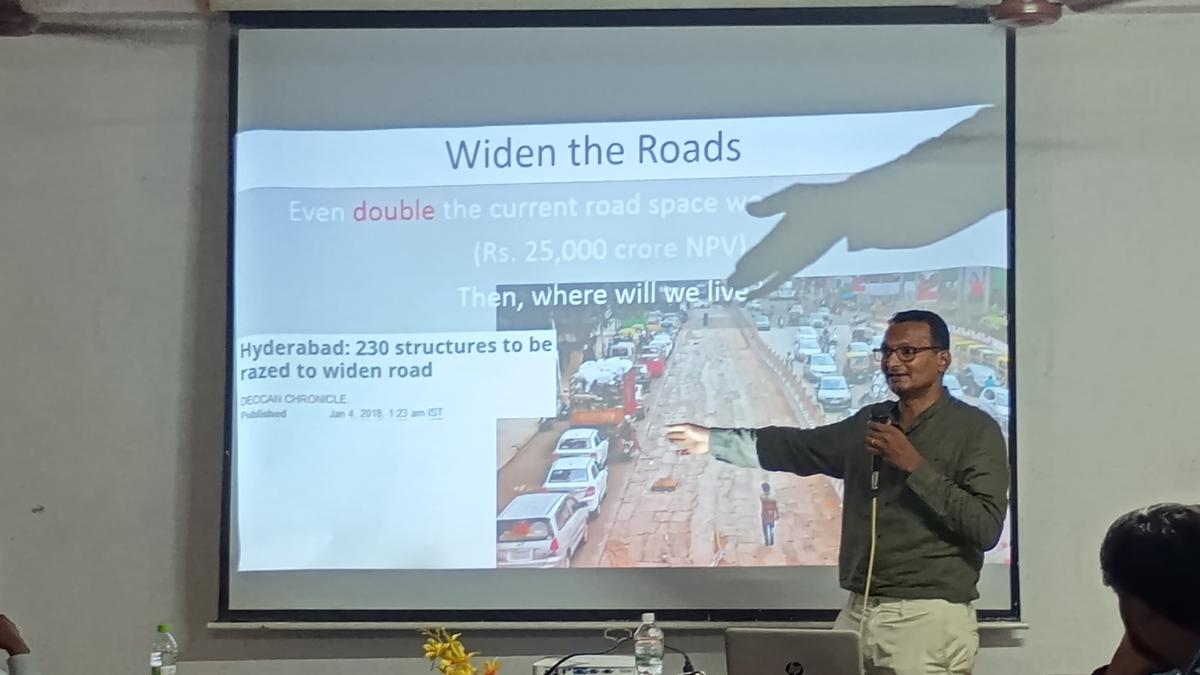
An average of 446 people, roughly the capacity of eight buses, were stuck on a single flyover at any given time, according to urban transport expert Prashanth Kumar Bachu, who spoke at a session on Sunday (June 8, 2025). Citing the Begumpet flyover as a case in point, he argued that such infrastructure projects merely relocate congestion rather than resolve it.
“Flyovers are not symbols of development,” he said. “They are responses to induced demand, built primarily to accommodate the growing number of private vehicles.” He warned that this approach does little to ease traffic and instead intensifies urban mobility issues.
Mr Bachu underscored the impracticality of continuing to rely on long-term, high-cost infrastructure as a solution. Hyderabad, he said, would need over 2,000 flyovers, requiring ₹50,000 crore and a century to build, to address projected vehicle volumes. Similarly, over 300 kilometres of metro rail would demand upwards of ₹75,000 crore and could take anywhere between 10 to 40 years to complete. “Even doubling the current road space will not be enough,” he said, “as this would come at the cost of footpaths, trees and other essential urban functions.”
Against this backdrop, Mr Bachu stressed that the city’s immediate relief lies not in more construction, but in more efficient use of existing roads through better urban design. “Designated lanes and road space for buses and pedestrians are the only viable short-term measures,” he said. “By simply reorganising road space, we can start making an impact now.”
The expert highlighted a decades-long shift in transport behaviour that has contributed to worsening congestion. Between 2001 and 2011, the share of private vehicles in the city jumped from 15% to 34%, while public transport usage declined from 41% to 32%. This trend, he said, has only deepened in the years since.
A stark imbalance in road space usage was also laid bare - cars account for just 11.8% of motorised trips in Hyderabad but occupy 37.1% of the city’s road space. In contrast, buses handle 34.5% of trips while using only 9.2% of the available space.
“This is not merely a question of social status,” Mr Bachu said. “It is a deliberate outcome of policy and market incentives. Cars have been made increasingly affordable, and infrastructure continues to reward their use.”


“Judicial time is a valuable public resource. Every frivolous or misconceived invocation of constitutional jurisdiction results in diversion of time from genuinely deserving litigants,” said the Madurai Bench of the Madras High Court while imposing a cost of ₹50,000 on a man from Theni district who filed a petition with an unusual prayer: permission to conduct daily protests till the ‘World War’ ends.

The Mangaluru city police on Wednesday, arrested Pavan Acharya, 22, of Moodubelle village in Kaup Taluk in Udupi district, on the charge of posting inflammatory content on the social media.

Bengaluru corporations will present five separate budgets on March 27-28, focusing on infrastructure and community funding.

A humorous exchange in the Legislative Assembly highlights CM Siddaramaiah's choice of a Mysore silk shawl over a towel.

Karnataka's fiscal deficit is under control, better than neighboring states, says Chief Minister Siddaramaiah amid revenue challenges.

Capt. S. Divakar takes charge as MD and CEO of Dredging Corporation of India, following board approval for his appointment.

Nara Bhuvaneswari inaugurates a job mela in Kuppam, promoting job creation and welfare initiatives for local youth and women.

Walajah residents protest by hoisting black flags, threatening to boycott elections over poor civic amenities and infrastructure issues.

The Railway Ministry has decided to regularise the services of Surat-Mangaluru Junction-Surat bi-weekly Special Express along with nine other special trains.

Training held for zonal election officers in Thoothukudi

Defence Minister highlights BRO's vital role in enhancing border infrastructure, national security, and socio-economic growth in India.

Andhra University celebrates its 91st and 92nd convocations, honoring graduates and distinguished personalities for their contributions and achievements.

Coimbatore students receive earthen bowls to provide water for birds, promoting conservation on World Sparrow Day.